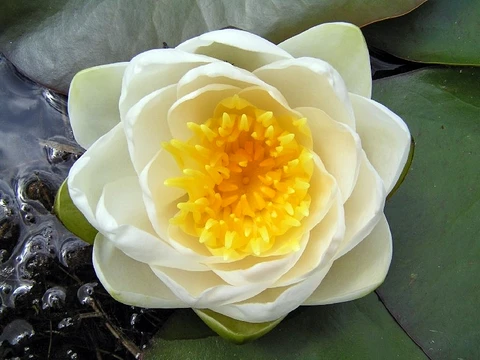
Pontederia crassipes
Last updated
Pontederia crassipes, formerly known as Eichhornia crassipes, is an aquatic plant native to South America that has become naturalized worldwide.[1] Within the genus Pontederia, the subgenus Oshunae contains just this one species.[1]
Scientific classification
- CladeTracheophytes
- CladeAngiosperms
- CladeMonocots
- CladeCommelinids
- OrderCommelinales
- FamilyPontederiaceae
- GenusPontederia
- SpeciesPontederia crassipes
Named by Mart.
Close relatives
Other species of Pontederia with a Codexery entry.
- Pontederia cordata Pontederia cordata
- Pontederia sagittata Pontederia sagittata
Sources: Wikipedia taxobox: Pontederia crassipes (CC BY-SA 4.0)
Where the pontederia crassipes has been recorded
Each dot is a place where the species has been observed and reported (44,888 records, half-degree grid) — not a modelled range. 499 inland records left out (institution coordinates).
Map: drawn by Codexery. Data: GBIF occurrence search (records CC0 / CC BY) · Natural Earth basemap (public domain)
Quick Facts
- Species
- crassipes
Facts from the source article.
Biology and range
Its broad, glossy, ovate leaves can rise up to 1 m above the water surface.[2] Each leaf measures 10–20 cm across, and the plant stays afloat thanks to bulb-like, buoyant nodules found at the leaf stem's base.[2] The roots, which are feathery and hang freely, display a purple-black color.[3] A single spike of 8–15 flowers, which are mostly lavender to pink and have six petals, is held up by an erect stalk.[3]
Daughter plants are formed primarily through the plant's runners, or stolons, which is its main method of reproduction.[4] Long-tongued bees are the pollinators of the flowers in the area where the plant is native.[5]
What the specialist sources record
Researchers found that M. scutellaris is highly host-specific and does not threaten native or economically important species.[6] The Earth Observatory reports that the plant's decay processes deplete dissolved oxygen and lead to fish kills.[7]
References
- Wikipedia, "Pontederia crassipes" (CC BY-SA 4.0), which cites: Pontederia crassipes. Kew Royal Botanic Gardens Plants of the World Online. Accessed April 19, 2022.; Eichhornia crassipes. Kew Royal Botanic Gardens Plants of the World Online. Accessed April 19, 2022.; Kochuripana, Water hyacinth, Eichhornia crassipes . June 15, 2016. Flora of Bangladesh. Accessed April 19, 2022.; "Total evidence phylogeny of Pontederiaceae (Commelinales) sheds light on the necessity of its recircumscription and synopsis of Pontederia L.", PhytoKeys, 2018, p. 25–83 (original not read by us) en.wikipedia.org
- Wikipedia, "Pontederia crassipes" (CC BY-SA 4.0), which cites: Mahmood, "Anatomical studies on water hyacinth ( Eichhornia crassipes (Mart.) Solms) under the influence of textile wastewater", Journal of Zhejiang University SCIENCE, 2005-09-28, p. 991–998; Khotsa, "A Comprehensive Review of the Biology, Ecological Impacts, and Control Strategies of Eichhornia crassipes", Diversity, 2025-08-12, p. 564 (original not read by us) en.wikipedia.org
- Wikipedia, "Pontederia crassipes" (CC BY-SA 4.0), which cites: "Limnobium spongia", UF / IFAS Center for Aquatic and Invasive Plants (we also read that source) en.wikipedia.org
- Wikipedia, "Pontederia crassipes" (CC BY-SA 4.0), which cites: Sullivan, "Water hyacinth (Eichhornia crassipes (Mart.) Solms) seed longevity and the implications for management", 2012; Dickinson, "Weeds of North America", University of Chicago Press, 2014, p. 625 (original not read by us) en.wikipedia.org
- Wikipedia, "Pontederia crassipes" (CC BY-SA 4.0), which cites: Coetzee, "Monographs on invasive plants in Europe N° 2: Eichhornia crassipes (Mart.) Solms", Botany Letters, 2017-10-02, p. 303–326 (original not read by us) en.wikipedia.org
- "Scientists Release Biocontrol for Waterhyacinth", United States Department of Agriculture, Agricultural Research Service. facts only, no text reused. ars.usda.gov
- Voiland, "Seven Things You Didn't Know About Water Hyacinth", Earth Observatory, 1 June 2016. facts only, no text reused. earthobservatory.nasa.gov
Each numbered sentence above was checked against the source it cites before publication. Sentences citing Wikipedia adapt text from the English Wikipedia article Pontederia crassipes (contributors), used under CC BY-SA 4.0; this entry is available under the same licence. Other sources were used for facts only; no text or images are copied from them.
More in Aquatic & Wetland Plants
Sources
Compiled from Wikipedia and the sources listed below. Text from Wikipedia is available under CC BY-SA 4.0; this entry is adapted from it.
- Wikipedia: Pontederia crassipes (CC BY-SA 4.0).
- Occurrence records: GBIF (CC0 / CC BY). Basemap: Natural Earth (public domain).
- Word definitions: the Codexery glossary, each quoted from its Wikipedia article.
Spotted an error? Know more?
Reader corrections go straight into our review queue. Suggest an edit · How this site is sourced