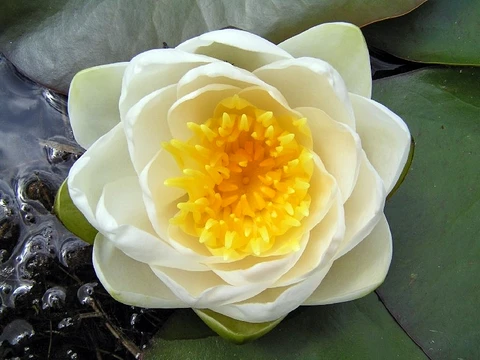
Nymphaea
Last updated
Nymphaea species are found across the world.[1]
Scientific classification
- CladeTracheophytes
- CladeAngiosperms
- OrderNymphaeales
- FamilyNymphaeaceae
- GenusNymphaea
Named by L.
Sources: Wikipedia taxobox: Nymphaea (CC BY-SA 4.0)
Quick Facts
- Type species
- Nymphaea alba L.
Facts from the source article.
Biology and range
Water lilies are aquatic, rhizomatous or tuberous, perennial or annual herbs with sometimes desiccation-tolerant rhizomes.[2] The flowers have (3–)4(–5) green sepals and about 6–50 differently coloured petals.[3] Nymphaea leaves are typically found floating on the water's surface, though some leaves may be submerged or rise above the water.[2] Nymphaea flowers can be found emerging above the water, floating on the surface, or, in rare cases, completely submerged.[3]
The male reproductive structures (androecium) contain between 20 and 750 stamens, while the female structures (gynoecium) are composed of 5 to 35 carpels.[3] In Nymphaea, researchers have documented ploidy levels of 2x, 3x, 4x, 6x, 8x, and 16x.[4] The chromosome number in Nymphaea species falls between 28 and 224.[4] Nymphaea can be found living in both freshwater and brackish water environments.[5]
The seeds and fruits of Nymphaea are consumed by many birds.[6]
What the specialist sources record
The fruit is globose, fleshy, spongy, and irregularly dehiscent.[7][3] A review by Carla Teixeira de Lima recognizes 23 native species of Nymphaeaceae from Brazil, including 16 previously described species.[8] The review also elevated Nymphaea amazonum subsp. pedersenii to species rank as N. pedersenii.[8] Nymphaea possesses contractile roots that are either tuberous or fibrous.[7][2]
References
- Wikipedia, "Nymphaea" (CC BY-SA 4.0), which cites: ; ; ; (original not read by us) en.wikipedia.org
- Wikipedia, "Nymphaea" (CC BY-SA 4.0), which cites: ; Heslop-Harrison, "Nymphaea L.", Journal of Ecology, 1955, p. 719–734; ; ; ; Pellegrini, "Nymphaeaceae", Flora e Funga do Brasil; ; ; "Nymphaea", VicFlora Flora of Victoria.; Conard, "The waterlilies: a monograph of the genus Nymphaea", the Carnegie Institution of Washington, 1905; "Nymphaea", VicFlora Flora of Victoria.; ; ; Jacobs, "Flora of Australia", Australian Biological Resources Study, Department of Climate Change, Energy, the Environment and Water; Trickett, "A New Tropical American Waterlily, Nymphaea belophylla", Kew Bulletin, 1971 en.wikipedia.org
- Wikipedia, "Nymphaea" (CC BY-SA 4.0), which cites: ; Landon, "A New Species of Waterlily (nymphaea Minuta: Nymphaeaceae) from Madagascar", SIDA, Contributions to Botany, 2006, p. 887–893; ; Pellegrini, "Nymphaeaceae", Flora e Funga do Brasil; ; Wiersema, "Reproductive Biology of Nymphaea (Nymphaeaceae)", Annals of the Missouri Botanical Garden, 1988, p. 795–804; Wiersema, "Reproductive Biology of Nymphaea (Nymphaeaceae)", Annals of the Missouri Botanical Garden, 1988, p. 795–804; ; Jacobs, "Flora of Australia", Australian Biological Resources Study, Department of Climate Change, Energy, the En en.wikipedia.org
- Wikipedia, "Nymphaea" (CC BY-SA 4.0), which cites: Pellicer, "Insights into the dynamics of genome size and chromosome evolution in the early diverging angiosperm lineage Nymphaeales (water lilies)", Genome, 2013, p. 437–449 (original not read by us) en.wikipedia.org
- Wikipedia, "Nymphaea" (CC BY-SA 4.0), which cites: Parveen, S., Kaur, S., Baishya, R., & Goel, S. (2022). Predicting the potential suitable habitats of genus Nymphaea in India using MaxEnt modeling. Environmenta; Wiersema, "Aquatic and Marsh Plants of Alabama III. Magnoliidae", Castanea, 1983, p. 99–108 (original not read by us) en.wikipedia.org
- Wikipedia, "Nymphaea" (CC BY-SA 4.0), which cites: Parveen, S., Kaur, S., Baishya, R., & Goel, S. (2022). Predicting the potential suitable habitats of genus Nymphaea in India using MaxEnt modeling. Environmenta (original not read by us) en.wikipedia.org
- Jacobs, "Flora of Australia", Australian Biological Resources Study, Department of Climate Change, Energy, the Environment and Water. facts only, no text reused. profiles.ala.org.au
- Carla Teixeira de Lima, "Nymphaeaceae of Brasil", SITIENTIBUS série Ciências Biológicas, 2021-03-03. facts only, no text reused. periodicos.uefs.br
Each numbered sentence above was checked against the source it cites before publication. Sentences citing Wikipedia adapt text from the English Wikipedia article Nymphaea (contributors), used under CC BY-SA 4.0; this entry is available under the same licence. Other sources were used for facts only; no text or images are copied from them.
More in Aquatic & Wetland Plants
Sources
Compiled from Wikipedia and the sources listed below. Text from Wikipedia is available under CC BY-SA 4.0; this entry is adapted from it.
- Wikipedia: Nymphaea (CC BY-SA 4.0).
- Word definitions: the Codexery glossary, each quoted from its Wikipedia article.
Spotted an error? Know more?
Reader corrections go straight into our review queue. Suggest an edit · How this site is sourced