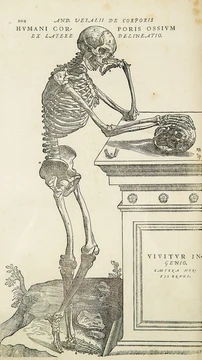
Circulatory system
A closed network of heart, blood, and vessels.

The circulatory system, found in vertebrates, is a network of organs comprising the heart, blood vessels, and blood, which is pumped around the body. It is also called the cardiovascular or vascular system, with "cardio" from the Greek for heart and "vascular" from the Latin for vessels. This system has two main divisions: the systemic circulation and the pulmonary circulation. In vertebrates, it is a closed system, meaning blood stays within the blood vessels at all times. This contrasts with many invertebrates, like arthropods, which have an open system where a heart pumps hemolymph through the body cavity, and with diploblasts such as sponges and comb jellies, which lack a circulatory system entirely.
Blood is a fluid made up of plasma, red blood cells, white blood cells, and platelets. It carries oxygen and nutrients to tissues and removes waste materials. Nutrients include proteins and minerals, while other components are hemoglobin, hormones, and gases like oxygen and carbon dioxide. These substances nourish the body, support the immune system in fighting disease, and help maintain homeostasis by stabilizing temperature and pH levels.
The lymphatic system works alongside the circulatory system in vertebrates. It carries excess plasma, which filters from circulatory capillaries as interstitial fluid, away from tissues and returns it to the blood as lymph. This subsystem is essential; without it, the blood would lose too much fluid. The lymphatic system also interacts with the immune system. Lymph circulation is much slower than blood flow, and unlike the closed blood system, the lymphatic system is open. Some sources call it a secondary circulatory system.
Cardiovascular diseases can affect the circulatory system. Cardiologists specialize in the heart, cardiothoracic surgeons operate on the heart and nearby areas, and vascular surgeons focus on disorders of blood vessels and lymphatic vessels.
**Structure**
The circulatory system includes the heart, blood vessels, and blood. In all vertebrates, the cardiovascular system consists of the heart and blood vessels. Some sources use "cardiovascular system" and "vascular system" interchangeably with "circulatory system." It is divided into two major circuits: pulmonary and systemic. The pulmonary circuit carries deoxygenated blood from the right heart to the lungs, where it is oxygenated and returned to the left heart. The systemic circuit delivers oxygenated blood from the left heart to the rest of the body and returns deoxygenated blood to the right heart via large veins called the venae cavae. The systemic circulation can also be split into macrocirculation and microcirculation. An average adult has about five to six quarts (4.7 to 5.7 liters) of blood, roughly 7% of body weight. Blood consists of plasma, red blood cells, white blood cells, and platelets. The digestive system provides the nutrients needed to keep the heart pumping.
Other circulatory routes exist, such as coronary circulation to the heart, cerebral circulation to the brain, renal circulation to the kidneys, and bronchial circulation to the lungs' bronchi. The human circulatory system is closed, with blood contained within the vascular network. Nutrients reach organs through tiny microcirculation blood vessels. The lymphatic system is an essential, open subsystem, consisting of lymphatic vessels, lymph nodes, organs, tissues, and circulating lymph. It drains and returns interstitial fluid to the heart via lymphatic ducts and works with the immune system to defend against pathogens.
**Heart**
The heart pumps blood throughout the body. In humans, it has one atrium and one ventricle for each circulation, totaling four chambers: left atrium, left ventricle, right atrium, and right ventricle.
**Pulmonary Circulation**
Oxygen-deprived blood from the superior and inferior vena cava enters the right atrium, flows through the tricuspid valve into the right ventricle, and is pumped through the pulmonary semilunar valve into the pulmonary artery to the lungs. Gas exchange occurs in the lungs, releasing CO₂ and absorbing oxygen. The pulmonary vein returns oxygen-rich blood to the left atrium. A separate bronchial circulation supplies blood to the tissue of the larger airways in the lung.
**Systemic Circulation**
The systemic circulation delivers oxygenated blood from the left heart to the body through the aorta. Deoxygenated blood returns to the right heart via two large veins.
- field
- Anatomy and Physiology
- known_for
- Transport of oxygen, nutrients, and waste; closed system in vertebrates; complementary lymphatic system
Lore & Background
The circulatory system consists of the heart, blood vessels, and blood. In vertebrates, it is a closed system, meaning blood never leaves the network of vessels. It has two major divisions: the pulmonary circulation, which carries deoxygenated blood to the lungs and returns oxygenated blood to the heart, and the systemic circulation, which delivers oxygenated blood to the body and returns deoxygenated blood to the heart. The systemic circulation includes macrocirculation and microcirculation. The heart has four chambers: left atrium, left ventricle, right atrium, and right ventricle. Blood vessels include arteries, veins, and capillaries. The great vessels are the large arteries and veins connected to the heart. The lymphatic system is a complementary, open subsystem that returns excess interstitial fluid as lymph to the blood circulation and works with the immune system. Blood is a fluid containing plasma, red blood cells, white blood cells, and platelets. It carries oxygen, nutrients, hormones, and gases, and helps maintain homeostasis. The circulatory system can be affected by cardiovascular diseases, treated by cardiologists, cardiothoracic surgeons, and vascular surgeons.
Reader's Guide
The circulatory system is fundamental to vertebrate physiology, enabling the transport of oxygen, nutrients, and waste throughout the body. Its closed nature in vertebrates contrasts with the open systems of many invertebrates. The division into pulmonary and systemic circuits allows efficient oxygenation and distribution. The complementary lymphatic system prevents fluid depletion and supports immunity. Understanding this system is critical for diagnosing and treating cardiovascular diseases, which are a major focus of medical specialties such as cardiology and vascular surgery. The system's structure—from the heart's four chambers to the extensive capillary network—illustrates the complexity required to sustain life. Its study remains central to biology and medicine.
Did You Know?
- An average adult contains five to six quarts (roughly 4.7 to 5.7 liters) of blood, accounting for approximately 7% of total body weight.
- The lymphatic system is an open system, while the blood circulatory system is closed in vertebrates.
- The hepatic portal vein is a portal vein that branches into a second capillary system in the liver.
More in Animal Anatomy 1-17
Spotted an error? Know more?
This is a living reference — every entry is fact-audited, and reader corrections feed straight into our audit queue. Suggest an edit · See this site's audit record