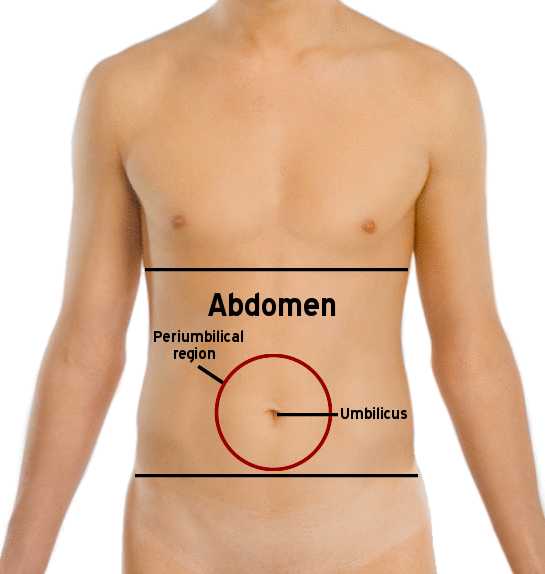
Abdomen
The abdomen contains digestive organs and core muscles.

Goleisureintl · CC BY 4.0
In humans and other vertebrates, the region called the abdomen is situated on the front of the torso, lying between the thorax and the pelvis, and it is also referred to as the belly or stomach.[1] The diaphragm connects the abdominal cavity to the thoracic cavity, and the abdominal cavity itself is continuous with the pelvic cavity.[2]
Last updated 2026-10-08 from the source article.
Quick Facts
- Action
- Movement and support for the torso
- Assistance with breathing
- Protection for the inner organs
- Postural support
Facts from the source article.
Key facts and history
The abdomen can be divided into quadrants—left upper, left lower, right upper, and right lower—to describe the location of an organ or structure.[3] In some mammals, abdominal organs are highly specialized, such as the four-chambered stomach of ruminants.[4] In insects, the abdomen is sometimes highly modified, with the first segment fused to the thorax in Apocrita.[5] Abdominal muscles enclose the front and sides of the abdominal cavity, while a portion of the vertebral column encloses the back.[2]
Ventral and lateral walls of the abdomen can also be enclosed by the lower ribs.[2] Passing through the diaphragm are structures that include the aorta, the inferior vena cava, and the esophagus.[2] A serous membrane called the parietal peritoneum lines both the abdominal cavity and the pelvic cavity.[2] Three fibrous bands, known as tendinous intersections, cross the long, flat rectus abdominis muscles.[6]
A passage through the layers in the groin region, the inguinal canal, is a site where weakness can develop, potentially leading to inguinal hernias.[6]
What the research sources say
The 2010 Encyclopaedia Britannica describes the abdominal wall as having three layers of muscles with fibers that criss-cross for strength.[7][6] The abdominal muscles assist as muscles of exhalation during forceful exhalation and serve as protection for inner organs.[7][6] According to the same source, fibers from each of the three lateral abdominal muscles form a thick sheath that encloses the rectus abdominis.[7][6] The 2011 McGraw-Hill "Human Anatomy" text indicates that quadrants are frequently used when describing the location of abdominal pain.[8][3]
Gallery
References
- Wikipedia, "Abdomen" (CC BY-SA 4.0), which cites: "Thesaurus results for abdomen", dictionary.cambridge.org, 2025-04-27 (original not read by us) en.wikipedia.org
- Wikipedia, "Abdomen" (CC BY-SA 4.0), which cites: Peritoneum. The Veterinary Dictionary. Elsevier, 2007. Retrieved 22 October 2007 (original not read by us) en.wikipedia.org
- Wikipedia, "Abdomen" (CC BY-SA 4.0), which cites: Saladin, "Human anatomy", McGraw-Hill, 2011, p. 14 (we also read that source) en.wikipedia.org
- Wikipedia, "Abdomen" (CC BY-SA 4.0), which cites: "Ruminant." The Veterinary Dictionary. Elsevier, 2007. Retrieved 22 October 2007 (original not read by us) en.wikipedia.org
- Wikipedia, "Abdomen" (CC BY-SA 4.0), which cites: "Glossary of Descriptive Terminology", Desertants.org (original not read by us) en.wikipedia.org
- Wikipedia, "Abdomen" (CC BY-SA 4.0), which cites: "Abdominal cavity", 2010, p. 19–20 (we also read that source) en.wikipedia.org
- Open Library record, ISBN 9781593398378 ("The New Encyclopaedia Britannica"). CC0 (metadata); book content not read. openlibrary.org
- Open Library record, ISBN 9780071222075 ("Human Anatomy"). CC0 (metadata); book content not read. openlibrary.org
Each numbered sentence above was checked against the source it cites before publication. Sentences citing Wikipedia adapt text from the English Wikipedia article Abdomen (contributors), used under CC BY-SA 4.0; this entry is available under the same licence. Other sources were used for facts only; no text or images are copied from them.
More in Animal Anatomy
Spotted an error? Know more?
Reader corrections go straight into our review queue. Suggest an edit · How this site is sourced