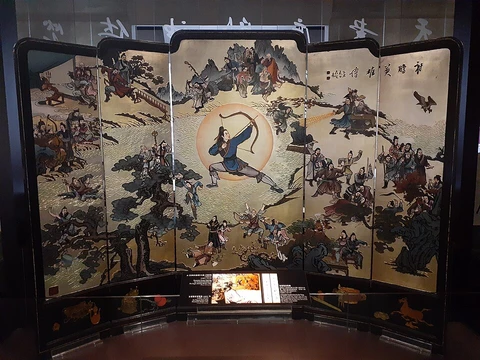
Kingdom of Paradise
Action RPG set in a feudal China-inspired world.

Neil Owen · CC BY-SA 2.0
Kingdom of Paradise, known in Japan as *Tenchi no Mon* and in Europe as *Key of Heaven*, is an action role-playing game from 2005. It was developed by Climax Entertainment and published by Sony for the PlayStation Portable. A digital re-release for PS4 and PS5 arrived on September 20, 2022. A prequel, *Tenchi no Mon 2: Busōden*, exists only in Japan, Korea, and China. The game draws heavily from Asian culture and Chinese Wuxia fantasy, with clans named after the Ssu Ling—plus a fifth clan, Kirin, which stands apart from that group.
The story unfolds in Ouka, a fictional continent modeled after feudal China. Ouka is split into five regions: Northern (Genbu), Eastern (Seiryu), Southern (Suzaku), Western (Byakko), and Central (Kirin). Each region has a Clan Lord, disciples, a distinct style of Chi and sword fighting, and a sacred sword. All sacred swords except Kirin’s control one of the Four Gods of Ouka. Another continent, Seima, lies west across the sea; no explorer has ever returned. Three hundred years ago, a war between Seima and Ouka ended with Ouka’s victory, but only the Kirin Lord Gikyo and the Seiman twins, Lu Yan and Li Yin, recall it—the twins are over three hundred years old, sustained by the chi of yin and yang moons. Lu Yan represents righteous Yang, Li Yin the mischievous Yin. Their Forbidden Poem describes the war and the five gates of Ouka.
The protagonist, Shinbu, was exiled from the Seiryu clan for viewing the Ancient Monument, which holds the secrets of Seiryu Chi Arts. The surviving disciple Sui Lin finds him and reveals their clan was destroyed, leaving only the two of them. They later learn their sacred sword was stolen, as were the other clans’ swords. Shinbu and Sui Lin set out to uncover who destroyed their clan and warn the other three that the ruling Kirin clan is amassing power and plans to steal all sacred swords. Every sixteen years, clan rule shifts in a cycle; the Kirin currently rule, following the Suzaku.
Gameplay centers on Bugei scrolls, which use Kenpu tiles to create martial arts combos (up to ten moves in a Freestyle Bugei). Players collect Bugei from cinematic sequences and Kenpu from battles or breakable objects like pots and chests. Shinbu also wields Chi Arts, learned from sacred stones in each clan’s temple.
Quick Facts
- Title
- Key of Heaven
- Developer
- Climax EntertainmentAdditional work by Sony Computer Entertainment Japan
- Publisher
- Sony Computer Entertainment
- Released
- JP · July 21, 2005 · NA · November 15, 2005 · EU · March 24, 2006 · AUS · March 30, 2006
- Genre
- Action role-playing
- Modes
- Single-player
- Platforms
- PlayStation Portable
Facts from the source article.
Lore & Background
The story takes place in the fictitious world of Ouka, divided into five regions: Northern (Genbu), Eastern (Seiryu), Southern (Suzaku), Western (Byakko), and Central (Kirin). Each region has a Clan Lord, disciples, a style of Chi and sword fighting, and a sacred sword. All swords except the Kirin Sacred Sword control one of the Four Gods of Ouka. The continent of Seima lies west over the sea, and no explorer has returned. Three hundred years before the game, the Seima-Ouka war occurred, with the Clan Lords prevailing; the only survivors from that time are the Kirin Lord Gikyo and the Seiman twins Lu Yan and Li Yin, who sustain themselves on the chi of yin and yang moons. The Forbidden Poem, written by the twins, recounts the war. The main character, Shinbu, is exiled from the Seiryu clan after viewing the Ancient Monument. He and the surviving disciple Sui Lin discover their clan destroyed and its sacred sword stolen, and they set out to warn the other clans that the ruling Kirin clan plans to steal all sacred swords.
Reader's Guide
Kingdom of Paradise is notable for its Bugei scroll combat system, which uses Kenpu tiles to create martial arts maneuvers. Players collect Bugei and Kenpu throughout the game, and Shinbu learns Chi Arts from sacred stones in each clan's temple. Chi Arts operate on a five-element system (wood, fire, earth, metal, water) with complementary and rival cycles. Players gain levels up to 20, with attributes (Mind, Technique, Body) increasing based on battle style. The game received average reviews from Metacritic, and Famitsu scored it 26 out of 40. Its significance lies in its integration of Chinese Wuxia themes and a unique tile-based combat system, as well as its re-release on modern PlayStation platforms. The prequel Tenchi no Mon 2: Busōden, available only in East Asia, extends the franchise's reach.
Did You Know?
- The game was released as Key of Heaven in Europe.
- The five clans are named after the Ssu Ling, with Kirin as the fifth clan not part of that group.
- The Seiman twins Lu Yan and Li Yin are over three hundred years old and sustain themselves on the chi of yin and yang moons.
The World of Ouka
Kingdom of Paradise draws its identity from Chinese Wuxia fantasy and broader Asian cultural traditions, constructing a fictional continent called Ouka that mirrors an almost feudal China. The land is divided into five regions—Northern (Genbu), Eastern (Seiryu), Southern (Suzaku), Western (Byakko), and Central (Kirin)—each governed by a Clan Lord, supported by disciples, and defined by a unique style of Chi and sword fighting. Every division also possesses a sacred sword, and it is later revealed that four of these blades each command one of the Four Gods of Ouka, with the Kirin sword standing apart from that arrangement. Beyond Ouka's borders, the lore references a mysterious continent called Seima, located somewhere over the western sea, from which no explorer has ever returned. A war between Seima and Ouka is said to have ended three centuries before the game's events, a conflict whose details are known only to a handful of ancient survivors. Political power among the five clans rotates on a sixteen-year cycle, ensuring that no single faction holds the throne indefinitely.
Shinbu's Exile and the Kirin Threat
The narrative follows Shinbu, a warrior cast out from his Seiryu clan after he glimpsed the Ancient Monument, a structure that guards the deepest secrets of Seiryu Chi Arts. His exile is short-lived when Sui Lin, the sole surviving disciple alongside him, tracks him down to deliver devastating news: their entire clan has been annihilated. As the pair sets out to uncover the truth behind the destruction, they discover that their sacred sword has been stolen—and that the same fate has befallen the other three clans. The growing power of the ruling Kirin clan emerges as the central threat, as it schemes to seize every sacred sword and topple the existing order. The story also introduces the Seiman twins, Lu Yan and Li Yin, who are over three hundred years old yet appear deceptively young because they sustain themselves on the chi of the yin and yang moons. Their names encode the duality of righteous Yang and mischievous Yin, and together they authored the Forbidden Poem, a verse that recounts the ancient Seima-Ouka war and the mystical mechanics of the five gates.
Bugei Scrolls, Chi Arts, and Elemental Combat
Combat in Kingdom of Paradise revolves around a layered system built on Bugei scrolls, which string together Kenpu tiles to form martial arts sequences of up to ten moves when a Freestyle Bugei is employed. Bugei scrolls are primarily discovered during cinematic sequences, while Kenpu tiles are earned through battles or hidden in breakable pots and chests scattered across the environment. In parallel, Shinbu wields Chi Arts, a form of elemental magic learned from a sacred stone in each clan's temple. The player charges Chi by holding the square button and releases it to unleash devastating attacks that can eliminate most enemies in one or two strikes as the arts grow stronger. Progression is tracked through a level system capped at twenty, where Mind, Technique, and Body attributes increase based on the player's combat choices. The five elements—wood, fire, earth, metal, and water—form both a rival cycle arranged as a star and a complementary cycle arranged as a clockwise circle, with the latter amplifying the final hit in a combo. Certain enemies, including clan gods, can only be damaged by Shinbu's Ginmei Sword.
Release Timeline and Critical Response
Developed by Climax Entertainment and published by Sony, Kingdom of Paradise first launched on the PlayStation Portable in 2005 under the Japanese title Tenchi no Mon, while European players received it as Key of Heaven. The title found a new audience nearly two decades later when it was re-released as a PlayStation Network download for PS4 and PS5 on September 20, 2022. A prequel, Tenchi no Mon 2: Busōden, was made available in Japan, Korea, and China, extending the franchise's narrative reach across those Asian markets. Critically, the game landed in the middle of the spectrum: Metacritic classified its overall reception as average, and Japan's Famitsu awarded it a score of 26 out of 40, with individual reviewers giving one seven, two sixes, and one seven. Despite the moderate critical scores, the game's distinctive blend of Wuxia-inspired storytelling, its intricate elemental combat system, and its portable-friendly design secured a dedicated following that kept the title relevant well into the PS4 and PS5 era.
Gallery






Frequently Asked Questions
What is Kingdom of Paradise?
Kingdom of Paradise is a 2005 action role-playing game developed by Climax Entertainment and published by Sony for the PlayStation Portable. It was localized as Key of Heaven in Europe and known as Tenchi no Mon in Japan.
What is the setting of Kingdom of Paradise?
The story unfolds on Ouka, a fictional continent modeled after feudal China and steeped in Wuxia martial-arts fantasy. Players navigate a world of warring factions and legendary combat within that culturally rich backdrop.
What clans appear in Kingdom of Paradise?
The game features four clans named after the Ssu Ling, the Four Spirits of Chinese mythology, plus a fifth clan called Kirin that stands apart from that traditional grouping.
Is Kingdom of Paradise available on modern consoles?
Yes, Sony issued a digital re-release for PS4 and PS5 via PlayStation Network on September 20, 2022. The original 2005 PSP cartridge remains the only physical version ever pressed.
Is there a sequel or prequel to Kingdom of Paradise?
A prequel titled Tenchi no Mon 2: Busōden was released exclusively in Japan, Korea, and China. No English-language follow-up or direct sequel has been announced.
More in Wuxia video games 1-24
Spotted an error? Know more?
Reader corrections go straight into our review queue. Suggest an edit · How this site is sourced