Chinese Hero (video game)
Rescue Princess Min-Min and recover the 10 treasures in this classic beat 'em up!

In 1984, Nihon Game developed the arcade beat 'em up *Chinese Hero*, published by Taiyo System and Taito. Known as *Super Chinese* in Japan, it launched the Super Chinese series. A port for the Nintendo Entertainment System, titled *Kung-Fu Heroes*, was released in Japan by Nihon Game in 1986, with a North American version following in 1989 under the Culture Brain label. The game later appeared on a 2004 Game Boy Advance compilation, *Super Chinese I+II Advance*, and was added to the Nintendo Classics service in August 2019.
The story follows kung-fu masters Jacky and Lee, who return from training to find that monsters have kidnapped Princess Min-Min and stolen the ten treasures of their nameless land, plunging everything into sorrow. The heroes set out to rescue the princess and recover the treasures.
Players control either Jacky or Lee, fighting through levels filled with enemy warriors. The objective is to defeat enough foes to open a door at the top of the room, allowing progress to the next area. Enemies use a variety of attacks and weapons, and bonus levels are available for players to discover.
In Japan, *Game Machine* magazine listed *Chinese Hero* as the most-successful table arcade unit of the month in its October 15, 1984 issue.
Quick Facts
- Title
- Chinese Hero
- Developer
- Nihon Game
- Publisher
- JP · Taiyo System / (arcade) · JP · Taito / (arcade) · NA · Kitkorp / (arcade) / JP · Namco / (Famicom) · NA · Culture Brain / (NES)
- Series
- Super Chinese
- Genre
- Beat 'em up
- Modes
- Single-player, multiplayer
- Platforms
- Arcade, Famicom/NES
- Released
- Arcade JP · October 1984 · NA · 1984Famicom/NESJP · June 20, 1986 · NA · March 1989
Facts from the source article.
Lore & Background
Monsters have taken Princess Min-Min captive and have stolen the 10 treasures of the nameless land the game takes place in, leaving everything in sorrow. Kung-fu Masters Jacky and Lee return from training and must set out to rescue the princess and find the treasures.
Reader's Guide
The player controls one of the characters, Jacky or Lee, and each level pits the player against countless enemy warriors. The goal is for the player to defeat enough enemies so that the door at the top of the room opens allowing the player to exit the room and proceed to the next. Enemies' attacks and weapons vary throughout the game. There are quite a number of BONUS levels that players can enter.
Did You Know?
- In Japan, Game Machine listed Chinese Hero on their October 15, 1984 issue as being the most-successful table arcade unit of the month.
- The arcade version was released in 1984, not 1985 as sometimes claimed.
- The North American release of Kung-Fu Heroes was in 1989, not 1987.
- The Game Boy Advance compilation Super Chinese I+II Advance was released in 2004; the source does not specify its regional limitation.
- The Nintendo Classics service added the game in August 2019, not September.
The Meaning and Code of the Wuxia Hero
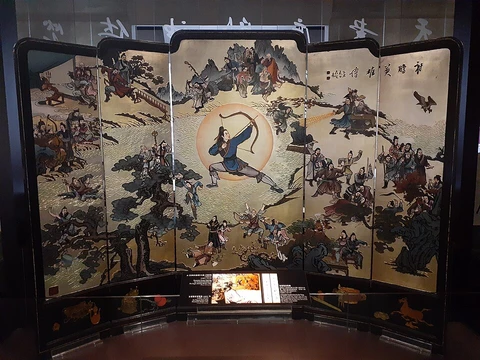
The term wǔxiá is a two-part compound: wǔ carries the sense of the martial, the military, or the armed, while xiá evokes chivalry, vigilantism, or heroism. A third layer of identity often appears in the tradition — a xiákè (literally a "follower of xia") or yóuxiá (a "wandering xia") — and in some translations the martial artist is called a jiànxiá or jiànkè, a "swordsman" or "swordswoman," even when the character never actually draws a blade. What unites these figures is their social position: wuxia heroes typically hold no lord, carry no military rank, and belong to no aristocratic house. They emerge from the lower strata of ancient Chinese society. Binding them together is a code of chivalry that demands they right and redress wrongs, champion righteousness, dismantle oppressors, and exact retribution for past injustices. This outsider status and moral obligation form the narrative engine that every wuxia story, from the earliest youxia tales to modern interactive adaptations, draws upon to define its protagonists.
Two Millennia of Literary Ancestors
Although the genre label is a recent coinage, narratives about xia stretch back more than two thousand years. The earliest roots lie in youxia tales from roughly 300 to 200 BC, a period the Legalist philosopher Han Fei regarded with open disdain in his treatise Han Feizi. Sima Qian's Records of the Grand Historian catalogued five celebrated assassins of the Warring States era — Cao Mo, Zhuan Zhu, Yu Rang, Nie Zheng, and Jing Ke — who are remembered as cike, or "stabbing guests," and who typically pledged service to feudal lords in exchange for material rewards. The Tang dynasty (618–907) marked a turning point: chuanqi tales such as Nie Yinniang, The Kunlun Slave, and The Bearded Warrior introduced isolated, fantasy-driven protagonists performing daring deeds, serving as direct prototypes for later wuxia. The Song dynasty saw similar stories circulate in huaben, short works linked to traditional oral storytelling. By the Ming dynasty, Luo Guanzhong's Romance of the Three Kingdoms and Shi Nai'an's Water Margin — with its 108 outlaws and their code of honour — cemented the jianghu setting that wuxia fiction still inhabits today.
A Borrowed Name and a Modern Identity
The very word "wuxia" as a genre designation first surfaced at the tail end of the Qing dynasty (1644–1911), and it arrived as a calque of the Japanese term bukyō, a label for militaristic, bushido-inflected adventure fiction. Writers like Liang Qichao and a generation of students who yearned for China to modernise its military and champion martial virtues imported the term, and it quickly solidified as the umbrella name for xiayi and other predecessor traditions. Ironically, in Japan itself bukyō faded into obscurity. The Qing period had already produced rich precursors: Gong'an detective novels in which xia collaborated with magistrates to solve crimes, the Justice Bao stories extended in Sanxia Wuyi and Xiaowuyi, and xiayi chivalrous romances featuring female heroes with supernatural combat abilities. Works such as Shi Gong'an Qiwen and Ernü Yingxiong Zhuan are often cited as the clearest nascent wuxia novels. Yet government crackdowns and bans — Water Margin was singled out for fostering anti-authority sentiment — meant the genre's patronage came almost exclusively from the common populace rather than the literati, stunting its literary development while leaving it enormously popular among ordinary readers.
From Opera Stages to Interactive Screens
Because wuxia is fundamentally a storytelling tradition rather than a single medium, its reach extends far beyond the printed page. The genre has been adapted into Chinese opera, manhua, television dramas, feature films, donghua animation, and video games, making it a living thread in the popular culture of Chinese-speaking communities worldwide. Hong Kong filmmaker Ronny Yu has cautioned that wuxia films should not be conflated with the broader martial-arts movie category; in a strict sense they occupy a distinct literary and aesthetic space. The setting that anchors all these adaptations is jianghu — literally "rivers and lakes" — a fictionalised version of China that foregrounds social underworlds and the marginalised figures who inhabit them. Whether rendered as a stage performance, a streaming series, or an interactive game where the player assumes the role of a wandering xiákè, the core appeal remains the same: a lower-class hero bound by a code of chivalry, fighting for righteousness against oppressors, and exacting retribution in a world that has no formal place for them.
Frequently Asked Questions
What is Chinese Hero (video game)?
It is a 1984 arcade beat 'em up that launched the Super Chinese series, developed by Nihon Bussan and published by Taiyo System and Taito. In Japan it shipped under the title Super Chinese, while Western players more often know it as Chinese Hero.
Who developed and published Chinese Hero (video game)?
Nihon Bussan handled development, and Taiyo System together with Taito served as the publishers for the original 1984 arcade cabinet release.
What genre and platform is Chinese Hero (video game)?
It is a side-scrolling beat 'em up that debuted on arcade hardware in 1984. The core loop has a kung-fu fighter blasting through successive waves of enemies across multiple stages.
Did Chinese Hero (video game) ever get home-console ports?
A 1986 NES version titled Kung-Fu Heroes was produced by Nihon Bussan and published by Culture Brain in Japan, with a North American launch following in 1989. The title later resurfaced on the 2004 GBA compilation Super Chinese I+II Advance and was added to Nintendo Switch Online in August.
Why is Chinese Hero (video game) important to wuxia gaming history?
As the first entry in the Super Chinese series, it helped cement the kung-fu beat 'em up formula that went on to shape a whole genre of arcade action. Its 1984 debut made it one of the earliest Japanese titles to put a martial-arts protagonist front and center in a side-scrolling arcade experience.
More in Wuxia video games 1-24
Spotted an error? Know more?
Reader corrections go straight into our review queue. Suggest an edit · How this site is sourced