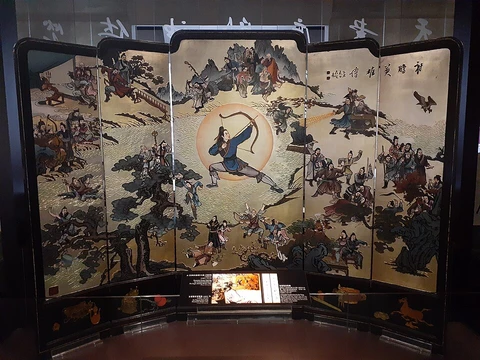
Dynasty Warriors
Hack and slash series based on the Three Kingdoms.

Josep Panadero · CC BY-SA 4.0
Dynasty Warriors (真・三國無双, Shin Sangokumusō; literally "True Three Kingdoms Unrivaled") is a Japanese hack and slash action game series developed by Omega Force and Koei (now Koei Tecmo). It originated as a spin-off from Koei's turn-based strategy series Romance of the Three Kingdoms, which itself is based on the Chinese novel of the same name—a romanticized account of China's Three Kingdoms period. The first game released under the English name Dynasty Warriors (Sangokumusō in Japanese) was a one-on-one fighting game, a genre distinct from all later entries. Koei later produced a new game as a spin-off, adding the word shin (真; meaning "true" or "genuine") to its Japanese title to set it apart from the original. When localized for North America, this game was called Dynasty Warriors 2. Consequently, every subsequent English title has been numbered one higher than its Japanese counterpart. Because the original fighting game belongs to a different genre and carries a different Japanese series title, Koei Tecmo does not count it as an official part of the Dynasty Warriors series; the company celebrated the series' 20th anniversary in 2020, two decades after Dynasty Warriors 2's release. In 2008, the franchise was Koei's most successful, and by 2025, total worldwide sales had exceeded 24 million copies.
The first Dynasty Warriors (Sangokumusō), released in 1997 for the PlayStation, is a traditional one-on-one fighting game with gameplay reminiscent of titles like Samurai Shodown, The Last Blade, Virtua Fighter, and Soul Blade. The next game, released in Japan as Shin Sangokumusou and internationally as Dynasty Warriors 2, introduced the series' signature format: players choose a character and progress through levels representing key battles of the Three Kingdoms period, aiming to defeat rival kingdoms and unite China. This mode, called "Musou Mode," initially featured generals from the three kingdoms of Wu, Shu, and Wei; from Dynasty Warriors 3: Xtreme Legends onward, independent generals also received full storylines. Dynasty Warriors 3 includes two secret characters, Nü Wa and Fu Xi, who are not playable in Musou Mode. In Dynasty Warriors 2, 3, and 5, each character has their own individual Musou Mode. In Dynasty Warriors 4, only the ruler and a few key officers from each kingdom have story stages in that kingdom's shared Musou Mode, not all characters.
Quick Facts
- Title
- Dynasty Warriors
- Genre
- Hack and slash / Fighting / Action role-playing / Action-adventure / Real-time strategy
- Developer
- Omega Force
- Publisher
- Koei (1997–2010) / Koei Tecmo (2010–present)
- First Release Date
- February 28, 1997
- Latest Release Version
- Dynasty Warriors: Origins
- Latest Release Date
- January 17, 2025
- Parent
- Romance of the Three Kingdoms
Facts from the source article.
Lore & Background
The first Dynasty Warriors (Sangokumusō) is a traditional one-on-one fighting game, released in 1997 for the PlayStation. Its gameplay style is reminiscent of Samurai Shodown, The Last Blade, Virtua Fighter and Soul Blade. The next game was released in Japan as Shin Sangokumusou. This game was released in other countries as Dynasty Warriors 2, leading to the discrepancy in title numbers. From this game onwards, the player chooses a playable character and plays a number of levels representing particular battles in the Three Kingdoms period, eventually defeating all other rival kingdoms and uniting China under a common ruler. In this game mode, known as 'Musou Mode', the generals are usually chosen from one of the three kingdoms (Wu, Shu or Wei; however, from Dynasty Warriors 3: Xtreme Legends onwards, independent generals were given full stories as well). Dynasty Warriors 3 has two secret characters, Nü Wa and Fu Xi, that are not playable in Musou Mode. Dynasty Warriors 2, Dynasty Warriors 3, Dynasty Warriors 5 and Dynasty Warriors 6 have individual Musou Modes for each character. In Dynasty Warriors 4, Dynasty Warriors 7, and Dynasty Warriors 8, each of the Three Kingdoms has its own Musou Mode, which all characters from a particular kingdom would play. The stages are presented in a third-person view, with the camera set behind the player as they engage the enemy forces. Each scenario can have different win/lose conditions, but the common losing conditions (defeat of the commander-in-chief, health bar reaching zero and maximum time limit reached) still hold. As for the other characters not from either of the Three Kingdoms, their Musou story modes are purely fictional since in Romance of the Three Kingdoms, most or all of them were eliminated until only the Three Kingdoms were left. In Dynasty Warriors 5, a relatively more realistic Musou Mode is introduced for each character. Instead of participating in the entire set of their kingdoms' events, the characters appear only in certain battles that they had fought in, as according to the novel or factual history. Therefore, characters will start at different points in time and they may never have opportunities to encounter some of the other characters (e.g. Zhuge Liang will never meet Lü Bu or Dong Zhuo in his Musou Mode). In between stages there are some dramatic cutscenes, in which the character will express their thoughts on the situation, adding a more personal touch and keeping the player updated on the events. Besides, a character's Musou Mode may end before the unification of China at any point of time, stopping for most at their historical point of death. However, some characters such as the three founders (Liu Bei, Cao Cao, and Sun Jian) may continue to participate in battles that occurred after their deaths (e.g. Cao Cao appearing at the Battle of Wuzhang Plains), representing an extended leadership under more successful circumstances. In Dynasty Warriors 8, an 'if' route is added for each country. By fulfilling conditions in previous battles, the player can unlock a hypothetical route for each country where it manages to achieve what it failed to do in actual history. For example, the player can help Wei avoid defeat in the battle of Chibi and unite China with all Wei characters alive. Dynasty Warriors 9 sought to introduce an 'open world' style of gameplay.
Reader's Guide
The Dynasty Warriors series is significant as Koei's most successful franchise as of 2008, with over 24 million copies sold worldwide by 2025. Its legacy lies in popularizing the hack and slash genre with a historical Chinese setting, spawning numerous expansions (Xtreme Legends and Empires) and portable titles across multiple platforms. The series' numbering discrepancy—where the Japanese Shin Sangokumusou became Dynasty Warriors 2 internationally—created a unique naming convention that persisted throughout the main entries. The series also introduced innovative gameplay modes such as Musou Mode, which allowed players to experience romanticized battles from the Three Kingdoms period, and later added hypothetical 'if' routes in Dynasty Warriors 8. The Xtreme Legends expansions added new characters and content, while Empires expansions combined action gameplay with strategic elements from the Romance of the Three Kingdoms series. The series also expanded to portable systems, including PlayStation Portable, Game Boy Advance, Nintendo DS, PlayStation Vita, and Nintendo 3DS, as well as PC and mobile platforms. The 2020 celebration of the series' 20th anniversary, two decades after Dynasty Warriors 2, underscores Koei Tecmo's official recognition of the modern series starting from that title, not the original 1997 fighting game.
Did You Know?
- The first Dynasty Warriors game was a one-on-one fighting game, not a hack and slash title.
- English titles are numbered one higher than their Japanese counterparts; for example, Shin Sangokumusou became Dynasty Warriors 2.
- Dynasty Warriors 8 introduced an 'if' route allowing players to alter historical outcomes, such as Wei avoiding defeat at the Battle of Chibi.
Origins and the Numbering Quirk
The franchise's roots trace to a 1997 PlayStation fighting game called Sangokumusō, whose one-on-one combat style drew comparisons to Samurai Shodown, The Last Blade, and Virtua Fighter. When Koei developed a follow-up in an entirely different genre, they prefixed the Japanese title with "shin" (meaning "true" or "genuine") to set it apart from its predecessor. Upon localization for North America, this new game was simply labeled Dynasty Warriors 2, creating a permanent one-number gap between Japanese and English releases that persists to this day. Because the original 1997 title belongs to a separate genre and carries a different series name in Japan, Koei Tecmo does not count it as a formal entry in the Dynasty Warriors line. That position was made explicit when the company marked the series' 20th anniversary in 2020—two decades after Dynasty Warriors 2, not the 1997 fighter. The result is a franchise whose first numbered entry in the West is technically its second game, a naming oddity that every subsequent title inherited.
The Evolution of Musou Mode
Musou Mode is the series' signature campaign structure, and its design has shifted dramatically across entries. Dynasty Warriors 2, 3, 5, and 6 granted each playable character an individual story arc, while Dynasty Warriors 4, 7, and 8 reorganized campaigns by kingdom—Wu, Shu, or Wei—so every general from a given faction shared the same battle sequence. Dynasty Warriors 5 marked a notable turn toward historical fidelity: characters now appeared only in the specific engagements they actually fought according to the novel or recorded history, starting at different points in the timeline. Zhuge Liang, for instance, never crosses paths with Lü Bu or Dong Zhuo in his campaign. Between stages, dramatic cutscenes let characters voice personal reflections on unfolding events. Most campaigns end at the character's historical death, though founders like Cao Cao may appear in battles occurring after his passing. Dynasty Warriors 8 added "if" routes, letting players unlock alternate histories such as Wei surviving the Battle of Chibi and unifying China with all its generals alive. Dynasty Warriors 9 then attempted an open-world approach to the formula.
The Expansion Ecosystem
Beyond the core numbered entries, Dynasty Warriors built a robust expansion ecosystem through two distinct product lines. The Xtreme Legends series, debuting with Dynasty Warriors 3 in 2002 (international release in 2003), delivered an overhauled bodyguard system, new stages and weapons, additional difficulty tiers, and challenge modes. A key quirk: the Xtreme Legends disc contained only new content, so players still needed the original game disc to access everything. This tradition continued through most entries, with Dynasty Warriors 6 and 9 as exceptions. Starting with Dynasty Warriors 7 and 8, Xtreme Legends expansions also introduced brand-new playable characters. The Empires line, first released for Dynasty Warriors 4 in 2004, took a different approach by blending the series' hack-and-slash action with the strategic and tactical layers of Koei's Romance of the Three Kingdoms strategy titles. Unlike Xtreme Legends, Empires discs were fully self-contained and did not require the base game. Every subsequent numbered entry received an Empires expansion.
Commercial Reach and Portable Expansion
By 2008, Dynasty Warriors had become Koei's most commercially successful franchise, and that momentum has only continued to build. As of 2025, the series has surpassed 24 million copies sold worldwide, a testament to its broad appeal across multiple platforms and regions. Koei also extended the franchise into the handheld space beginning in 2004 with a Dynasty Warriors title for PlayStation Portable, followed by Dynasty Warriors Advance for Game Boy Advance in 2005. The PSP line continued with Dynasty Warriors Vol. 2 in 2006, while Nintendo DS received Dynasty Warriors DS: Fighter's Battle in 2007. In 2009, Dynasty Warriors: Strikeforce brought the series back to PSP, built around Dynasty Warriors 6, with a sequel to follow. These portable entries broadened the audience beyond console players and kept the franchise visible in markets where handheld gaming dominated. Combined with the expansion ecosystem and the deep cultural resonance of the Three Kingdoms narrative, these factors helped Dynasty Warriors sustain commercial relevance across more than two decades of continuous development.
Gallery




Frequently Asked Questions
What is Dynasty Warriors?
Dynasty Warriors is a Japanese action game series in which players take on the roles of famous generals from China's Three Kingdoms era and fight their way through massive open-field battles. The franchise is developed by Omega Force and published by Koei Tecmo, and it has been a PlayStation staple since the early 2000s.
What genre is Dynasty Warriors?
The core series is a hack-and-slash action game where a single character cuts through hundreds of enemy soldiers in real time. It is worth noting that the very first 1997 title carrying the Dynasty Warriors name was actually a one-on-one fighting game, a genre entirely separate from every entry that followed.
Who developed Dynasty Warriors?
Omega Force handles the development while Koei (now Koei Tecmo) serves as publisher. The series debuted on PlayStation in 1997 and has since appeared on PlayStation 2, PSP, GBA, Nintendo DS, PS Vita, Nintendo 3DS, PC, and mobile platforms.
What is Dynasty Warriors based on?
The games pull their characters, rival factions, and plotlines from the Chinese novel Romance of the Three Kingdoms, a romanticized retelling of the late Han Dynasty and the Three Kingdoms period. Koei first adapted that novel in their turn-based strategy franchise, and Dynasty Warriors later became a spin-off that reimagines the same stories as real-time combat.
How popular is Dynasty Warriors?
The franchise has shipped over 24 million copies worldwide as of 2025. It remains one of the most recognizable Japanese action series and a go-to recommendation for fans of large-scale historical combat.
More in Wuxia video games 1-24
Spotted an error? Know more?
Reader corrections go straight into our review queue. Suggest an edit · How this site is sourced