Ornate wrasse
A colorful wrasse of eastern Atlantic and Mediterranean waters.

(c) Eleftherios Katsillis, some rights reserved (CC BY) · CC BY 4.0
The ornate wrasse (Thalassoma pavo), also called the circus fish, lives along rocky coasts in the eastern Atlantic Ocean and the Mediterranean Sea. It is caught in small numbers by local fisheries, is a popular target for sport fishing, and appears in the aquarium trade.
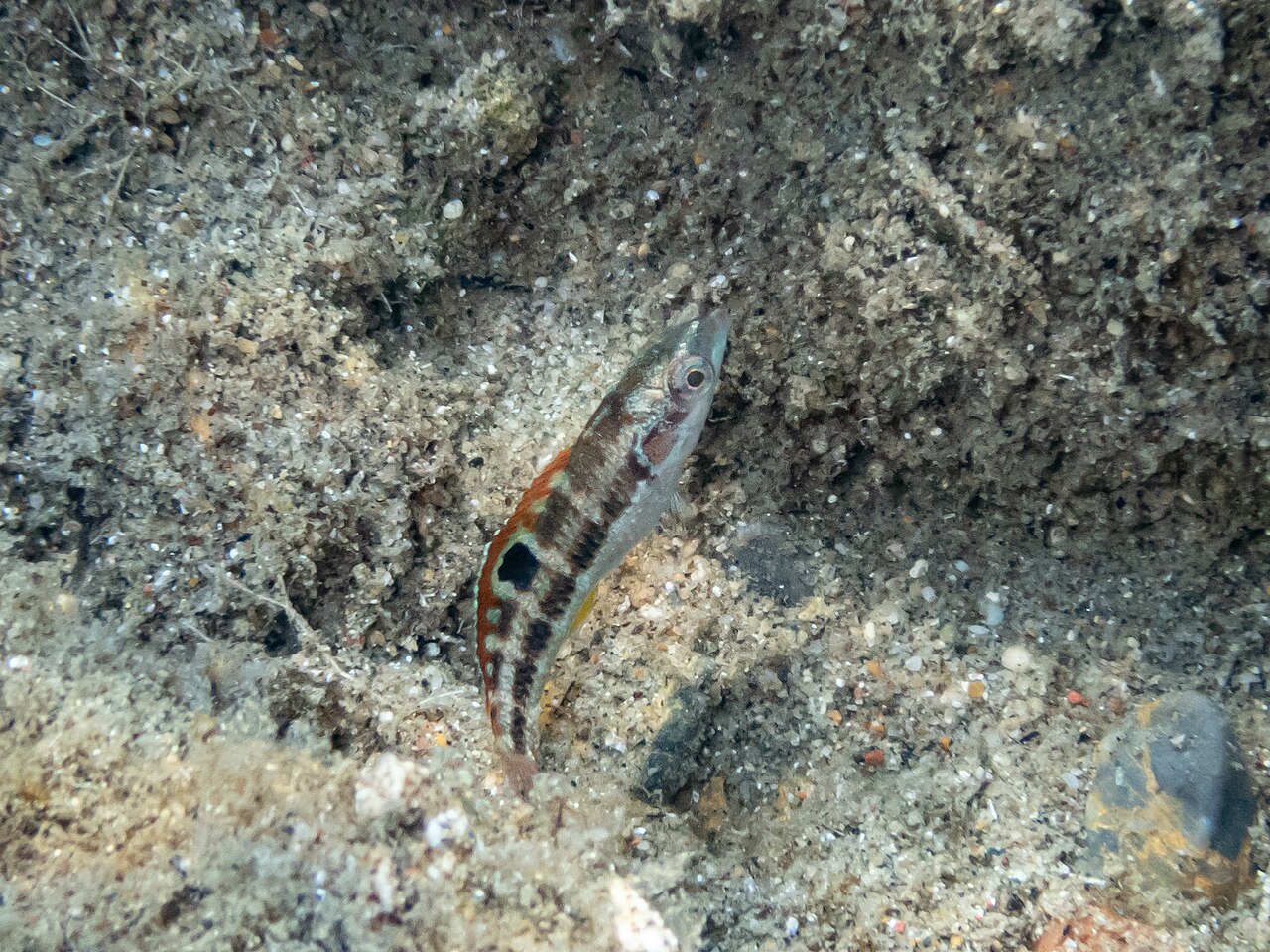
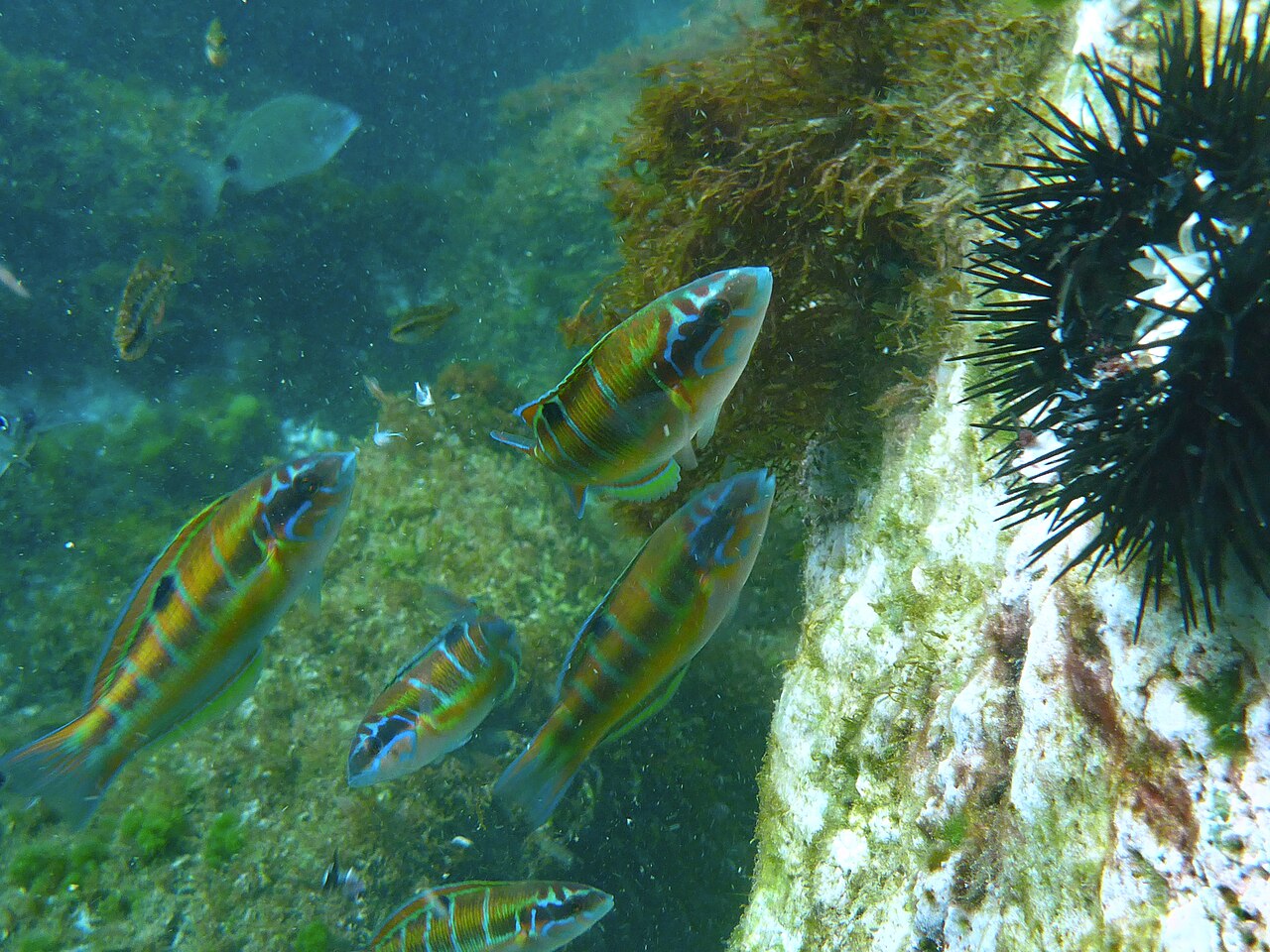
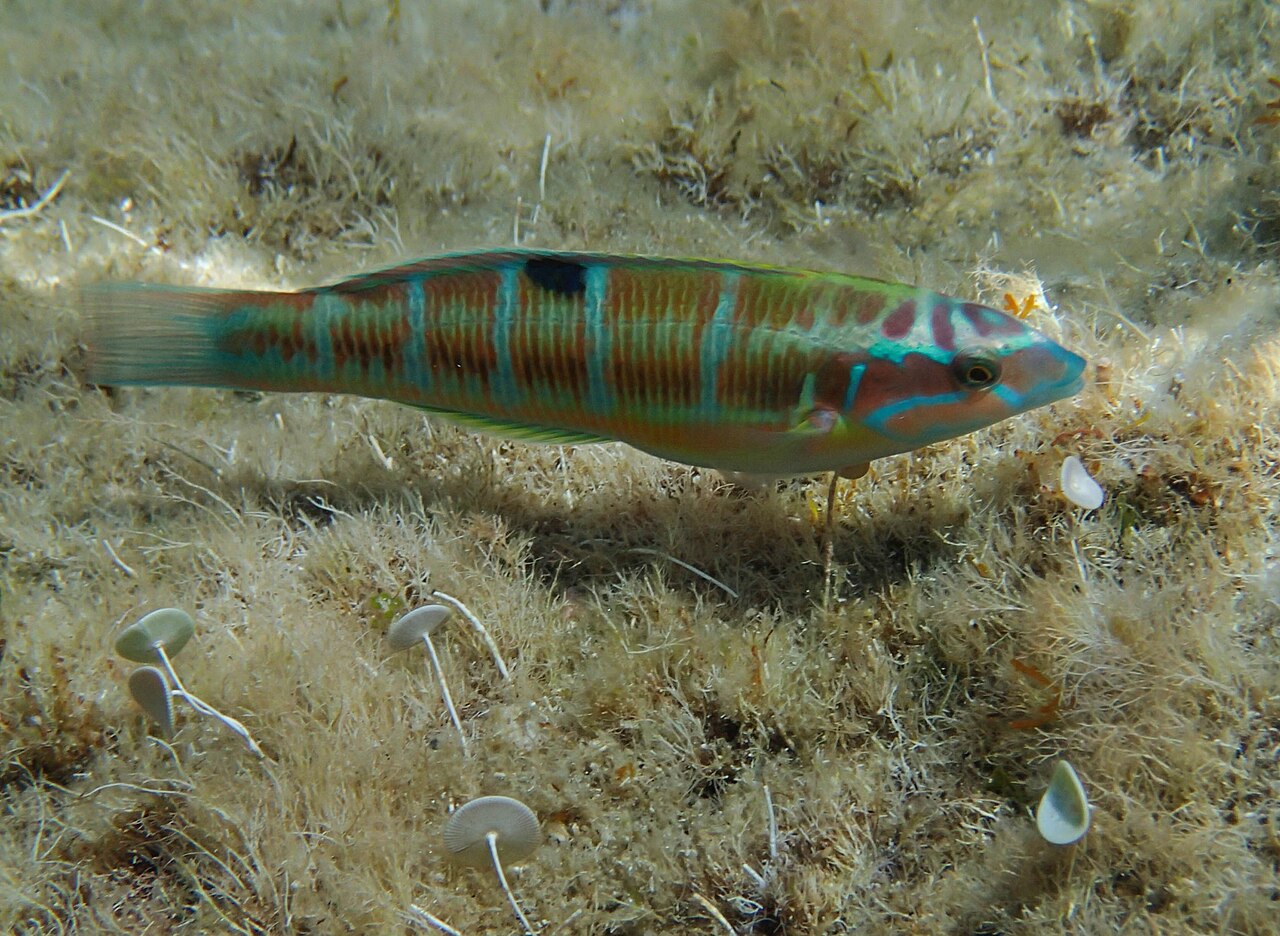
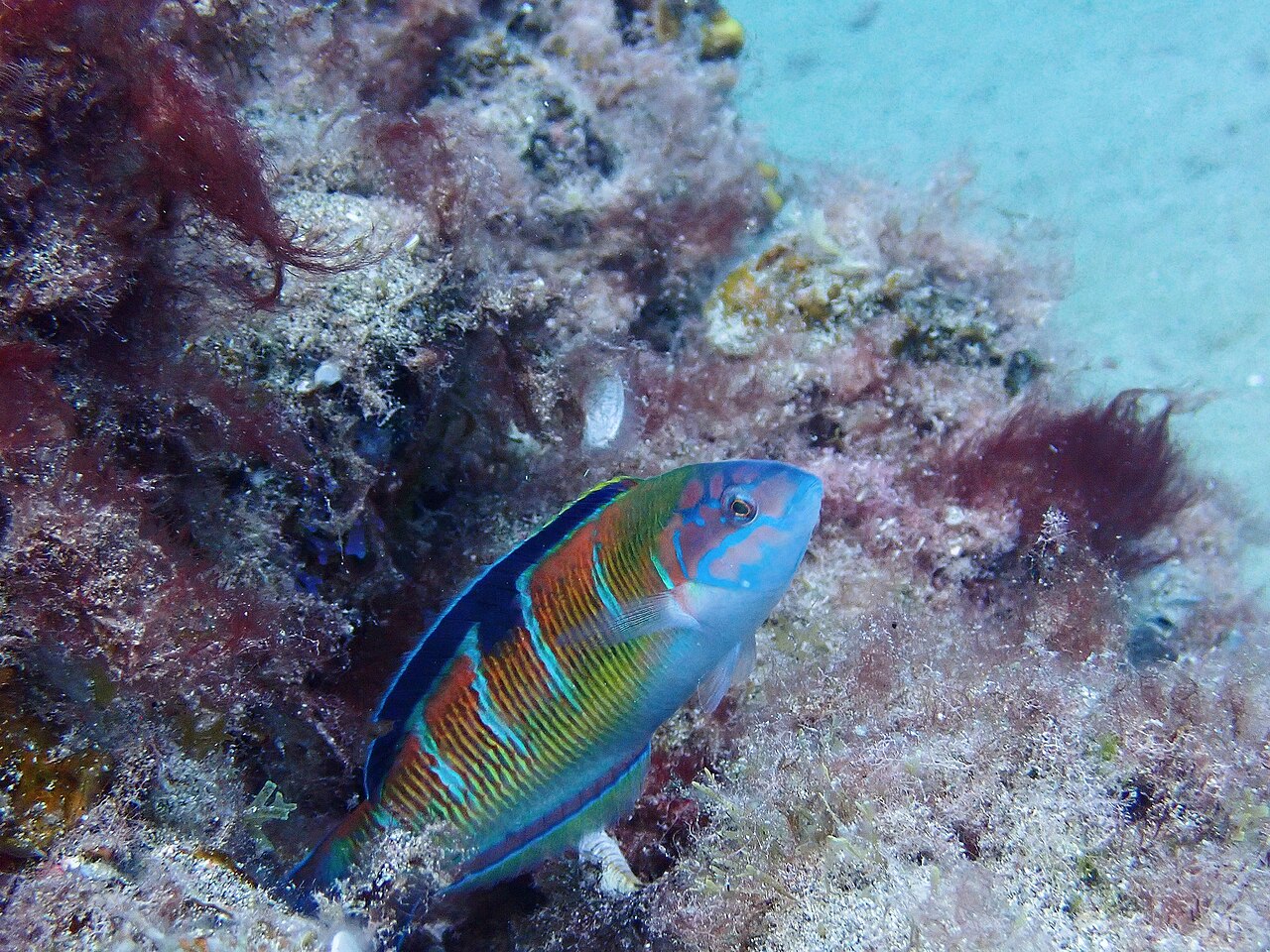
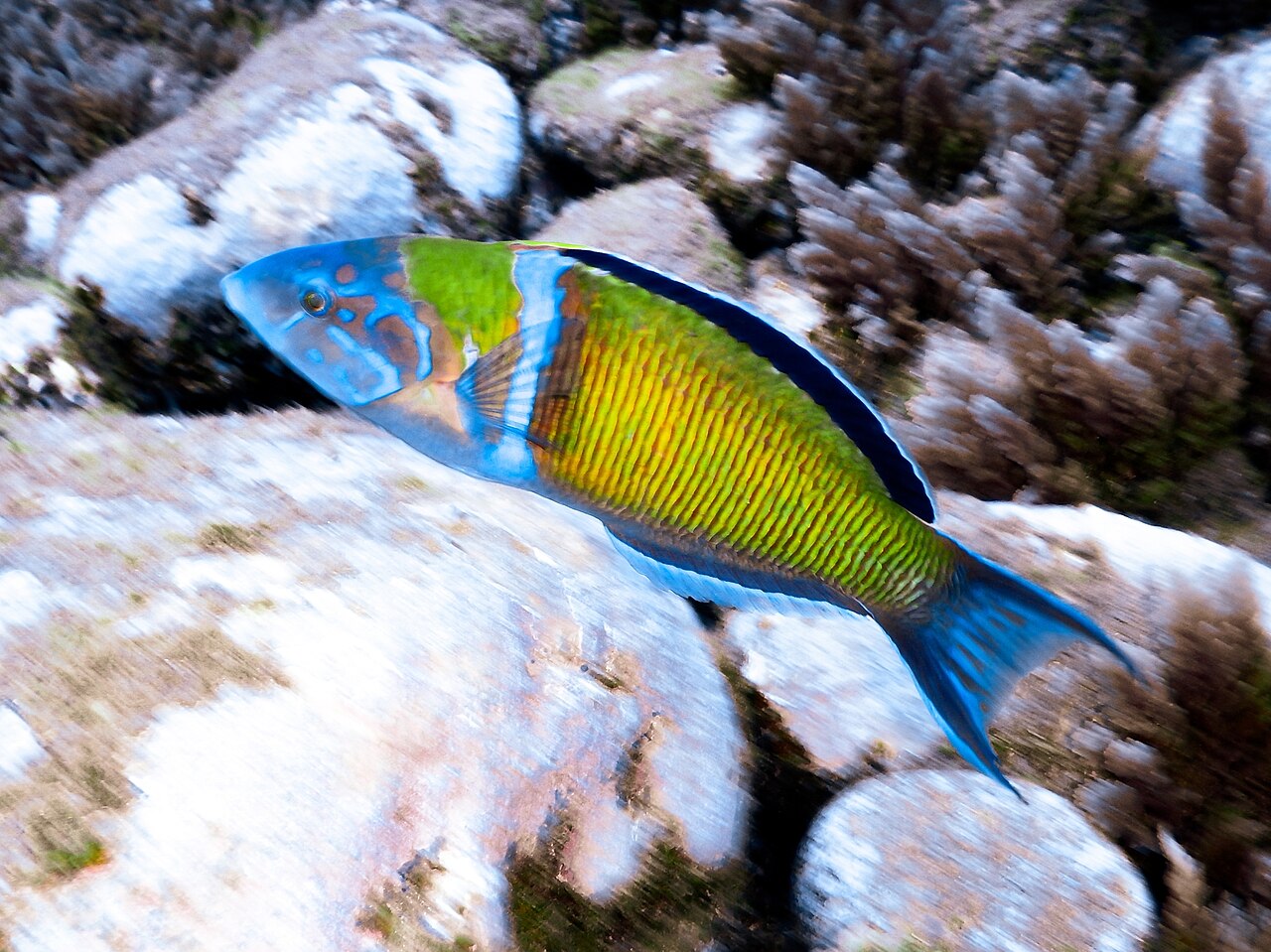
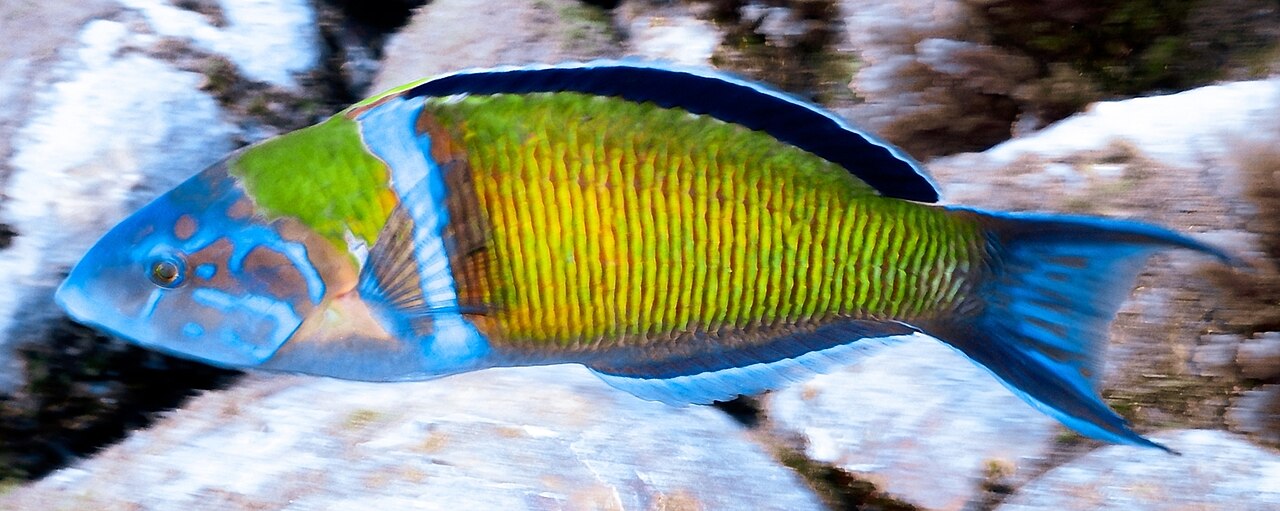
Males and females look different. Females are greenish-brown with a dark bar on each scale and five bluish vertical stripes. Males have red heads marked with blue, and a vertical blue stripe with red edges sits just behind the pectoral fin. Both sexes have a turquoise tail fin. Juveniles are green all over, with a black spot halfway along the back under the dorsal fin. The body is long and flattened from side to side, with a sharp, oval head, a short snout, a small mouth at the tip, and thick lips. Younger fish have a rounded tail fin, but as they mature it becomes concave, with the outer rays lengthening into filaments. Most individuals grow to no more than 20 centimeters, though some reach 25 centimeters. The dorsal fin has eight spines and 12 to 13 soft rays; the anal fin has three spines and 10 to 12 soft rays.
This species is found in the eastern Atlantic from Portugal south along West Africa to Senegal, and around the Macaronesian islands: Cape Verde, the Canaries, Madeira, the Salvage Islands, and the Azores. In the Mediterranean, it occurs along the African and Asian coasts and most northern shores, except the northern Adriatic and parts of the northwestern Mediterranean. It is absent from the Black Sea. Warming waters may be pushing its range northward, as it has been collected more often in the Ligurian Sea and off Provence.
The ornate wrasse lives on rocky bottoms with algae and seagrass beds, from the surface down to 50 meters. It also inhabits human-made structures like shipwrecks, piers, and jetties. Females and juveniles gather in small groups, while adult males are solitary. During breeding season, males become territorial and guard a harem. Its diet includes small mollusks and crustaceans; juveniles act as cleaner fish, eating ectoparasites from other fish. While hunting, it swims with quick, jerky movements. At night, it buries into sandy areas by shaking its tail vigorously, then rests on its side in the sand.
The ornate wrasse is a protogynous hermaphrodite: females can change into males, signaled by a color shift.
Quick Facts
- Scientific name
- Thalassoma pavo
- Original describer
- Carolus Linnaeus
- Year described
- 1758
- Type locality
- Syria
- Maximum length
- 25 cm
- Typical length
- 20 cm
- Depth range
- 0 to 50 m
Facts from the source article.
Lore & Background
The ornate wrasse was originally formally described in 1758 as Labrus pavo by Carolus Linnaeus in Volume X of the Systema Naturae, with the type locality given as Syria. The species shows sexual dichromatism: females are greenish-brown with a dark bar on each scale and five bluish vertical stripes, while males have red heads with blue markings and a vertical blue stripe with red margins behind the pectoral fin. Juveniles are green overall with a black spot halfway along the back below the dorsal fin. The body is elongated and laterally compressed with a sharp, oval head, short snout, small terminal mouth, and thick lips. The caudal fin in younger fish is rounded, becoming concave with elongated outer rays forming filaments as the fish matures. The dorsal fin has eight spines and 12–13 soft rays; the anal fin has three spines and 10–12 soft rays.
The ornate wrasse occurs in the eastern Atlantic from Portugal south to Senegal, and around the Macaronesian archipelagoes including the Cape Verde Islands, Canary Islands, Madeira, Salvage Islands, and the Azores. In the Mediterranean it is found along African and Asian coasts and most northern coasts except the northern Adriatic and parts of the northwestern Mediterranean. Global warming may be allowing it to extend its range northward, with increasing records in the Ligurian Sea and off Provence. It is absent from the Black Sea.
It inhabits rocky areas with algae and Posidonia seagrass beds from 0 to 50 m, as well as anthropogenic structures such as shipwrecks, piers, and jetties. Females and juveniles live in small groups, while adult males are solitary. During breeding season, males become territorial and guard a harem. Its diet consists of small molluscs and crustaceans; juveniles act as cleaner fish, feeding on ectoparasites from other fishes. It swims with quick jerky movements while hunting. At night, it buries into sandy areas by vigorously shaking its tail, spending the night on its side in the sand. The ornate wrasse is a protogynous hermaphrodite: females may transform into males, signified by a color change. The population is dominated by young, fertile females that produce many eggs; older, larger solitary males are fewer due to greater predation pressure. Spawning occurs in spring, and the eggs are pelagic.
Reader's Guide
The ornate wrasse holds a modest but notable place in human activities across its range. It is a quarry species for local fisheries in the eastern Mediterranean and the Macaronesian archipelagoes, where it is caught using hook and line as well as traps. Its popularity as a game fish adds to its recreational value, and it is also present in the aquarium trade, appealing to marine aquarists. The species' ability to inhabit anthropogenic structures such as shipwrecks, piers, and jetties demonstrates its adaptability to altered coastal environments. Its role as a cleaner fish in its juvenile stage contributes to the health of other fish populations by removing ectoparasites. The ornate wrasse's protogynous hermaphroditism—where females can transform into males—is a key biological trait that shapes its population structure, with a predominance of young females ensuring high reproductive output. The ongoing northward range expansion, potentially linked to global warming, may alter its distribution and interactions with other species in the Mediterranean. Overall, the ornate wrasse is a colorful and ecologically interesting species with moderate economic and cultural significance in the regions it inhabits.
Did You Know?
- The ornate wrasse was originally described as Labrus pavo by Carolus Linnaeus in 1758.
- It buries into sandy areas at night by vigorously shaking its tail and sleeps on its side.
Gallery
More in Wrasses and Gobies 1-24
Spotted an error? Know more?
Reader corrections go straight into our review queue. Suggest an edit · How this site is sourced