Black-ray goby
A burrow-sharing goby that watches for danger while its shrimp partner digs.

Rickard Zerpe · CC BY 2.0
The black-ray goby (Stonogobiops nematodes) is a marine fish native to the Indian Ocean and western Pacific Ocean, ranging from the Seychelles to the Philippines and Bali. It is notable for its striking coloration, elongated dorsal fin, and its commensal relationship with Randall's pistol shrimp (Alpheus randalli), with which it shares a burrow in a mutualistic partnership.
Quick Facts
- Taxon
- Stonogobiops nematodes
Facts from the source article.
Lore & Background
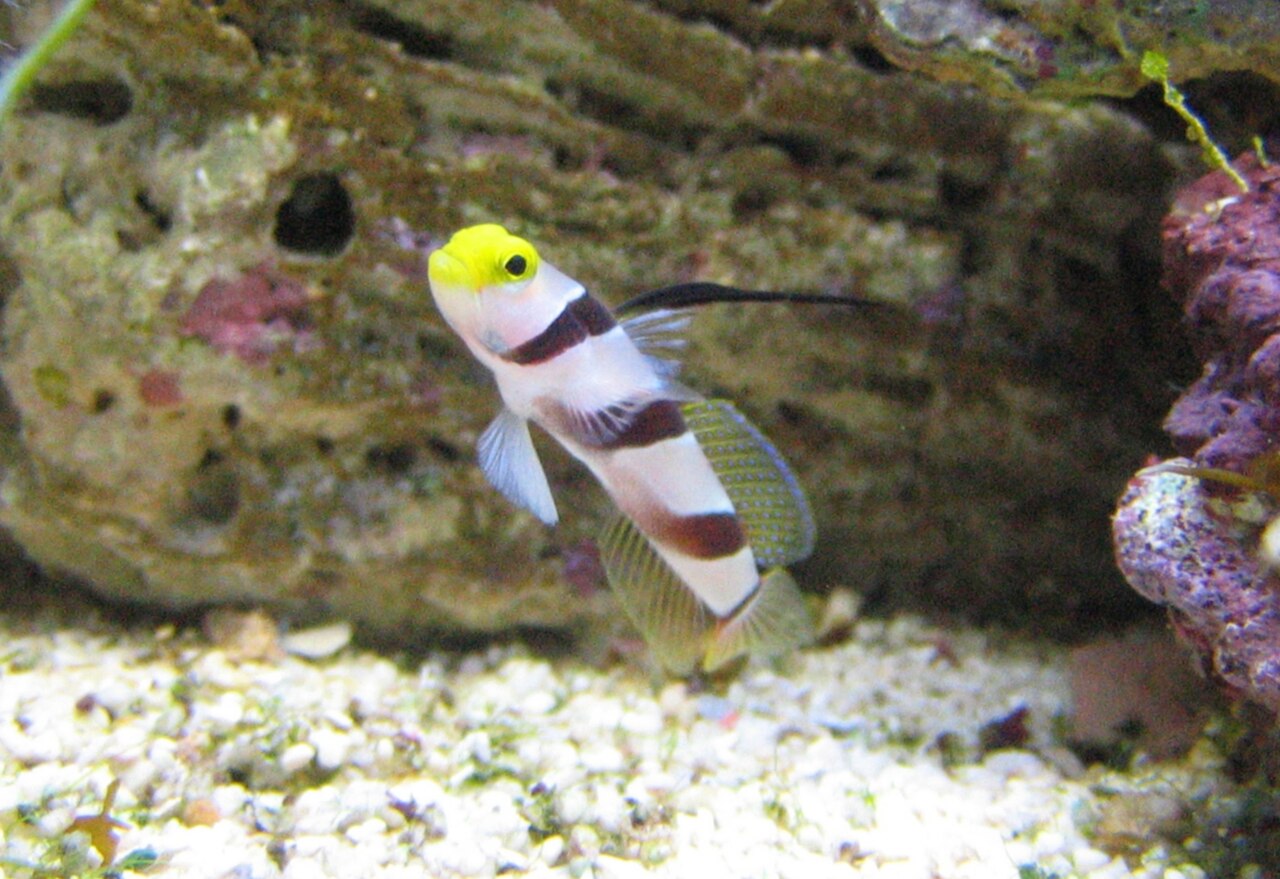
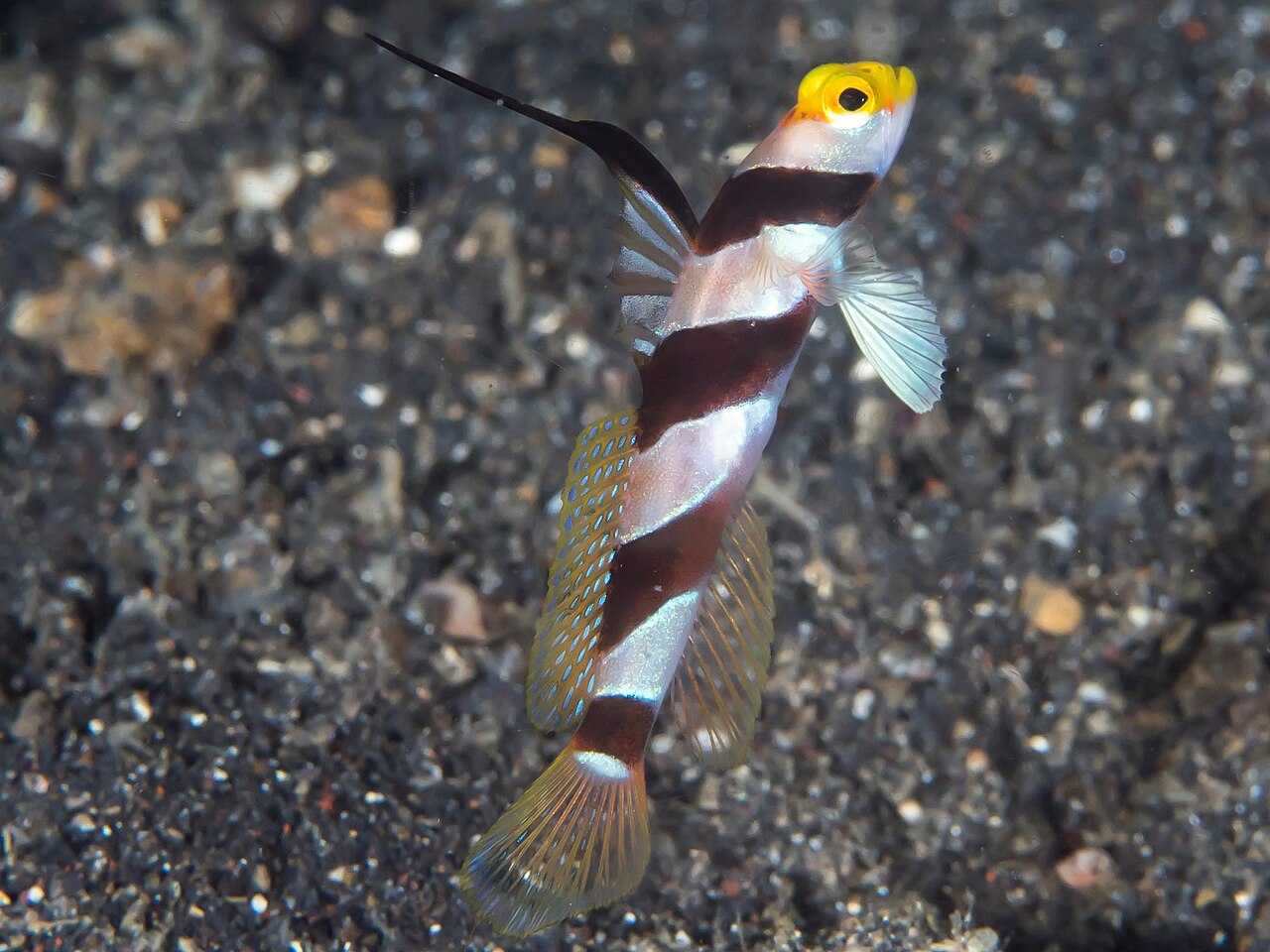
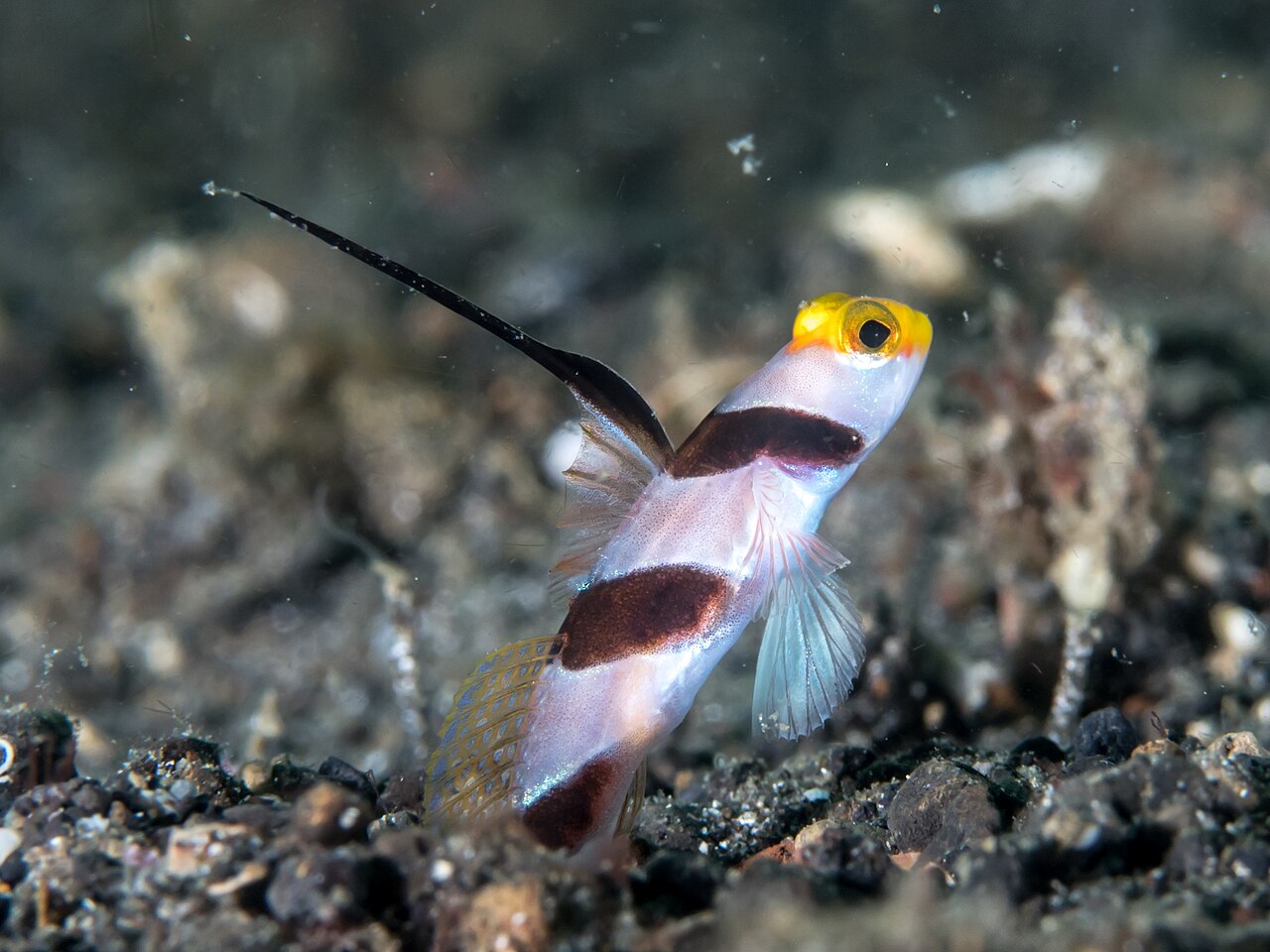
The black-ray goby inhabits sandy or sand-rubble bottoms adjacent to reefs. Adults grow up to 6 cm in length and develop a pronounced pointed dorsal fin, which distinguishes them from the similar yellow snout goby (S. xanthorhinica). The body is white with four diagonal brown stripes and a distinctive yellow head. Distinguishing males from females is nearly impossible for non-specialists.
This species forms a symbiotic relationship with Randall's pistol shrimp. The goby, possessing superior eyesight, acts as a watchman while the shrimp digs and maintains a burrow that can reach up to four feet in length and about one inch in diameter, typically built under rocks or solid objects. The shrimp maintains contact with the goby by placing an antenna on its tail or pointing an antenna toward it. When danger is detected, the goby flicks its tail to warn the shrimp, and both retreat into the burrow if necessary. At night, the goby enters the burrow and the shrimp may collapse the entrance, rebuilding it the next day. The pair sometimes share food; the goby may regurgitate food for the shrimp, though an underfed shrimp may kill the goby. In the wild, most burrows house a male and female goby pair with their shrimp partner, and the female uses the burrow as a nesting site. Dartfish (genus Ptereleotris) are sometimes tolerated as unwelcome guests in the burrow.
Reader's Guide
The black-ray goby is the most common Stonogobiops species in the marine aquarium trade, though it remains quite rare. Its popularity stems from its beautiful coloration, docile nature, and the fascinating mutualistic behavior it displays with pistol shrimp. In captivity, the fish is shy and may take weeks to leave its hiding place after introduction. It spends most of its time hovering about two inches above its bolt hole, searching for food scraps, and retreats slowly or darts inside when startled. It poses little threat to other tank inhabitants, making it suitable for delicate species such as seahorses or pipefish. Aggression is limited to a 'yawning' display that rarely escalates. Mated pairs are difficult to obtain, and individual males may fight in tanks smaller than about 50 gallons. The species requires a sandy or coral rubble substrate at least four inches deep for burrow-building, along with rock cover. It accepts small meaty foods like mysid or brine shrimp, as well as flake food and algae wafers. Water quality must be kept high, with specific gravity of 1.020–1.025, pH of 8.1–8.4, and temperature of 72–78 °F (tolerating up to 80 °F). Despite a recommended minimum tank size of 10 gallons, the fish's sedentary nature makes it a candidate for smaller 'pico' aquariums of 4 gallons or less.
Did You Know?
- The black-ray goby is also known as the filament-finned prawn-goby, antenna goby, high-fin goby, red-banded goby, striped goby, and barber-pole goby.
- It shares a burrow with Randall's pistol shrimp, which can dig tunnels up to four feet long.
- The goby warns the shrimp of danger by flicking its tail, and both retreat into the burrow if threatened.
- If the shrimp is not well fed, it may kill the goby.
The Signature Sucker: A Morphological Marvel
The single most recognizable trait of any goby is the flat, disc-shaped structure formed by its fused pelvic fins. This adhesive organ allows the fish to cling firmly to rocks, coral surfaces, and even the glass walls of an aquarium tank. What makes this feature particularly fascinating from an evolutionary standpoint is that it is not a shared inheritance. The goby's pelvic disc is functionally similar to the dorsal-fin sucker of remoras and the pelvic-fin sucker of lumpsuckers, yet it is anatomically distinct in each group. Biologists recognize these parallels as a textbook example of convergent evolution, where unrelated lineages independently arrive at the same solution to the problem of staying anchored in flowing water. Because gobies are overwhelmingly benthic, this sucker is not merely a curiosity but a central element of their daily existence, enabling them to hold position against currents, rest on substrates, and navigate the complex three-dimensional architecture of reefs and riverbeds.
Reef Dominance and Global Reach
Gobies occupy a staggering share of aquatic life wherever they occur. On coral reefs, they account for roughly 35 percent of all individual fish and 20 percent of total species diversity, making them arguably the most numerically important fish group in those ecosystems. Their geographic spread is equally impressive, stretching from Old World tropical reefs to the temperate seas of the New World, and into the rivers and near-shore waters of Europe and Asia. They thrive in an extraordinary range of settings: tide pools, seagrass meadows, mangrove swamps, salt marshes, the lower reaches of rivers, and even brackish estuaries. A low number in the hundreds of species have fully adapted to freshwater, including the round goby, the Australian desert goby, and the European Padogobius bonelli. Most gobies are bottom-dwellers, many excavating burrows, while a few such as members of the genus Glossogobius have become true cavefish. Their diet is primarily small invertebrates, though larger individuals may take other fish and a handful of species feed on planktonic algae.
Courtship, Burrows, and the Choreography of Parenting
Reproduction in gobies is a remarkable display of cooperative labor and shifting roles. Many species form male-female pairs that jointly dig and maintain a burrow in the sea floor, using their mouths to remove dead coral fragments, rubble, and benthic algae. The pair also constructs a mound six to thirteen centimeters high over the spawning burrow entrance; the fast water flowing over this mound delivers oxygen to the developing eggs. A single goby can carry as many as nine pieces of coral rubble per minute to block the burrow entrance. After the female deposits anywhere from five to a few thousand eggs on a substrate, the division of labor shifts: the male takes on egg-guarding, fanning the clutch to supply oxygen and clearing away detritus, while the female focuses on maintaining the burrow. If the female departs, the mounds lose their height, and the male will abandon and consume the eggs, redirecting his energy toward future mating. In warmer waters, juveniles reach adulthood within a few months, whereas cooler-water species need about two years. Total lifespan ranges from one to ten years.
A Family in Flux: Taxonomy and the Size Spectrum
The Gobiidae family is one of the largest in all of vertebrate biology, encompassing more than two thousand species distributed across over two hundred genera. Its members span an astonishing size range: the majority stay under ten centimeters, yet the family also shelters some of the tiniest vertebrates on Earth, including Trimmatom nanus, which never exceeds one centimeter, and Pandaka pygmaea, whose standard length is just nine millimeters with a maximum known record of eleven millimeters. At the other extreme, a few exceptional species surpass thirty centimeters. Fossil evidence pushes the family's origins back to the Early Oligocene, giving it a deep evolutionary history. Taxonomically, Gobiidae underwent a major reshuffling in the fifth edition of Fishes of the World. Four of the six previously recognized subfamilies were elevated to the new family Oxudercidae, while four other families—Kraemeriidae, Microdesmidae, Ptereleotridae, and Schindleriidae—were folded into the revised Gobiidae. The two retained subfamilies are Gobiinae, the most widespread and diverse with roughly two thousand species in about one hundred fifty genera, and Benthophilinae, which is endemic to the Ponto-Caspian region and distinguished by the absence of a swimbladder in adults.
Gallery
More in Wrasses and Gobies 1-24
Spotted an error? Know more?
Reader corrections go straight into our review queue. Suggest an edit · How this site is sourced