Humphead wrasse
Largest wrasse, key reef predator, endangered by overfishing.

Bernard DUPONT from FRANCE · CC BY-SA 2.0
The humphead wrasse (Crassilabrus undulatus) is the biggest wrasse species alive, living mainly on Indo-Pacific coral reefs. People also call it the Māori wrasse, Napoleon wrasse, or Napoleonfish. As a top predator in its reef home, it eats many invertebrates, such as the crown-of-thorns starfish. Humans value it for food, for aquariums, and increasingly for the ecological benefits it provides.
For a long time, scientists placed this fish in the genus *Cheilinus*. But genetic work later showed it is more closely related to the slingjaw wrasses of *Epibulus*, sitting as the sister group to a cluster containing *Epibulus* and *Concholabrus*. So, in 2025, as part of a larger reorganization of the wrasse family, it was moved into the revived genus *Crassilabrus*.
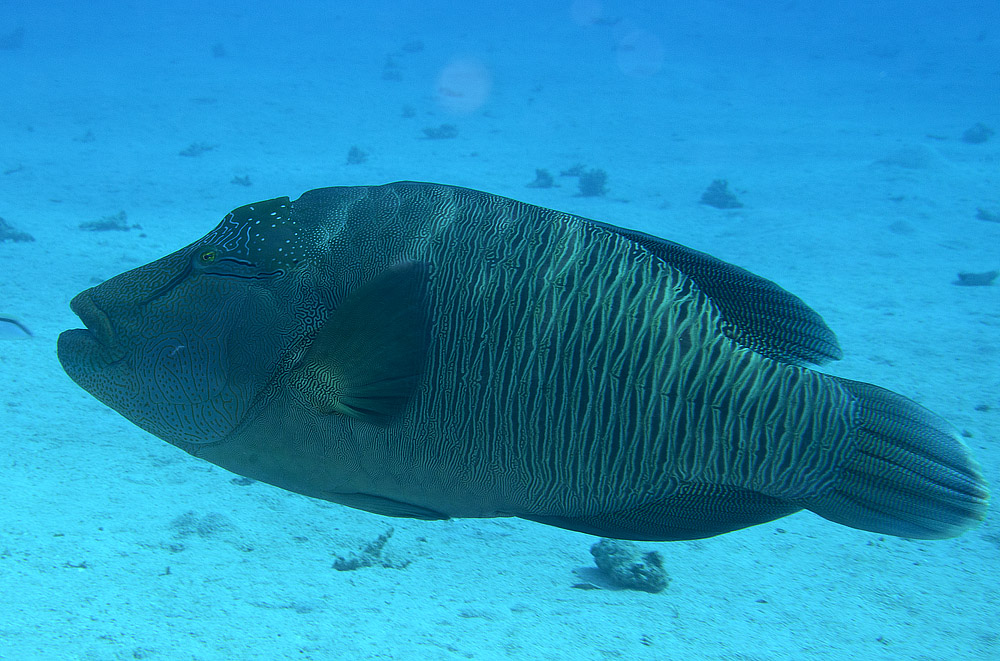
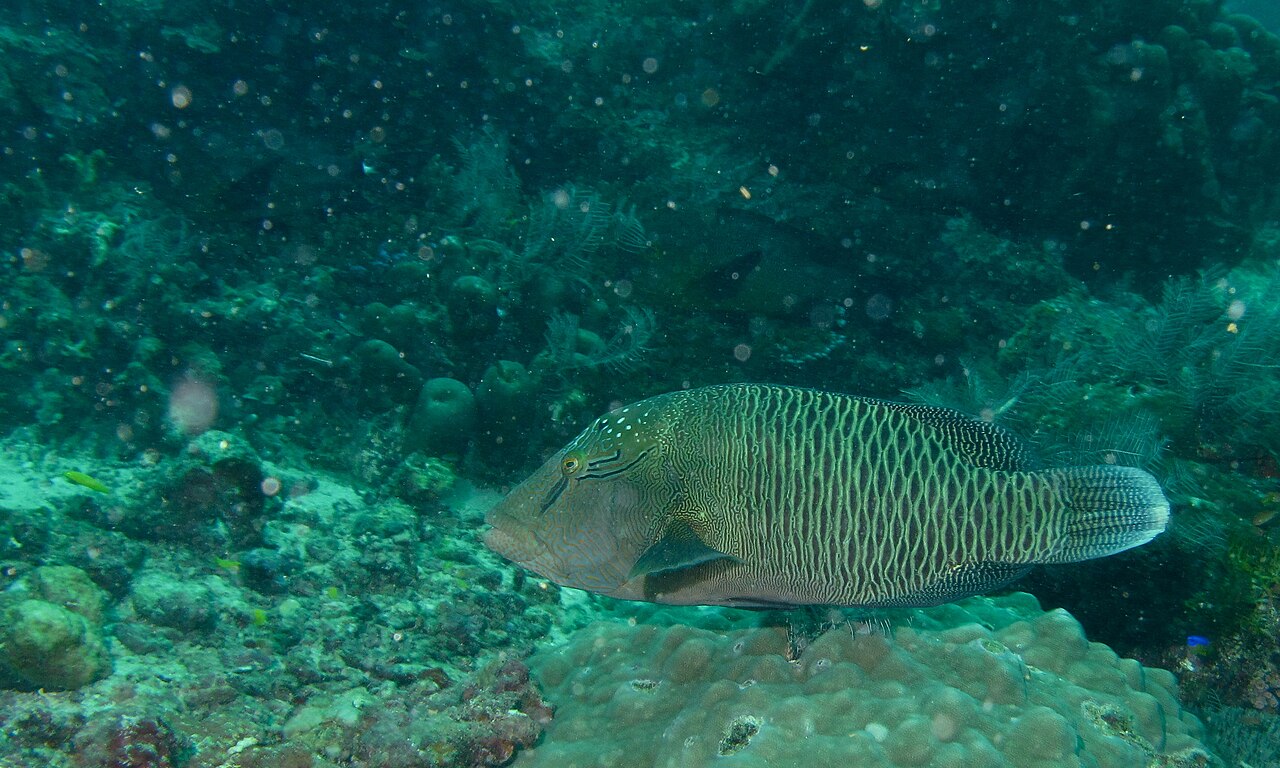
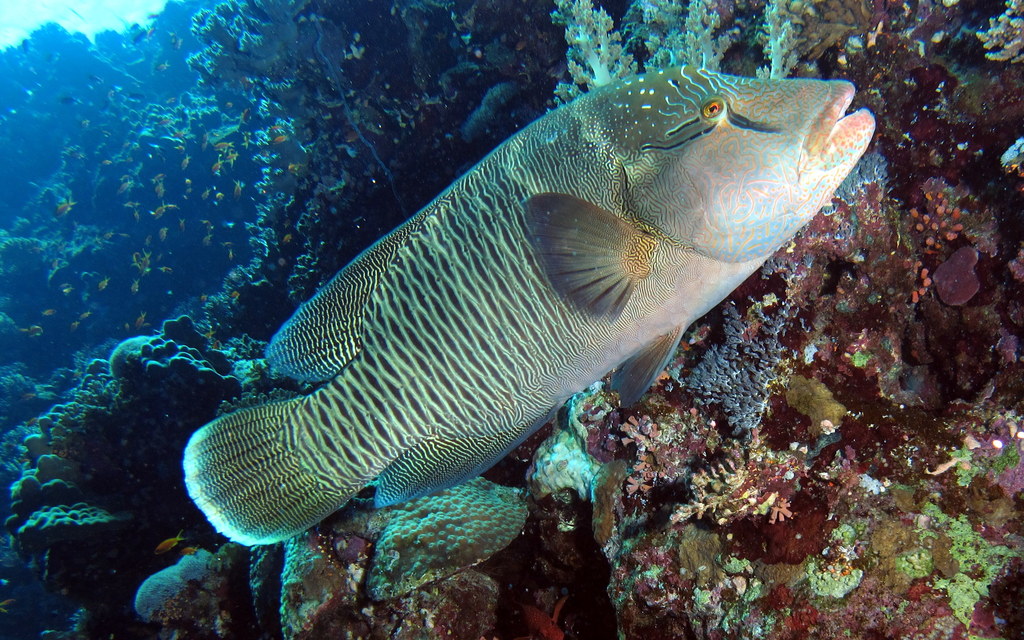
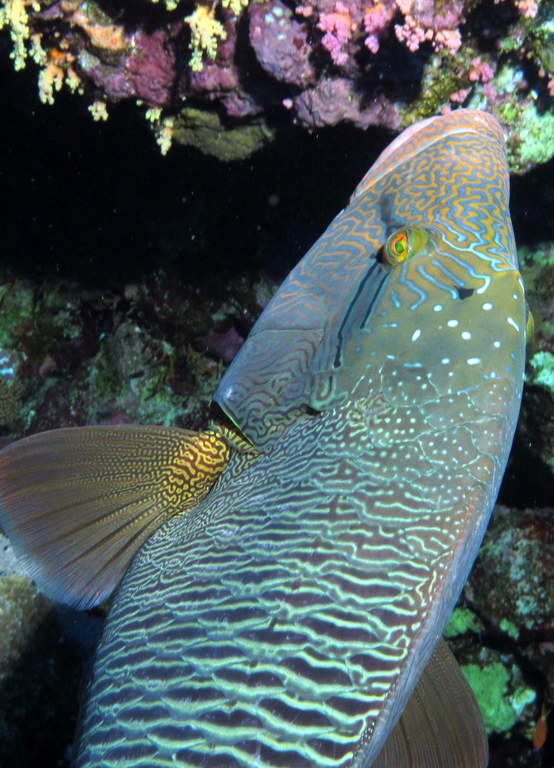
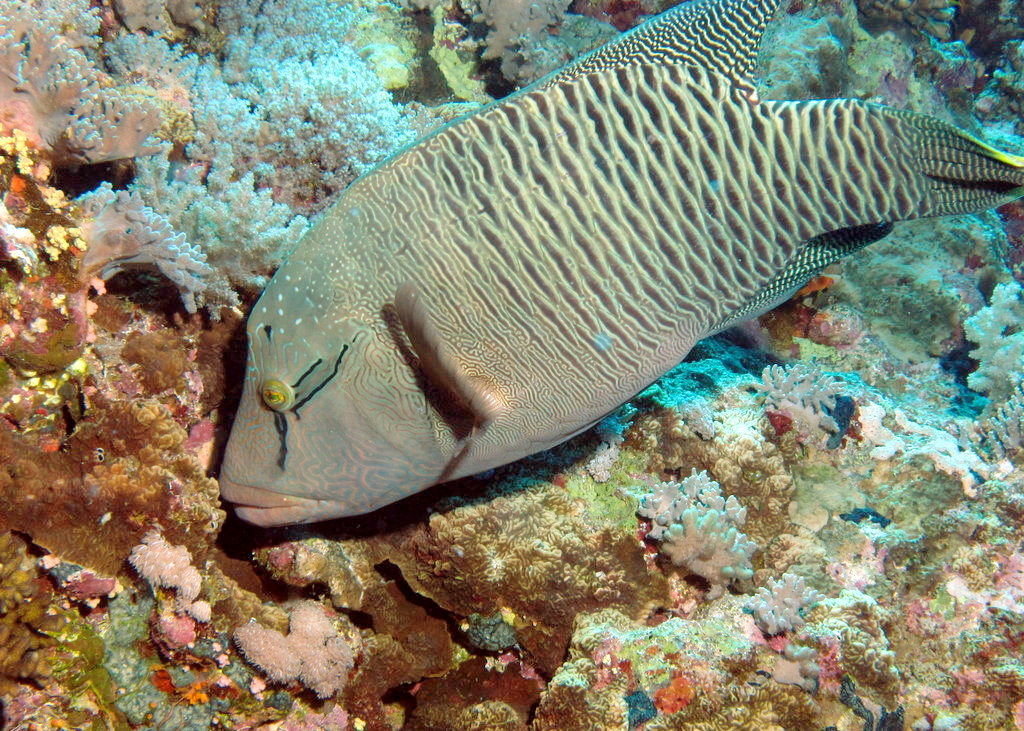
Males are bigger than females, reaching up to 229 centimeters and 191 kilograms, though the average length is about 60 centimeters. Females rarely grow past one meter. You can spot this wrasse by its large size, thick lips, two black lines behind each eye, and the hump on the forehead of older, larger adults. Its color ranges from olive to brighter greens and purplish-blue, with yellow wavy lines or a net-like pattern on the head. Adults usually live alone, but also turn up in male-female pairs or small groups.
The wrasse’s mitogenome was sequenced in 2013. Because scientists knew little about its genetic relationships across different areas, they used a test with microsatellite loci to help study its populations. (DNA markers could not be used because the humphead wrasse lacks them.) Out of 15 microsatellite loci tested, only four gave different results than the other 11. Those four were prone to null alleles. These null alleles might have slightly skewed the results, or they could reflect something unique about *C. undulatus*, which sticks closely to coral reef habitats.
The humphead wrasse lives from the east coast of Africa near the Red Sea mouth to parts of the Indian and Pacific Oceans. Juveniles stay in shallow, sandy areas next to coral reefs, while adults prefer deeper, offshore spots like outer-reef slopes, channels, and lagoons. Adults are common on steep coral slopes, channel slopes, and lagoon reefs in water 2 to 60 meters deep.
This fish is a very opportunistic eater.
Quick Facts
- Taxon
- Crassilabrus undulatus
Facts from the source article.
Lore & Background
The humphead wrasse was long placed within the genus Cheilinus, but genetic analysis revealed it is closer to the slingjaw wrasses of genus Epibulus, being the sister taxon to a clade containing Epibulus and Concholabrus. It was moved to the resurrected genus Crassilabrus in 2025 as part of a greater taxonomic revision. Males, typically larger than females, can reach up to 229 cm and 191 kg, though average length is about 60 cm; females rarely exceed one meter. The species is identified by its large size, thick lips, two black lines behind the eyes, and a hump on the foreheads of larger adults. Color varies from olive to green and purplish-blue, with yellow undulating lines or reticulation on the head. Adults are usually solitary but also occur in male-female pairs and small groups. The mitogenome was sequenced in 2013; a test using 15 microsatellite loci facilitated population genetic studies, though four loci prone to null alleles may have biased results or relate to the species' restriction to coral reef habitats.
Reader's Guide
The humphead wrasse is listed as endangered on the IUCN Red List and in Appendix II of CITES. Its decline stems from intensive removal by the live reef food-fish trade, destructive fishing techniques (bombs and cyanide), habitat loss, local consumption, export of juveniles for aquaria, and illegal, unreported, and unregulated fishing. Unsustainable overfishing within the live reef food fish trade is the primary threat. In Sabah, Borneo, the export of humphead wrasses led to a roughly 99% population decline; an export ban has not prevented illegal activities. The species is protected in Queensland since 2003 and Western Australia since 1998. Malaysia has implemented the Fisheries Act 1985 and the International Trade in Endangered Species Act 2008. Other protections include permit requirements in Guangdong, fishing restrictions in Indonesia, an export ban in the Maldives, size limits in Papua New Guinea, and a fishing ban in Niue. The humphead wrasse is considered an umbrella species, meaning its conservation benefits many other sympatric species with smaller ranges.
Did You Know?
- The humphead wrasse is the largest extant member of the family Labridae.
- It is one of the top predators of the reef ecosystem and preys on crown-of-thorns starfish.
- The species was moved to the resurrected genus Crassilabrus in 2025 based on genetic analysis.
Taxonomic Home: The Wrasse Family Within Perciformes
The Humphead wrasse belongs to the wrasse family, a lineage nested within the order Perciformes, one of the most species-rich groupings in the IUCN's September 2016 data deficient fish assessment. Perciformes is an extraordinarily broad order, and within it, 786 species and two subspecies were flagged as lacking sufficient information for a proper conservation status evaluation. The wrasse family is just one of dozens of subfamilies catalogued under this order, sharing taxonomic space with cichlids, gobies, sparids, dragonets, and many others. This immense taxonomic breadth means the Humphead wrasse's conservation story cannot be isolated from the wider challenge of assessing thousands of species across numerous families. The IUCN's evaluation placed wrasses within a landscape where more than 2,600 ray-finned fish species across all orders face the same informational void, making the Humphead wrasse's particular status one thread woven into a vast tapestry of incomplete scientific knowledge about aquatic life.
What Data Deficient Actually Means
In September 2016, the IUCN published its assessment identifying 3,191 fish species as data deficient, a category signifying that available information is simply insufficient to determine whether a species faces extinction risk. This designation does not imply a species is safe, nor does it confirm it is endangered; rather, it marks a critical gap in scientific understanding. Across all fish species the IUCN has evaluated, a striking 21 percent fall into this uncertain category, underscoring how much of the world's aquatic biodiversity remains poorly documented. The Humphead wrasse, as a member of the wrasse family within Perciformes, exists within this broader context where hundreds of species across dozens of families share this informational void. For any individual species, the data deficient label functions as a call to action: more field surveys, population studies, and ecological documentation are needed before meaningful conservation decisions can be made and protections can be justified.
Subpopulation-Level Assessment and Its Relevance
The IUCN's framework extends well beyond species-level evaluation to assess subpopulations and stocks individually. In the September 2016 listing, 34 fish species subpopulations were assessed as data deficient, and an additional 12 fish subspecies received the same designation. This granular approach recognizes that a single species can harbor populations with vastly different fates, some thriving while others teeter on the edge, and that conservation planning must account for this internal variation. For a large, wide-ranging marine species like the Humphead wrasse, whose family is catalogued within the 786-species data deficient count for Perciformes, the subpopulation framework carries particular weight. Different regional populations may face different pressures, and the IUCN's insistence on evaluating stocks separately means that even within a single species, some distinct groups may demand urgent attention while others remain relatively stable. The Humphead wrasse's conservation narrative is thus shaped not only by its species-level standing but by the condition of each discrete population it comprises.
A Complete Catalogue of Uncertainty
The IUCN's data deficient fish list is not a narrow document but a comprehensive catalogue spanning the full diversity of fish life. It encompasses cartilaginous fishes, including sharks, rays, skates, and sawfish, with 475 species and three subpopulations flagged, alongside 2,682 ray-finned fish species, 12 subspecies, and one subpopulation. Within the ray-finned fishes alone, the orders range from the 610-species Cypriniformes, which includes carps, minnows, and loaches, to the 439-species catfish groupings and the 786-species Perciformes that houses the wrasse family. The Humphead wrasse's place in this taxonomy means its conservation context is shared with thousands of unrelated species, from the 20 Chimaera species to the 71 pipefish and seahorse species in Syngnathiformes. This complete list, with its species and subspecies entries and subpopulation indicators, stands as the IUCN's acknowledgment that a significant fraction of aquatic life has not yet been studied enough to be properly protected.
Gallery
More in Wrasses and Gobies 1-24
Spotted an error? Know more?
Reader corrections go straight into our review queue. Suggest an edit · How this site is sourced