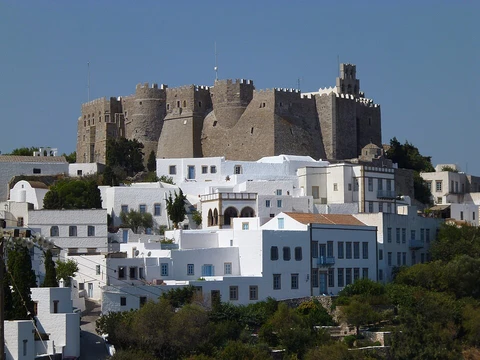
Nea Moni of Chios
11th-century Byzantine monastery famed for its Macedonian Renaissance mosaics.

Nea Moni, meaning "New Monastery" in Greek, is an 11th-century Greek Orthodox complex on the island of Chios, in the North Aegean region of Greece. Originally a monastery, it now functions as a convent and a history museum. The site sits on Provateio Oros Mountain, about 15 kilometers from Chios town, and was added to the UNESCO World Heritage List in 1990. Its mosaics are considered among the finest examples of Macedonian Renaissance art in Greece, alongside those at Daphni and Hosios Loukas.
The complex was built in the mid-11th century by Byzantine emperor Constantine IX Monomachos and his wife, Empress Zoe. Tradition holds that three monks—Nikitas, Ioannes, and Iosif—found an icon of the Virgin Mary hanging from a myrtle branch at this spot. At the time, Constantine was exiled on nearby Lesbos. The monks visited him and described a vision that he would become emperor. Constantine promised to build a church if this came true. He became emperor in 1042 and began constructing a monastery dedicated to the Theotokos. The main church, or katholikon, was inaugurated in 1049, and the entire complex was finished in 1055, during Constantine’s reign.
From early on, the monastery received special privileges. In a July 1049 chrysobull, Constantine Monomachos granted it the head tax of all Jews on Chios and placed it outside any superior ecclesiastical or secular authority. Through land grants, tax exemptions, and other privileges from later emperors, the monastery flourished during the Byzantine period. Over time, it amassed great wealth, becoming one of the richest monasteries in the Aegean. At its peak around 1300, its estates covered one-third of Chios, and it is estimated that up to 800 monks belonged to it.
Genoese rule later reduced its wealth, but the monastery prospered again under the Ottomans, when it answered directly to the Patriarch of Constantinople and enjoyed considerable autonomy. The late 16th-century English cleric Samuel Purchas, in his compilation 'Purchas his Pilgrimage' (1613), recounted that it had 200 monks and was the only place in Greece allowed to use bells. The number of monks dropped during the 17th century but recovered in the 18th.
- Location
- Provateio Oros Mt., Chios, Greece
- Founded
- Mid-11th century (katholikon inaugurated 1049, complex finished 1055)
- Founders
- Byzantine emperor Constantine IX Monomachos and Empress Zoe
- Type
- Greek Orthodox former monastery, now convent and history museum
- Unesco status
- Inscribed 1990
- Known for
- Macedonian Renaissance mosaics
- Peak monks
- Up to 800 (c. 1300)
Lore & Background
The monastery complex was built in the mid-11th century by Byzantine emperor Constantine IX Monomachos and his wife, Empress Zoe. According to tradition, it was built where three monks—Nikitas, Ioannes, and Iosif—miraculously found an icon of the Virgin Mary hanging from a myrtle branch. At that time, Constantine was exiled in nearby Lesbos, and the monks visited him, telling of a vision that he would become emperor. Constantine promised to build a church if this came to pass. In 1042 he became emperor and began constructing the monastery dedicated to the Theotokos. The main church (katholikon) was inaugurated in 1049, and the complex finished in 1055, during Constantine's reign.
Reader's Guide
Nea Moni's significance lies in its mosaics, which are among the finest examples of Macedonian Renaissance art in Greece, alongside those at Daphni and Hosios Loukas. The monastery complex covers approximately 17,000 square metres and includes the katholikon, two smaller churches, a dining hall, monks' cells, a reception hall, and an underground water cistern, all surrounded by a wall. The katholikon, dedicated to the Dormition of the Virgin Mary, is of an octagonal 'insular' type found in Chios and Cyprus. Its original 11th-century form was altered after significant damage from the 1822 Ottoman destruction during the Greek War of Independence, when 2,000 refugees were slaughtered or burned inside, and from an 1881 earthquake that collapsed its dome. The monastery never recovered its former glory. In 1952, due to a shortage of monks, it was converted to a convent; by the 2001 census, only three nuns inhabited it. A small museum opened in 1992 houses artefacts mostly from the latter 19th century. The site remains a key monument of Byzantine religious and artistic heritage.
Did You Know?
- The monastery was built after Constantine IX Monomachos, while exiled in Lesbos, was told by three monks of a vision that he would become emperor.
- In July 1049, Constantine Monomachos granted the monastery the head tax of all Jews on the island of Chios.
- During the 1822 Ottoman destruction, 2,000 people who sought refuge in the monastery were slaughtered or burned alive.
- The monastery was converted to a convent in 1952 due to a shortage of monks.
More in World Heritage Sites in Greece 1-24
Spotted an error? Know more?
Reader corrections go straight into our review queue. Suggest an edit · How this site is sourced