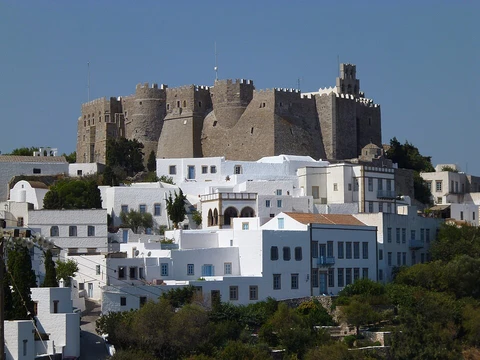
Fortifications of Rhodes
Fortifications of Rhodes, built by Knights Hospitaller, withstood major Ottoman sieges.

The fortifications of Rhodes are a defensive crescent of walls, bastions, moats, and glacis surrounding the medieval town, built primarily by the Knights Hospitaller of Saint John after they took possession of the island in 1309 following a two-year campaign (1307–1309). They are notable for showing the transition between classical medieval and modern fortifications, having been frozen at 1522 when the Ottomans conquered Rhodes and thereafter maintained without major alteration.
- Built by
- Knights Hospitaller of Saint John
- Started
- 1309
- Location
- Rhodes, Greece
- Type
- Defensive fortification with scarp, bastions, moat, counterscarp, and glacis
- Known for
- Withstanding sieges of 1444, 1480, and showing transition from medieval to modern fortifications
Lore & Background
The fortifications were constructed by enhancing existing Byzantine walls after the Knights Hospitaller conquered Rhodes in 1309 following a two-year campaign (1307–1309). The walls were built using rubble masonry with smooth external stone faces to resist gunshots and prevent climbing. Different portions were assigned to different Langues (tongues) of Knights: the North face to the Grand Master, then West and South to the Langue of France and Alvernia, Spain, Germany (English and German), and Italy. Bastions and terrepleins still bear the names of these Langues, such as the Bastion of Italy and terreplein of Spain.
Continuous works updated the fortifications after artillery became common in sieges. The reference model was the Theodosian walls of Constantinople. Grand Master Antonio Fluvian de Riviere expanded the walls, and the curtain was finished between 1457 and 1465. After the destructive earthquake of 1481, Grand Masters Pierre d'Aubusson, Emery d'Amboise, Fabrizio del Carretto, and Philippe Villiers de l’Isle Adam rebuilt the fortifications to withstand cannons, calling Italian military architects including Matteo Gioeni, Basilio della Scuola, Gerolamo Bartolucci, and Gabriele Tadino da Martinengo. The Bastion of Italy was rebuilt in the 16th century with a powerful chemin de ronde for reverse fire of cannons, and the Gate of Saint John was closed and replaced by a pentagonal bastion.
Reader's Guide
The fortifications of Rhodes are significant as one of the few European walled towns that still shows the transition between classical medieval fortification and modern ones, frozen at the point of the Ottoman conquest in 1522. They were built and continuously improved by the Knights Hospitaller, who had long experience in fortress construction from the Holy Land, and they successfully repelled sieges by the Mameluke sultan of Egypt in 1444 and by Mehmed II in 1480, despite the latter's army of 100,000 troops and 170 ships. After the Ottomans conquered Rhodes in 1522, they did not demolish the walls but repaired and maintained them for four centuries. The fortifications were restored during the Italian administration of the island and, as of 2011, were being studied, restored, and maintained. The walls still form a belt around the medieval town, separating it from the new town. After their expulsion, the Hospitallers moved to Malta and built fortifications in Birgu in a similar style to those of Rhodes.
Did You Know?
- The fortifications were built using rubble masonry with smooth external stone faces to prevent climbing and withstand gunshots.
- The Bastion of Italy was rebuilt in the 16th century as part of later upgrades, and it was named 'Bastion Del Carretto' after Grand Master Fabrizio del Carretto.
- The Gate of Saint Athanasios was built between 1441 and 1442, and according to Turkish tradition, Suleiman the Magnificent's troops entered Rhodes through this gate.
- The Acandia Gate was opened by the Italian administration in 1935 to connect the commercial harbour with the South-East zone of the town.
Frequently Asked Questions
Who built the Fortifications of Rhodes and when did construction begin?
The Knights Hospitaller of Saint John raised the defensive ring after they finally secured the island in 1309, following a two-year campaign. Their work turned the medieval town into a heavily fortified crescent of walls and outworks.
What makes the Fortifications of Rhodes architecturally significant?
The site is a rare physical snapshot of the shift from medieval castle design to early modern bastion engineering. Because the Ottomans took over in 1522 and kept the layout largely unchanged, that transitional moment in military architecture is preserved intact.
What happened to the Fortifications of Rhodes after the Ottoman conquest in 1522?
The new rulers essentially froze the design in place, maintaining the existing walls and features without introducing major redesigns. Visitors today therefore see the same layered defensive profile the Knights left behind just over five centuries ago.
Which major sieges did the Fortifications of Rhodes successfully repel?
The walls held firm against large-scale Ottoman assaults in both 1444 and 1480, proving their effectiveness against increasingly powerful siege tactics. Those victories cemented the site's reputation as one of the era's most formidable defensive works.
What defensive elements make up the Fortifications of Rhodes?
The system layers a scarp wall, bastions, a moat, a counterscarp, and an outward-sloping glacis around the medieval town. Together these components created a multi-tiered perimeter designed to absorb and deflect attacking forces.
More in World Heritage Sites in Greece 1-24
Spotted an error? Know more?
Reader corrections go straight into our review queue. Suggest an edit · How this site is sourced