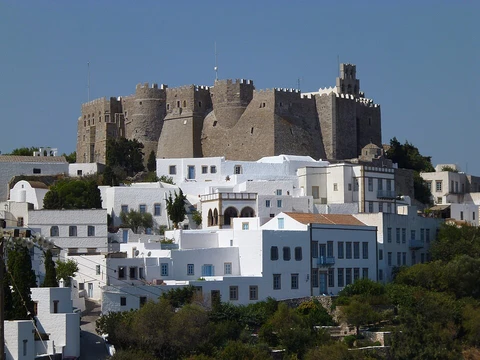
Daphni Monastery
Eleventh-century Byzantine monastery famed for its mosaics and architecture.

The Daphni Monastery is an eleventh-century Byzantine monastery located eleven kilometers northwest of central Athens in the suburb of Chaidari, near the forest of the same name on the Sacred Way to Eleusis. It is one of three monasteries—along with Hosios Loukas and Nea Moni—designated as UNESCO World Heritage Sites for their significant historical and architectural value, particularly as masterpieces of middle Byzantine architecture and for their sumptuous interior gold-ground mosaics.
- Founded
- Late 5th or early 6th century A.D. (first monastery); restored in eleventh–twelfth centuries
Lore & Background
The Daphni Monastery was founded in the late 5th or early 6th century A.D. on the site of the Sanctuary of Apollo. The first monastery was built in the style of a castle with a basilica in the middle, fortified with enclosing walls and small cells. One of the four Ionic columns from the ancient sanctuary was re-used in the monastery, built into the southern wall of the church; another column was removed to London by Thomas Bruce, Earl of Elgin, and is now in the British Museum. This first monastery declined after invasions in the ninth and tenth centuries.
During renewed prosperity in the eleventh and twelfth centuries, the monastery was restored with a new octagonal church, a refectory, and a chapel. The old basilica was demolished except for the enclosing walls and cells, which were incorporated into the new church. Traces of old frescoes suggest Emperor Basil II may have brought workers from Constantinople. The monastery was sacked by Frankish crusaders in 1205, after which it was given to the Cistercian Abbey of Bellevaux, who added a cloister and Gothic twin pointed arches. The Cistercians abandoned the monastery in 1458 after the coming of the Turks.
Reader's Guide
The Daphni Monastery is significant as a key example of middle Byzantine architecture and art, particularly its mosaics from the early Komnenian period (c. 1100). The church's Greek cross-octagon plan and cloisonné masonry exemplify Byzantine design, while the mosaics—especially the Christ Pantocrator in the dome—are considered among the most important and best-preserved from the period. The mosaics reflect iconographic and stylistic conceptions formulated after the iconoclastic crisis by the Church of Constantinople, with a rigid consistency in subject distribution characteristic of Constantinopolitan art. The monastery's history also illustrates the cultural and political shifts in Greece, from ancient Greek sanctuary to Byzantine monastery, then to Cistercian abbey under Frankish rule, and finally abandonment under Ottoman control. Its designation as a UNESCO World Heritage Site alongside Hosios Loukas and Nea Moni underscores its global cultural importance.
Did You Know?
- The name 'Daphni' means 'laurel grove' in modern Greek, derived from Daphneion (Lauretum).
- One of the four Ionic columns from the ancient Sanctuary of Apollo was re-used in the southern wall of the monastery church.
- The Christ Pantocrator mosaic has been described as 'one of the greatest creations in art' and 'the most awe-inspiring and convincing' of all Byzantine Pantokrators.
- The glass tesserae for the mosaics are believed to have been created on site.
Frequently Asked Questions
What is Daphni Monastery?
Daphni Monastery is an eleventh-century Byzantine monastery in the Chaidari suburb of Athens, Greece. It is widely regarded as one of the finest surviving examples of middle Byzantine architecture and is especially celebrated for its lavish gold-ground mosaic decoration.
Where is Daphni Monastery located?
The monastery sits roughly eleven kilometers northwest of central Athens, nestled near a forest that shares its name. It lies close to the ancient Sacred Way that once guided pilgrims on their journey to Eleusis.
Why is Daphni Monastery a UNESCO World Heritage Site?
UNESCO inscribed Daphni as part of a group that also includes Hosios Loukas and Nea Moni, recognizing all three as masterpieces of middle Byzantine building and art. Their sumptuous interior gold-ground mosaics and architectural innovation are the primary grounds for the designation.
What makes Daphni Monastery's mosaics stand out?
The interior mosaics are set against a shimmering gold ground, giving them a luminous, jewel-like quality rarely seen at this scale in Byzantine art. They are considered a high point of the middle Byzantine period and a central reason the site earned World Heritage status.
How old is Daphni Monastery?
The original foundation dates to the late fifth or early sixth century A.D., making the site well over a millennium old. The structure most visitors see today was substantially restored and rebuilt during the eleventh and twelfth centuries, the period when its famous mosaics were laid.
More in World Heritage Sites in Greece 1-24
Spotted an error? Know more?
Reader corrections go straight into our review queue. Suggest an edit · How this site is sourced