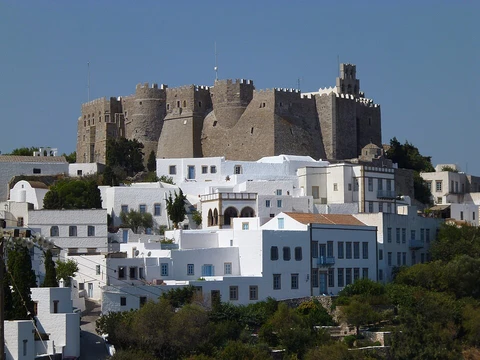
Corfu (city)
Capital of the Ionian Islands with Venetian and British heritage.

Corfu (also known as Kerkyra) is a city and former municipality on the island of Corfu in the Ionian Islands, Greece. Since the 2010 local government reform, it is part of the municipality Central Corfu and Diapontian Islands. It serves as the capital of the municipality, the Corfu regional unit, and the region of the Ionian Islands. The city has played an important role in Greek history since antiquity.
- Population city
- 23,541
- Population municipal unit
- 40,047
- Land area municipal unit
- 41.905 km²
- Ancient name
- Korkyra
- Medieval name
- Koryfó
- World heritage inscription
- 2007
- Notable sieges
- 1537, 1571, 1573, 1716
Lore & Background
The ancient city of Corfu, known as Korkyra, took part in the Battle of Sybota, which was a catalyst for the Peloponnesian War. According to Thucydides, Korkyra was one of the three great naval powers of fifth-century-BC Greece, along with Athens and Corinth. Medieval castles punctuating strategic locations across the city are a legacy of struggles against invasions by pirates and the Ottomans. The city has been known since the Middle Ages as Kastropolis (Castle City) because of its two castles.
From 1386 to 1797, Corfu was ruled by Venetian nobility; much of the city reflects this era, with multi-storied buildings on narrow lanes. The Old Town has clear Venetian influence. The city was subjected to four notable sieges in 1537, 1571, 1573 and 1716, in which the strength of the city defenses asserted itself time after time, mainly because of the effectiveness of the powerful Venetian fortifications. Writer Will Durant claimed that Corfu owed to the Republic of Venice the fact that it was the only part of Greece never conquered by the Ottomans.
In the city, the ruins of the ancient city of Korkyra, also known as Palaiopolis, include ancient temples excavated at the location of the palace of Mon Repos. The temples are: Kardaki Temple, Temple of Artemis, and the Temple of Hera. The Palace of St. Michael and St. George was built between 1819 and 1824, commissioned by Sir Thomas Maitland as Lord High Commissioner of the Ionian Islands. Near Gastouri stands the Pompeian style Achilleion, built for Empress Elizabeth of Austria and purchased in 1907 by German emperor William II.
Reader's Guide
Corfu city is significant as a major tourist attraction and Greek regional centre, with a history stretching from antiquity to the present. Its ancient role as a naval power in the Peloponnesian War, its medieval identity as a fortified castle city, and its long period under Venetian rule (1386–1797) shaped its unique character. The city's Old Town was inscribed on the UNESCO World Heritage List in 2007, recognized as a quintessential example of a fortified maritime city, with Venetian fortifications and a predominantly Neoclassical urban fabric. The city also served as the seat of a Greek and a Roman Catholic archbishop, and housed a university founded in 1823 by Frederick North, 5th Earl of Guilford. Corfu is the only place in Greece where cricket is popular, imported during British rule, and the Hellenic Cricket Federation is based there. The city's climate is hot-summer Mediterranean (Csa), with hot, dry summers and mild, wet winters. The city has a long tradition in the fine arts, exemplified by the Philharmonic Society of Corfu.
Did You Know?
- Corfu is the only part of Greece that, according to writer Will Durant, was never conquered by the Ottomans, owing to the Republic of Venice.
- Maria Desylla-Kapodistria, mayor from 1956 to 1959, was the first female mayor in Greece.
Frequently Asked Questions
What is Corfu (city)?
Corfu (Kerkyra) is the capital city of Greece's Ionian Islands region, situated on the island of Corfu in the Ionian Sea. Since the 2011 administrative reform it falls within the municipality of Central Corfu and Diapontian Islands, where it also serves as the seat of the Corfu regional unit.
When was Corfu (city) inscribed as a UNESCO World Heritage Site?
The Old Town of Corfu received its World Heritage inscription in 2007, recognising the layered urban fabric that blends classical, Venetian, and British architectural traditions.
Why is Corfu (city) historically important?
The city has functioned as a strategic and cultural crossroads since antiquity, absorbing successive layers of Greek, Venetian, and British political and artistic influence. That long succession of rule gave the Ionian Islands a distinctive identity separate from the mainland.
What were the ancient and medieval names of Corfu (city)?
In classical antiquity the Greeks called the settlement Korkyra, and during the medieval period it was known as Koryfó before the modern name Corfu / Kerkyra took hold.
How large is Corfu (city) in terms of population and area?
The city proper is home to roughly 23,500 residents, while the wider municipal unit spans about 42 square kilometres and supports a population close to 40,000.
More in World Heritage Sites in Greece 1-24
Spotted an error? Know more?
Reader corrections go straight into our review queue. Suggest an edit · How this site is sourced