Cave of the Apocalypse
Grotto where St. John received visions for the Book of Revelation.

The Cave of the Apocalypse sits on the island of Patmos, halfway up the mountain on the road connecting the villages of Chóra and Skala. It is the place where St. John of Patmos experienced the visions he later wrote down as the Book of Revelation. Since then, the grotto has served as a Christian pilgrimage site and continues to function as a Greek Orthodox church. In 1999, UNESCO designated the cave and the Monastery of Saint John the Theologian—located at the island’s highest point—as a joint World Heritage Site, recognizing them among Christianity’s most sacred places.
St. John of Patmos, also called John the Revelator, John the Divine, or John the Theologian, is traditionally identified with the Apostle John, though mainstream scholarship does not confirm he was one of Jesus Christ’s twelve disciples. During the 1st century, under the Roman emperor Domitian, early Christians were seen as a strange cult and potential troublemakers for the empire. Many followers of Christ were persecuted and exiled to Patmos. Banishment was a common punishment at the time for refusing to worship the Roman emperor, and St. John was exiled for his Christian preaching. The cave became his refuge, where he received visions of the Earth’s final days, witnessing the destruction of the old world and the creation of a new one as the Holy City of Jerusalem descended from heaven. Christian tradition holds that the rock inside the cave was split, and through three narrow openings—symbolizing the Holy Trinity—John heard a loud voice instructing him to write down what he saw in a book and send it to the seven churches. The site where he received and recorded these visions became known as the Cave of the Apocalypse, signifying the end of the world, and his writings formed the Book of Revelation.
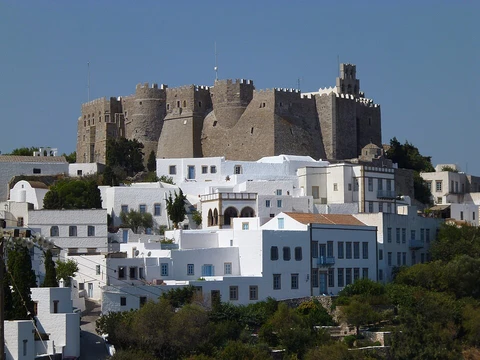
The Monastery of St. John the Theologian, a Greek Orthodox monastery dedicated to the saint, was founded in 1088 and stands at the island’s highest point. That year, Byzantine Emperor Alexios Komnenos gave Patmos as a gift to the soldier and priest John Christodoulos, who built most of the monastery within three years. The structure dominates the island and led to the settlement of the town below, called Chóra.
- Location
- Aegean island of Patmos, between Chóra and Skala
- Religious affiliation
- Greek Orthodox Church
- Unesco status
- World Heritage Site (1999)
- Associated figure
- St. John of Patmos (John the Revelator, John the Divine, John the Theologian)
- Sacred text
- Book of Revelation
- Key feature
- Three narrow openings in the rock symbolizing the Holy Trinity
Lore & Background
St. John of Patmos is traditionally identified with the Apostle John, though mainstream scholarship does not confirm he was one of Jesus Christ's twelve disciples. During the 1st century under Roman rule of Domitian, Christians were persecuted and exiled to the island of Patmos. Banishment was a common punishment for refusing to worship the Roman emperor, and St. John was exiled for his Christian preaching. On the island, he received visions of the final days of Earth, witnessing destruction of the old Earth and the creation of the new Earth as the Holy City of Jerusalem came down from heaven. The cave became a place of refuge for him as he recorded these visions.
Reader's Guide
The Cave of the Apocalypse is significant as the location where St. John of Patmos received and recorded his visions, which became the Book of Revelation in the Bible. Christian tradition holds that the rock inside the cave was shredded, and through three thin openings symbolizing the Holy Trinity, he heard a loud voice instructing him to write down what he saw and send it to the seven churches. The cave's interior features include a hollow portion in the wall believed to be where St. John rested, a natural ledge for his scroll, and a lectern used by Prochorus. In modern times, the cave is a sacred area holding a temple dedicated to St. John, and visitors may touch the three narrow openings, the rock where he sat, and the crevices he used to stand. It is a place of silence and prayer available to the public. The cave's recognition as Orthodox asserts a physical connection to St. John himself, and it remains a popular tourist and pilgrimage site.
Did You Know?
- The cave is located approximately halfway up the mountain on the Aegean island of Patmos, along the road between the villages of Chóra and Skala.
- St. John's faithful disciple and scribe Prochorus, also exiled, helped record the visions in the cave.
- The three thin openings in the rock are said to symbolize the Holy Trinity, through which St. John heard a loud voice.
- In 1999, UNESCO declared the cave a joint World Heritage Site together with the Monastery of Saint John the Theologian.
Frequently Asked Questions
What is the Cave of the Apocalypse and where is it located?
It is a small grotto on the Aegean island of Patmos, set halfway up the mountain along the road linking the villages of Chóra and Skala. The site is traditionally identified as the spot where St. John of Patmos received the divine visions that became the Book of Revelation.
Why is the Cave of the Apocalypse important to Christianity?
The grotto is venerated as the exact place where John the Theologian experienced the prophetic revelations he later recorded in the New Testament. It has continued to serve as a Greek Orthodox church and a pilgrimage destination for nearly two thousand years.
What are the key physical features of the cave?
The most notable element is a set of three narrow openings in the rock face, which the faithful read as a symbol of the Holy Trinity. The enclosed, modest size of the grotto reinforces its character as a place of intimate spiritual encounter.
What is the UNESCO World Heritage status of the Cave of the Apocalypse?
In 1999, UNESCO inscribed the cave together with the Monastery of Saint John the Theologian at Patmos's highest point as a single joint World Heritage Site. The designation recognizes the pair as among the most sacred locations in the history of Christianity.
Who is the Cave of the Apocalypse associated with?
The site is tied to St. John of Patmos, also known as John the Revelator, John the Divine, and John the Theologian. He is the apostle and evangelist credited with authoring the Book of Revelation during his exile on the island.
More in World Heritage Sites in Greece 1-24
Spotted an error? Know more?
Reader corrections go straight into our review queue. Suggest an edit · How this site is sourced