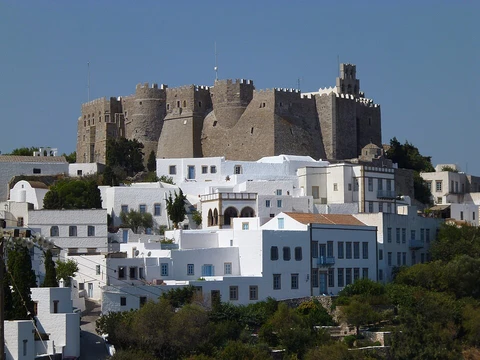
Mount Athos
Eastern Orthodox monastic center on a Greek peninsula.

Mount Athos is a mountain on the Athos peninsula in northeastern Greece, directly on the Aegean Sea. It is an important center of Eastern Orthodox monasticism, governed as an autonomous region by the monastic community under the Ecumenical Patriarch of Constantinople. The mountain and most of the peninsula are closed to women by Greek law and religious tradition.
- Location
- Northeastern Greece, Athos peninsula, Aegean Sea
- Elevation
- 2,033 m (6,670 ft)
- Area
- 335.6 km² (130 sq mi)
- Governance
- Autonomous monastic community under Ecumenical Patriarch of Constantinople
- Unesco inscription
- 1988
- Prohibition
- Women prohibited from entering the monastic community area
Lore & Background
In Greek mythology, Mount Athos was formed when the giant Athos threw a rock at Poseidon during the Gigantomachia; another version says Poseidon buried the giant under the mountain. Homer mentions the mountain in the Iliad. Herodotus records that in 492 BC, Persian commander Mardonius lost many men and 300 ships to a storm near Mount Athos. The peninsula was populated by Pelasgians from Lemnos, with cities including Sane, Kleonai, Thyssos, Olophyxos, and Akrothoon. Xerxes I excavated a canal across the isthmus in 480 BC for his invasion fleet. After Alexander the Great's death, architect Dinocrates proposed carving the entire mountain into a statue of Alexander. Pliny the Elder claimed in 77 AD that inhabitants could live to 400 years by eating viper skin.
Reader's Guide
Mount Athos has been inhabited since ancient times and is known for its long Christian presence and monastic traditions dating back to at least the 9th century during the Byzantine era. According to Athonite tradition, the Virgin Mary blessed the mountain, consecrating it as her garden and barring other women. Monks have been present since at least the 4th century, possibly the 3rd. During Constantine I's reign, both Christians and followers of traditional Greek religion lived there. Under Julian, churches were destroyed; under Theodosius I, pagan temples were destroyed. After the Islamic conquest of Egypt in the 7th century, monks from the Egyptian desert came to Athos. The monastic community was inscribed on the UNESCO World Heritage List in 1988 due to its religious importance, well-preserved monastery architecture, and preserved natural environment. The peninsula's seas are dangerous, with ancient fleet disasters recorded by Herodotus and in 411 BC. The mountain hosts extensive Byzantine-era footpaths, diverse flora including 35 endemic plant species, 350 mushroom species, and fauna such as grey wolves, golden eagles, and Mediterranean monk seals.
Did You Know?
- Mount Athos is also called Agio Oros, meaning 'Holy Mountain'.
- The peninsula is the easternmost 'leg' of the Chalkidiki peninsula in central Macedonia.
- At least 35 plant species are endemic to Mount Athos, including Viola athois.
- Herodotus recorded that Persian commander Mardonius lost 300 ships near Mount Athos in 492 BC.
More in World Heritage Sites in Greece 1-24
Spotted an error? Know more?
Reader corrections go straight into our review queue. Suggest an edit · How this site is sourced