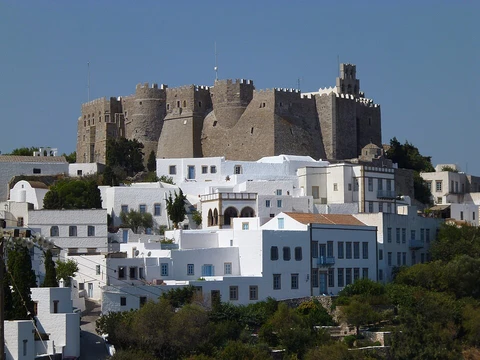
Monastery of Saint John the Theologian
Greek Orthodox monastery founded in 1088 on Patmos.

The Monastery of Saint John the Theologian, also known as the Monastery of Saint John the Divine, is a Greek Orthodox institution on the island of Patmos, in the town of Chora. It was established in 1088 and takes its name from Saint John of Patmos, who, according to Christian tradition, received the visions of the Book of Revelation while living on the island. From its earliest days, the monastery has served both as a destination for pilgrims and as a center for Greek Orthodox worship and scholarship. A distinctive feature is that the surrounding community of Chora was built around the monastery’s fortifications from the outset, integrating the settlement with the religious complex. Early Christian liturgical practices continue to be observed within its walls. In 1999, UNESCO recognized the monastery, along with the town of Chora and the nearby Cave of the Apocalypse, as a World Heritage Site, citing its sacred importance, continuous architectural development, and the exceptional preservation of ancient Christian customs.
The monastery’s founding dates to 1088, when Byzantine Emperor Alexios I Komnenos granted the island of Patmos to a monk named Christodoulos. Most of the structure was completed by Christodoulos within three years. He gave the exterior heavy fortifications as protection against pirates and the Seljuk Turks. The oldest surviving sections are the main church, or Katholikón, and the refectory, both from the 11th century. The Katholikón follows the typical Byzantine cross-in-square plan with a central dome. Its floor features elaborate marble opus sectile work, and the walls are decorated with medieval frescoes and paintings. A two-story arcade was added to the south side of the monastery in 1698. The library holds at least 330 manuscripts, 267 of which are on parchment, including 82 New Testament manuscripts (such as minuscules 1160–1181, 1385–1389, 1899, 1901, 1966, 2001–2002, 2080–2081, 2297, 2464–2468, 2639, 2758, 2504, and 2639, as well as lectionaries). As of 2012, the monastery was home to 40 monks.
- Founded
- 1088
- Founder
- Monk Christodoulos
- Location
- Chora, island of Patmos
- Denomination
- Greek Orthodox
- World heritage status
- 1999
- Manuscripts housed
- at least 330
Lore & Background
In 1088, Byzantine Emperor Alexios I Komnenos gave the island of Patmos to a monk named Christodoulos. The greater part of the monastery was completed by Christodoulos three years later. He heavily fortified the exterior because of the threats of piracy and Seljuk Turks. The oldest parts of the monastery are the Katholikón (main church) and the refectory, dating from the 11th century. The Katholikón has the typical shape of a Byzantine church, with a domed cross-in-square style. The floor is elaborately carved out of marble in opus sectile style, and has wall paintings and frescoes dating to the Middle Ages. A two-storied arcade on the south side of the monastery was built in 1698.
Reader's Guide
The Monastery of Saint John the Theologian is significant for its uninterrupted architectural evolution and the exceptional preservation of early Christian customs. Religious ceremonies that date back to the early Christian period are still practiced within the monastery today. The monastery is unique in that it integrated from its founding the surrounding community of Chora, which was built around its fortifications. Because of its sacred significance, the monastery was declared a UNESCO World Heritage Site in 1999, along with the town of Chora and the nearby Cave of the Apocalypse. The library houses at least 330 manuscripts, including 82 manuscripts of the New Testament. As of 2012, 40 monks reside at the monastery. Among its relics is the skull of Saint Thomas the Apostle.
Did You Know?
- The monastery was founded in 1088 by Byzantine Emperor Alexios I Komnenos granting the island to monk Christodoulos.
- The Katholikón (main church) and refectory date from the 11th century.
- The library contains at least 330 manuscripts, including 82 New Testament manuscripts.
More in World Heritage Sites in Greece 1-24
Spotted an error? Know more?
Reader corrections go straight into our review queue. Suggest an edit · How this site is sourced