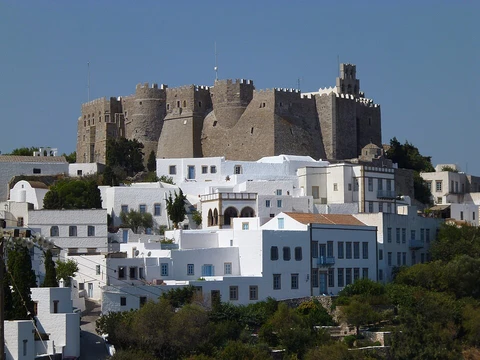
Hosios Loukas
A historic walled monastery and UNESCO World Heritage site in Greece.

Hosios Loukas, a walled monastery near Distomo in Boeotia, Greece, was founded in the mid-10th century and is a key example of Middle Byzantine architecture and art. Since 1990, it has been a UNESCO World Heritage Site, grouped with Nea Moni and Daphnion. The monastery honors the hermit known as Hosios (Venerable) Luke of Steiris, distinct from the Evangelist Luke, and his relics remain there.
The monastery sits on Mount Helicon’s slopes. Luke, a hermit who died on 7 February 953, predicted the conquest of Crete by Emperor Romanos—though it’s unclear if he meant Romanos I or Romanos II, under whom Nicephorus Phocas actually retook the island. The Church of the Theotokos (Panagia) was likely built during Romanos II’s reign (959–963). The main shrine is Luke’s tomb, originally in the vault but later placed where the two churches meet. The monastery’s wealth came from the belief that Luke’s relics exuded myron, a perfumed oil that healed; pilgrims slept by the tomb for incubation healing. Mosaics near the tomb show Luke and hegumen Philotheos offering a model of the new church to the saint. In the late 11th century, the wandering holy fool Nicholas the Pilgrim, a native of Steiris, lived at the monastery before being expelled for his unusual behavior. In 1206, under the Latin Empire, legate Benedict of Porto gave the monastery to the canons of the Holy Sepulchre.
The oldest church in the complex, Hosios Loukas, is the only 10th-century church in mainland Greece with a confirmed date. Its centralized, parallelogram shape is the earliest cross-in-square plan in the country, closely modeled on Constantinople’s Lips Monastery. The walls use opus mixtum (brick, stone, marble) with pseudo-kufic patterns. It adjoins a larger Katholikon, dated to around 1011–12, an early example of a domed-octagon church, though not necessarily the earliest surviving one. Eight piers surround the naos, and the hemispherical dome (without a drum) rests on four squinches transitioning from an octagonal base to a square below. Galleries and chapels surround the main cube.
Hosios Loukas is the largest of three surviving Middle Byzantine monasteries in Greece, differing from Daphnion and Nea Moni by being dedicated to a single military saint.
- Founded
- mid-10th century
- Location
- near Distomo, Boeotia, Greece
- Type
- monastery
- Hermit
- Venerable Luke of Steiris (died 7 February 953)
- Unesco listing
- 1990 (with Nea Moni and Daphnion)
- Known for
- Middle Byzantine architecture, mosaics, and healing cult of Saint Luke
Lore & Background
The monastery of Hosios Loukas was founded in the early 10th century AD by the hermit Venerable Luke of Steiris, who died on 7 February 953. He is famous for having predicted the conquest of Crete by Emperor Romanos, though it was unclear if he referred to Romanos I or Romanos II; the island was actually reconquered by Nicephorus Phocas under Romanos II. It is believed that during the latter's reign (959–963) the monastery's Church of the Theotokos (Panagia) was constructed. The main shrine is the tomb of St. Luke, originally in the vault but later placed at the juncture of the two churches. The monastery derived wealth from the relics of St. Luke, which were said to exude myron, a perfumed oil that produced healing miracles. Pilgrims hoping for miracles would sleep by the tomb for incubation healing. In the late 11th century, the wandering holy fool Nicholas the Pilgrim, a native of Steiris, lived at the monastery before being expelled for his unusual behavior.
Reader's Guide
Hosios Loukas is the largest of three monasteries surviving from the Middle Byzantine period in Greece. Its Katholikon is the earliest extant domed-octagon church, containing the best preserved complex of mosaics from the Macedonian Renaissance, though the original image of Christ Pantocrator in the dome is missing. The burial crypt beneath the Katholikon has the most complete programme of wall paintings surviving from the Middle Byzantine period, according to C.L. Connor. The monastery's decoration, including colored marble facings and window grilles, gives the best impression available anywhere today of the character of a church interior in the first centuries after the end of Iconoclasm. The healing cult of Saint Luke, centered on his tomb, attracted pilgrims who practiced incubation—sleeping near the tomb—to receive healing. The monastery's significance lies in its architectural innovation, artistic preservation, and role as a pilgrimage site.
Did You Know?
- The Katholikon is the earliest extant domed-octagon church, with eight piers arranged around the perimeter of the naos.
- The crypt frescoes were cleaned in the 1960s by the Greek Archaeological Service, revealing their remarkably well preserved state.
- Saint Nicholas the Pilgrim, a local shepherd, lived in the monastery in the second half of the eleventh century until he was expelled due to abnormal behavior.
More in World Heritage Sites in Greece 1-24
Spotted an error? Know more?
Reader corrections go straight into our review queue. Suggest an edit · How this site is sourced