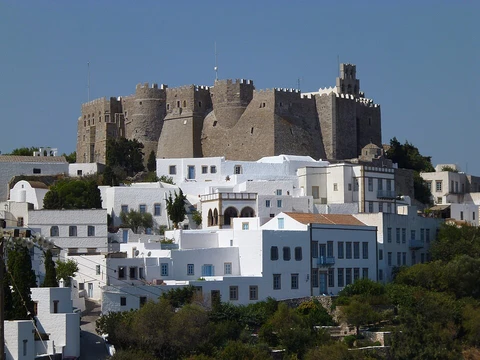
Heraion of Samos
Sanctuary of Hera on Samos, site of colossal Ionic temples.

The Heraion of Samos, a major sanctuary for the goddess Hera, sat about 6 kilometers southwest of the ancient city of Samos (now Pythagoreion) on the Greek island of Samos. It occupied a low, marshy floodplain near the mouth of the Imbrasos River. The late Archaic temple there was the first enormous, free-standing Ionic temple ever built. In 1992, the temple ruins and the nearby archaeological site of Pythagoreion became a UNESCO World Heritage Site, honoring both their architectural significance and the naval and commercial strength of Samos in the Archaic period.
The sanctuary’s central myth held that Hera was born under a lygos tree (Vitex agnus-castus, or chaste-tree). During the annual Samian festival called the Toneia, or “binding,” the cult statue of Hera was ritually tied with lygos branches, then carried to the sea for washing. The tree appeared on Samian coins even in Roman times, and the traveler Pausanias noted it still stood in the sanctuary. Literary sources offer little detail about the temple. Herodotus is the most important, repeatedly calling it “the largest of all the temples that we know of” and listing it among Samos’s three great engineering marvels, alongside the Tunnel of Eupalinos and the harbor mole at Pythagoreion. Most other references are scattered and come from works written long after the sanctuary’s prime. Pausanias, whose *Description of Greece* is a key source for mainland sites, never visited Samos.
Archaeology reveals that the area was settled in the Early Bronze Age, and cult activity at the altar may have begun in the late Mycenaean period. The first temple of Hera went up in the 8th century BC. The sanctuary’s golden age started in the late 7th century with a first wave of monumental building: the Hekatompedos II temple, the south stoa, two colossal kouroi, and the Sacred Way linking the sanctuary to the city by land. In the second quarter of the 6th century BC, a second, even larger wave of construction brought the monumental altar, the North and South Buildings, and the Rhoikos Temple. This was soon followed by a third phase, which expanded the North Building and began work on an even larger temple to replace the Rhoikos one. This peak coincided with Samos’s rise as a major Aegean power, culminating under the tyrant Polycrates.
- Location
- Samos, Greece
- Period of activity
- c. 1700 BC to AD 391
- Unesco designation
- 1992
- Key architectural phases
- Hekatompedos, Rhoikos Temple, Polycrates Temple
- Associated figures
- Rhoikos, Theodoros, Polycrates
Lore & Background
The sanctuary's hub was the altar of Hera and the successive temples opposite it, along with other temples, treasuries, stoas, a sacred way, and countless votive offerings. The Sacred Way, laid out around 600 BC, ran from the city to the sanctuary and was repaved in the 3rd century AD. The first temple (Hekatompedos I) was an 8th-century BC mudbrick structure; its rebuild (Hekatompedos II) was limestone, about 33 m long. The Rhoikos Temple, about 100 m by 50 m, was dipteral with unusual torus bases; it stood only about a decade before destruction around 550 BC, possibly by earthquake or instability. The Polycrates Temple, 55.2 m by 108.6 m, was never wholly finished; its foundations were laid in the late 6th century BC, with colonnade foundations around 500 BC. Strabo described it as an open-air picture gallery with many statues.
Reader's Guide
The Heraion of Samos holds significance as the site of the first gigantic free-standing Ionic temples, marking a pivotal development in monumental Ionic architecture. Its successive temples—the Hekatompedos, the Rhoikos Temple, and the Polycrates Temple—demonstrate a rapid escalation in scale and ambition during the Archaic period, when Samos was a major Aegean power. The Rhoikos Temple, though short-lived, is considered a prototype for later colossal Ionian temples such as the Temple of Artemis at Ephesus. The sanctuary's long history, from the 8th century BC to the end of pagan worship in AD 391, reflects changing religious, political, and architectural currents. Its UNESCO World Heritage designation underscores its exceptional architecture and its testimony to Samian mercantile and naval strength. The site's integration of a sacred way, monumental altar, and numerous votive offerings illustrates the complex organization of a major Greek sanctuary. The eventual abandonment of the temple and its reuse as a quarry and church site mirror the broader transition from pagan to Christian and Byzantine eras.
Did You Know?
- The cult image of Hera was ceremonially bound with lygos branches during the annual Toneia festival.
- The Rhoikos Temple stood for only about a decade before being destroyed around 550 BC.
- The Polycrates Temple was never wholly finished, with construction continuing into the Roman period.
More in World Heritage Sites in Greece 1-24
Spotted an error? Know more?
Reader corrections go straight into our review queue. Suggest an edit · How this site is sourced