VB 10
A dim red dwarf and the primary standard for M8V spectral class.

Tyrogthekreeper ( talk ) · CC BY-SA 3.0
VB 10, also called Van Biesbroeck's star, is a faint red dwarf in the constellation Aquila. It is the smaller member of a binary system and serves as the main reference for the M8V spectral class. From its discovery in 1944 until 1982, it held the record as the least luminous and least massive star known, until LHS 2924 was found to be dimmer. Despite being relatively nearby—about 19 light-years away—it shines at a dim magnitude 17, making it hard to spot with amateur telescopes because it tends to be lost in the glare of its brighter companion.
The star was discovered in 1944 by George Van Biesbroeck using the 82-inch Otto Struve reflector at McDonald Observatory. He found it while scanning the area around the high-proper-motion red dwarf Gliese 752 (Wolf 1055) for companions. Wolf 1055 had been cataloged 25 years earlier by Max Wolf. Van Biesbroeck listed it as VB 10 in his 1961 star catalog, and later astronomers began calling it Van Biesbroeck's star. Earlier surveys missed it because it is so dim and so close to its much brighter primary, even though its large parallax and proper motion should have made it stand out on time-lapse photographic plates.
VB 10 has an extremely low luminosity, with an absolute magnitude near 19 and an apparent magnitude of about 17.3 (slightly variable). If it replaced the Sun at the center of the solar system, it would appear as bright as the full moon in Earth's sky—magnitude −12.87. Its mass, roughly 0.08 times that of the Sun, sits right at the lower boundary needed for nuclear fusion, making it a star rather than a brown dwarf. At discovery, it was the lowest-mass star known, surpassing the previous record holder, Wolf 359. It also moves rapidly across the sky, with a proper motion exceeding one arcsecond per year.
VB 10 is a variable star, cataloged as V1298 Aquilae, and belongs to the UV Ceti class, meaning it frequently flares. The Hubble Space Telescope studied its dynamics in the mid-1990s. Although its surface temperature is a low 2,600 K, it produces violent flares reaching up to 100,000 K—a surprise to astronomers, who had assumed such low-mass red dwarfs lacked the magnetic fields needed for flares, since they were thought to have no radiative zone to power a dynamo. The flares suggest an unknown process allows their fully convective cores to generate strong magnetic fields.
- Discovery year
- 1944
- Discoverer
- George Van Biesbroeck
- Constellation
- Aquila
- Distance
- 19 light-years (5.8 parsecs)
- Apparent magnitude
- 17.3 (somewhat variable)
- Absolute magnitude
- nearly 19
- Spectral class
- M8V
Lore & Background
VB 10 was discovered in 1944 by astronomer George Van Biesbroeck using the 82-inch Otto Struve reflector telescope at the McDonald Observatory. He found it while surveying the telescopic field of view of the high-proper-motion red dwarf Gliese 752 (Wolf 1055) for companions. Wolf 1055 had been catalogued 25 years earlier by German astronomer Max Wolf. The star was designated VB 10 in the 1961 publication of Van Biesbroeck's star catalog, and later astronomers began referring to it as Van Biesbroeck's star. Because it is so dim and so close to its much brighter primary star, earlier astronomical surveys missed it even though its large parallax and proper motion should have made it stand out on photographic plates.
VB 10 has an extremely low luminosity, with a baseline absolute magnitude of nearly 19 and an apparent magnitude of 17.3. If placed at the center of the solar system instead of the Sun, it would shine at magnitude −12.87—approximately the same as the full moon. Its mass, at 0.08 solar mass, is right at the lower limit needed to initiate nuclear fusion and be a star rather than a brown dwarf. At the time of its discovery it was the lowest-mass star known, surpassing the previous record holder Wolf 359. VB 10 also exhibits very large proper motion, moving more than one arcsecond per year through the sky.
VB 10 is a variable star identified in the General Catalogue of Variable Stars as V1298 Aquilae. It is a UV Ceti-type variable star known to be subject to frequent flare events. Its dynamics were studied from the Hubble Space Telescope in the mid-1990s. Although VB 10 has a normal low surface temperature of 2,600 K, it was found to produce violent flares of up to 100,000 K, surprising astronomers who had assumed low-mass red dwarfs would have insignificant or non-existent magnetic fields. The detection of solar flares indicates some unknown process allows the solely convective cores of low-mass stars to produce sufficient magnetic fields for such outbursts.
Reader's Guide
VB 10 holds significance as a benchmark for the lowest-mass stars and as the primary spectral standard for the M8V class. Its discovery in 1944 pushed the known lower limit of stellar mass and luminosity, a record it held for nearly four decades. The star's extreme dimness, despite its proximity at 19 light-years, illustrates the challenges of detecting very low-luminosity objects even when they are nearby. Its role as the secondary in a binary system with Gliese 752 highlights how such companions can be overlooked by surveys. The detection of powerful flares reaching 100,000 K from a star with a surface temperature of only 2,600 K challenged existing models of magnetic field generation in fully convective stars, suggesting unknown processes at work. The disputed claim of a planet, VB 10b, announced in 2009 using astrometry from the Hale Telescope, was not confirmed by subsequent Doppler spectroscopy; the claimants noted that those measurements only ruled out planets more massive than three Jupiter masses, while the original best-fit mass was six Jupiter masses. By 2016, it was suspected that an asymmetric debris disk signal had been mistaken for the planet. This places VB 10 in a history of astrometric exoplanet claims that were later refuted.
Did You Know?
- VB 10 was the least luminous and least massive known star from its discovery in 1944 until 1982.
- It is the primary standard for the M8V spectral class.
- Despite a surface temperature of 2,600 K, VB 10 produces violent flares of up to 100,000 K.
- A claimed planet, VB 10b, announced in 2009, was not confirmed by later Doppler spectroscopy.
Discovery & Historical Significance
In 1944, astronomer George Van Biesbroeck made a find that would reshape the known boundaries of stellar physics. Working with the 82-inch Otto Struve reflector at McDonald Observatory, he was scanning the field around the high-proper-motion red dwarf Wolf 1055—catalogued a quarter-century earlier by Max Wolf—searching for faint companions. Among the dim smudges on his photographic plates, he identified a remarkably faint object that would come to bear his initials. Formally designated VB 10 in the 1961 publication of his star catalog, the object was so close to the glare of its much brighter primary that earlier surveys had overlooked it, despite its large parallax and proper motion making it a candidate for detection on comparison plates. From the moment of its identification, VB 10 held the record as the least luminous and least massive star known to science. That distinction endured for nearly four decades, until 1982, when LHS 2924 was demonstrated to be even fainter. Beyond its record-breaking dimness, VB 10 also serves as the primary reference standard for the M8V spectral class, anchoring an entire category of stellar classification to a single, elusive point of light in the constellation Aquila.
A Star at the Edge of Fusion
At roughly 0.08 solar masses, VB 10 sits precisely at the theoretical threshold below which a celestial object cannot sustain the internal pressures and temperatures required for hydrogen fusion. In other words, it is the faintest possible thing that still qualifies as a star rather than a brown dwarf. Before its discovery, the record for the lowest-mass known star belonged to Wolf 359 at 0.09 solar masses, but VB 10 pushed that boundary lower and held the title for nearly four decades. Its luminosity is correspondingly extreme: an absolute magnitude approaching 19 and an apparent magnitude of about 17.3, which means that even though it sits a mere 19 light-years (5.8 parsecs) from Earth, it is far too faint for most amateur telescopes to isolate from the glare of its brighter companion. A striking thought experiment illustrates just how dim it is—if VB 10 replaced the Sun at the center of our solar system, its light on Earth's sky would register at roughly magnitude −12.87, comparable to the full Moon. Despite its small size, the star traverses the sky at an unusually rapid proper motion, exceeding one arcsecond per year as observed from Earth.
Defying Expectations: A Flaring Red Dwarf
When the Hubble Space Telescope turned its gaze toward VB 10 in the mid-1990s, astronomers expected to observe a quiet, cool object with a surface temperature of about 2,600 kelvin. What they found instead was a star capable of erupting in violent flares that briefly reached temperatures as high as 100,000 kelvin. VB 10 is catalogued as V1298 Aquilae in the General Catalogue of Variable Stars and classified as a UV Ceti-type variable, meaning it is subject to frequent and dramatic outbursts. This discovery struck at a core assumption in stellar physics. It had long been believed that low-mass red dwarfs possessed negligible or entirely absent magnetic fields, because they lack the radiative zone just outside the core that drives the dynamo mechanism in Sun-like stars. Their interiors are thought to be wholly convective, which should preclude the generation of strong magnetic activity. Yet VB 10's flares proved that some as-yet-unidentified process within these solely convective cores can produce magnetic fields powerful enough to fuel spectacular outbursts, forcing a rethinking of how magnetism operates in the smallest stars.
The Ghost of a Planet
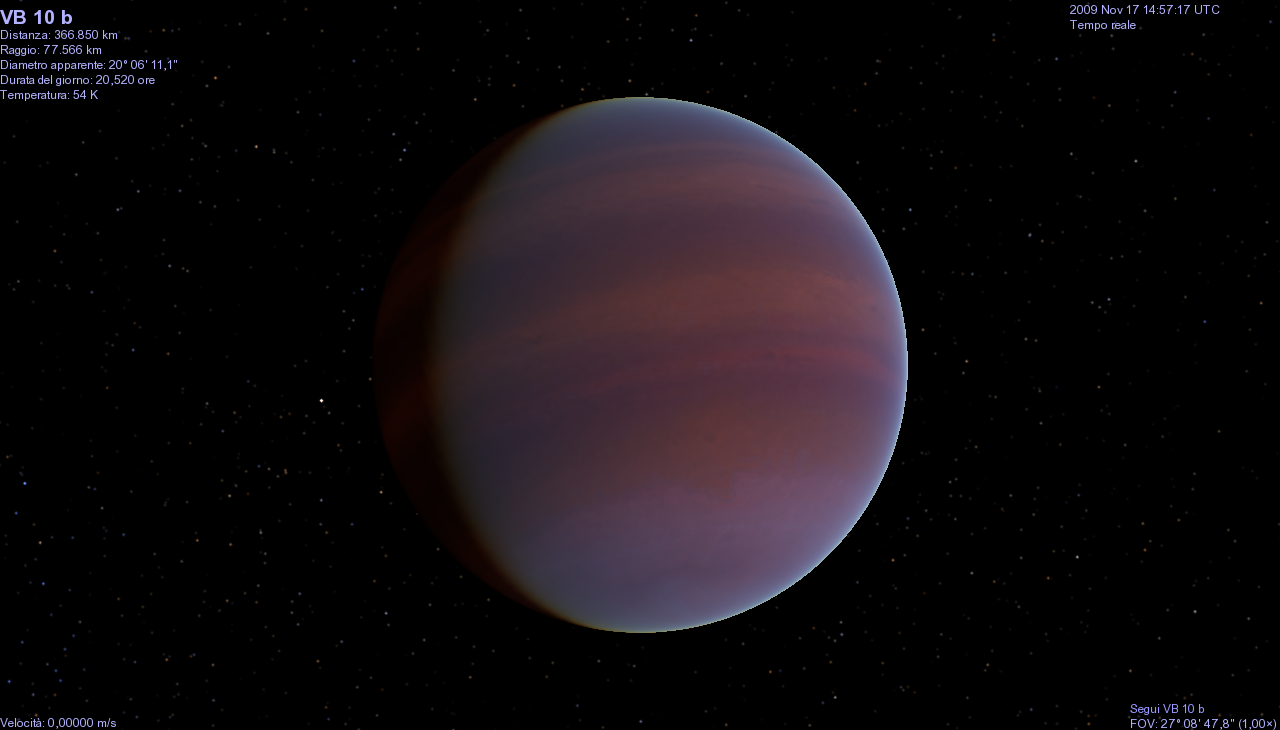
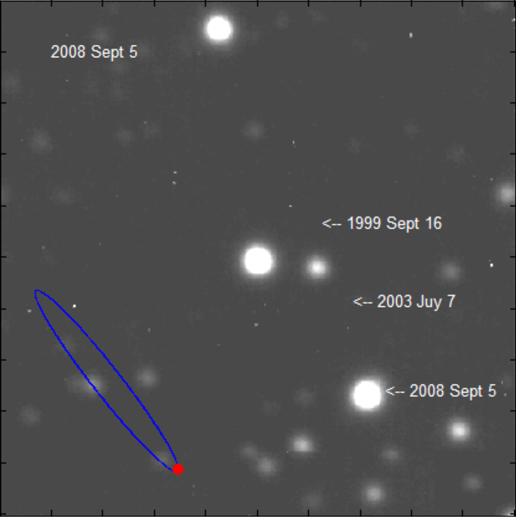
In May 2009, a team from NASA's Jet Propulsion Laboratory announced what they believed was the first evidence of a planet orbiting one of the smallest known stars. Using the 200-inch Hale Telescope at Palomar Observatory and the astrometric method, they reported a companion they designated VB 10b, with a claimed mass of six Jupiter masses and an orbital period of roughly 270 days. The announcement generated excitement, but the claim did not survive scrutiny. Follow-up observations employing Doppler spectroscopy failed to detect the radial velocity wobbles that a planet of that mass should impart to such a low-mass star. The original claimants acknowledged that the Doppler results only excluded planets heavier than three Jupiter masses—half the best-fit mass they had reported—leaving a narrow window of ambiguity. Nevertheless, the episode became another entry in a long catalogue of astrometric planet detections that were later refuted. By 2016, the prevailing suspicion was that an asymmetric debris disk signal had been misinterpreted as the signature of a long-period planet, leaving VB 10 once again as a solitary, dim red dwarf with no confirmed planetary companion.
Gallery
More in Variable Stars, Part 4 1-24
Spotted an error? Know more?
Reader corrections go straight into our review queue. Suggest an edit · How this site is sourced