10 Aquilae
A faint Ap star reclassified from α2 CVn to rapidly oscillating Ap.

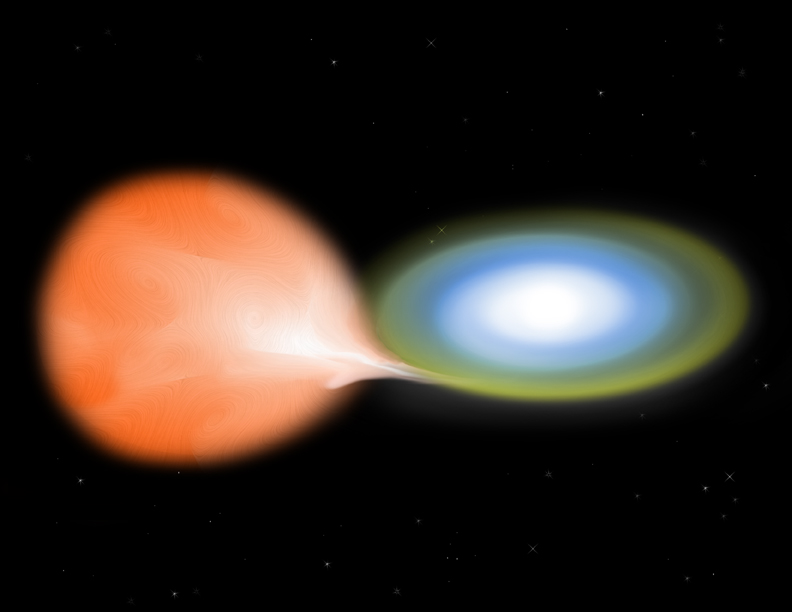
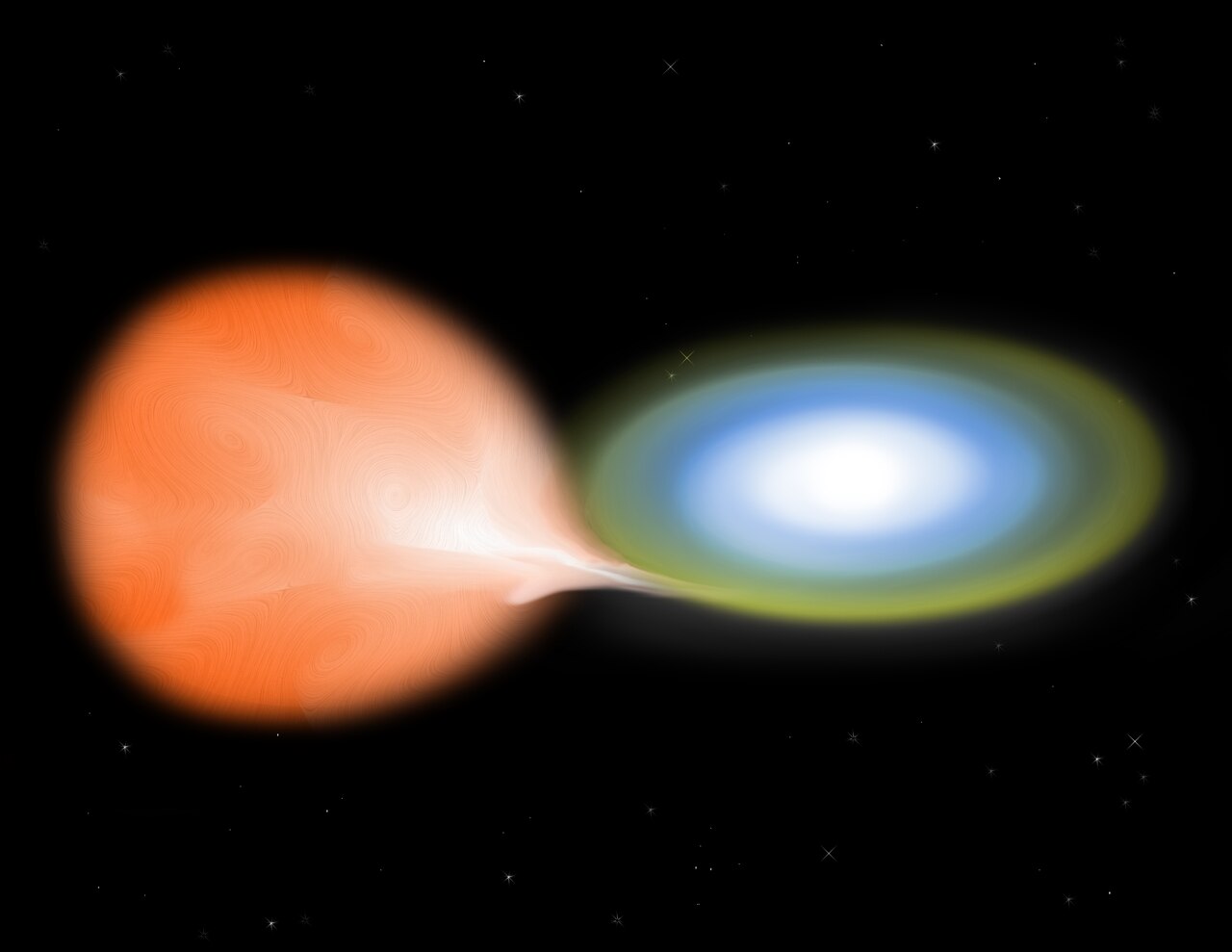
(Illustration) NASA/CXC/M.Weiss · Public domain
10 Aquilae, also known by its Flamsteed designation 10 Aql, is a star located in the equatorial constellation Aquila. With an apparent visual magnitude of 5.9, it is a faint star that can just be glimpsed without a telescope under sufficiently dark skies. Its brightness is reduced by 0.17 in visual magnitude due to extinction from interstellar gas and dust. Based on an annual parallax shift of 13.45 milliarcseconds, the star lies roughly 240 light-years away.
The star’s outer envelope has an effective temperature of 7,550 K, giving it the yellow-white glow characteristic of an F-type star. It is a chemically peculiar star of the Ap type, as indicated by the 'p' in its stellar classification. In 1973, 10 Aql was described as a variable star, with a suggested period of six days. Its small amplitude, period, chemical peculiarity, and position on the Hertzsprung–Russell diagram suggested it might be an α² Canum Venaticorum variable, and it was classified as such in the General Catalogue of Variable Stars, receiving the variable star designation V1286 Aquilae. However, later studies found the six-day period to be spurious, instead revealing several very short pulsation periods: 11.6, 12.0, and 13.4 minutes. This indicated that 10 Aql belongs to the newly recognized class of rapidly oscillating Ap stars.
- Flamsteed designation
- 10 Aquilae
- Constellation
- Aquila
- Apparent visual magnitude
- 5.9
- Parallax
- 13.45 mas
- Distance
- ~240 ly
- Effective temperature
- 7,550 K
- Stellar classification
- Ap star
Lore & Background
10 Aquilae was described as a variable star in 1973, with a suggested period of six days. Its small amplitude, period, chemical peculiarity, and position in the H–R diagram indicated it might be an α2 Canum Venaticorum variable, and it was given that classification in the General Catalogue of Variable Stars, along with the variable star designation V1286 Aquilae. Later studies showed the six-day period was spurious, and instead several very short pulsation periods were found: 11.6, 12.0, and 13.4 minutes. This indicated that 10 Aquilae was a member of the new rapidly oscillating Ap star class.
The star's outer envelope has an effective temperature of 7,550 K, giving it the yellow-white hued glow of an F-type star. Its brightness is diminished by 0.17 in visual magnitude from extinction caused by interstellar gas and dust. Based on an annual parallax shift of 13.45 mas, the distance to this star is around 240 light-years.
Reader's Guide
10 Aquilae holds significance as an early example of a star whose classification shifted from a suspected α2 Canum Venaticorum variable to a rapidly oscillating Ap star, a class that was newly recognized at the time of the later studies. Its history illustrates the evolving understanding of variable star types, where initial period estimates can be overturned by more precise observations. The discovery of very short pulsation periods—11.6, 12.0, and 13.4 minutes—rather than the originally proposed six-day period, placed it among a group of stars that pulsate in rapid, low-amplitude modes. As a chemically peculiar Ap star, it also contributes to the study of stellar magnetic fields and abundance anomalies. The star's legacy lies in its role in the refinement of variable star classification, demonstrating how careful photometric monitoring can reveal fundamentally different pulsation behaviors. Its variable star designation V1286 Aquilae remains in use, and the star continues to be of interest for studies of rapid oscillations in chemically peculiar stars.
Did You Know?
- 10 Aquilae has an apparent visual magnitude of 5.9, just visible to the naked eye in dark skies.
- The star was initially thought to have a six-day period, later found to be spurious.
- Three very short pulsation periods were identified: 11.6, 12.0, and 13.4 minutes.
Nomenclature & Cultural Heritage
Eta Aquilae carries one of the most layered naming histories in the night sky. Its Bayer designation, η Aquilae (abbreviated Eta Aql or η Aql), places it among the brighter stars of the eagle constellation Aquila. For centuries it belonged to the now-obsolete constellation Antinous, shared with five other Aquila stars. The name traces even deeper: an Akkadian antecedent called Pagru, meaning the corpse or dead man, appears in the ancient MUL.APIN star catalogue. The IAU Working Group on Star Names formally adopted Pagru for the primary component on 18 June 2026, while assigning the name Antinous to θ Aquilae A. In Chinese astronomy, the star is the fourth member of the asterism Tiān Fú (Celestial Drumstick), which also includes θ Aql, 62 Aql, and 58 Aql. Arabic tradition grouped it with δ Aql and θ Aql as Al Mizān, the Scale-beam, with η Aql specifically designated Al Mizān II in the Technical Memorandum 33-507 catalogue.
The Triple System Architecture
Pagru is not a single star but a gravitationally bound triple system. The dominant component, η Aql A, is so luminous that it overwhelms the combined light of its two companions and sets the tone of the system's spectrum. An ultraviolet excess in the spectral energy distribution revealed a faint, hot companion, η Aql B, whose light has been modeled as a B8.9 V star—though the fractional spectral type is purely a mathematical artifact of the fitting procedure rather than evidence of intermediate features. A 2022 radial-velocity study failed to produce a clean orbital solution for this inner pair, hinting that the orbit may be viewed nearly face-on or simply very large. By 2024, archival observations had confirmed a radial-velocity shift consistent with roughly a 50-year period, though it remained unclear which companion drove the signal. The outermost member sits at an angular separation of 0.7 arcseconds, a projected distance of about 191 astronomical units. Hubble Space Telescope fine-guidance-sensor data showed positional shifts of 4.1 degrees over 7.5 years, implying an orbital period of at least 659 years and confirming the companion is physically bound.
Cepheid Pulsation & Stellar Evolution
First identified as a variable by Edward Pigott in 1784, the primary star of Pagru is a Classical Cepheid whose brightness swells and contracts over a 7.177-day cycle, shifting between apparent magnitudes 3.49 and 4.3. Together with Delta Cephei, Zeta Geminorum, and Beta Doradus, it ranks among the handful of Cepheids whose pulsation is visible to the unaided eye. The star is roughly 100 to 200 million years old, having exhausted the hydrogen in its core and swollen into a supergiant with a baseline classification of F6 Iab. During each pulsation the spectral type drifts between F6.5 Ib and G2 Ib. In solar terms the numbers are staggering: about six times the Sun's mass, 52 times its radius, and 2,850 times its luminosity, all radiated from an outer envelope at an effective temperature of 5,700 K that lends the star a warm yellow-white glow. The radius itself changes by roughly 4.59 million kilometres each cycle. Pagru also moves through its local neighbourhood at a notably high peculiar velocity of 16.7 ± 6.9 km/s.
Observational Legacy & Modern Measurements
Pagru's story spans nearly three centuries of improving measurement. Edward Pigott's 1784 discovery of its periodic brightness changes opened a window into Cepheid physics that astronomers are still refining. In the modern era, the Gaia spacecraft's third data release (DR3) supplied a parallax-based distance of approximately 272 parsecs, or 890 light-years, anchoring the star's position in three-dimensional space. At that range, interstellar dust dims its apparent brightness by 0.74 magnitudes—a correction that must be applied before any intrinsic property can be assessed. The 2022 and 2024 radial-velocity studies, combined with Hubble fine-guidance-sensor tracking, pieced together the architecture of the triple system and constrained the outer companion's orbital period to a minimum of 659 years. The IAU's 2026 adoption of the name Pagru for the primary component marks a symbolic closing of a loop that began with Akkadian sky-watchers recording the dead man in MUL.APIN, linking ancient observation to contemporary astrometry.
Gallery
Frequently Asked Questions
What is 10 Aquilae?
10 Aquilae is a faint variable star in the constellation Aquila, listed under its Flamsteed designation 10 Aql. At an apparent visual magnitude of 5.9, it sits right at the limit of naked-eye visibility on truly dark nights.
What type of variable star is 10 Aquilae?
It is a rapidly oscillating Ap (RoAp) star, showing small periodic brightness pulsations driven by magnetic fields in its chemically peculiar atmosphere. It was formerly catalogued as an α2 Canum Venaticorum type before being reclassified into the RoAp category.
How far is 10 Aquilae from Earth?
Its measured parallax of 13.45 milliarcseconds places it at roughly 240 light-years. Interstellar gas and dust along the line of sight further dim it by about 0.17 magnitudes beyond its intrinsic brightness.
What color and temperature does 10 Aquilae have?
Its photosphere radiates at an effective temperature of about 7,550 K, which puts it squarely in the F spectral class. That gives the star a yellow-white glow rather than the blue-white hue of hotter types.
Why is 10 Aquilae interesting to variable star observers?
As a faint Ap star exhibiting rapid oscillations, it serves as a natural laboratory for studying how magnetic fields and chemical peculiarities drive small-amplitude pulsations in stellar envelopes. Its reclassification from α2 CVn to RoAp also illustrates how our understanding of these subtle variability mechanisms is still evolving.
More in Variable Stars, Part 4 1-24
Spotted an error? Know more?
Reader corrections go straight into our review queue. Suggest an edit · How this site is sourced