21 Aquilae
A blue-white B-type star, probable Alpha2 CVn variable.

Jacques Callot · Public domain
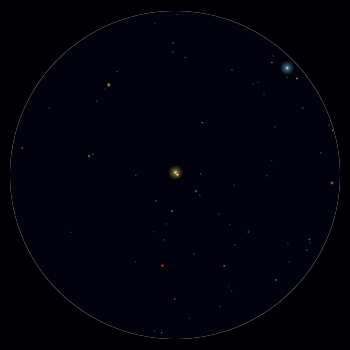
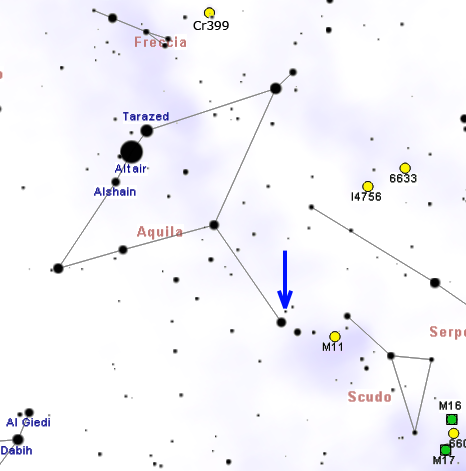
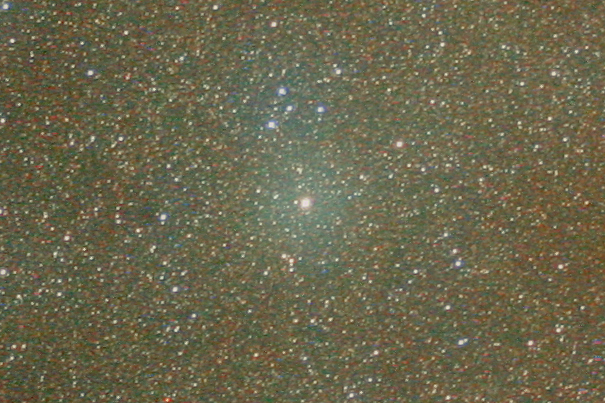
21 Aquilae is a solitary variable star in the equatorial constellation of Aquila, visible to the naked eye as a dim, blue-white hued star with a baseline apparent visual magnitude of about 5.1. It has the variable star designation V1288 Aql and the Flamsteed designation 21 Aquilae. The star is located at a distance of around 680 light-years from Earth, give or take a 20-light-year margin of error, and is moving closer to the Earth with a heliocentric radial velocity of –5 km/s.
- Variable star designation
- V1288 Aql
- Flamsteed designation
- 21 Aquilae
- Apparent visual magnitude range
- 5.06 to 5.16
- Baseline apparent visual magnitude
- 5.1
- Distance
- ~680 ly (margin of error ±20 ly)
- Heliocentric radial velocity
- –5 km/s
- Stellar classification
- B8 II-III
Lore & Background
In 1962, Helmut A. Abt and John C. Gloson published data showing that 21 Aquilae was a variable star, and based on that publication the star was given its variable star designation in 1972. The stellar classification of this star is B8 II-III, with the luminosity class of II-III suggesting that the spectrum displays elements of both a giant star and a bright giant. It is a chemically peculiar star of the Mercury-Manganese type (CP3), although some catalogues consider that status to be doubtful. This is a probable Alpha2 Canum Venaticorum variable that ranges in visual magnitude from 5.06 down to 5.16. The star is radiating 704 times the luminosity of the Sun from its photosphere at an effective temperature that gives it the blue-white glow of a B-type star. 21 Aquilae is catalogued as an optical double star, having a 12th magnitude companion away as of 2010; it was first identified as a double star by John Herschel. The companion is a distant background object.
Reader's Guide
21 Aquilae holds significance as a variable star of the probable Alpha2 Canum Venaticorum type, a class of chemically peculiar stars that exhibit small-amplitude brightness variations linked to magnetic fields and surface abundance patches. Its classification as B8 II-III places it in a transitional luminosity class between giant and bright giant, offering insight into stellar evolution for intermediate-mass stars. The star's Mercury-Manganese peculiarity (CP3) is noted but considered doubtful in some catalogues, reflecting ongoing debate about its chemical nature. As an optical double first identified by John Herschel, it contributes to the historical record of binary star discovery, though the companion is merely a background object. Its variability was established by Abt and Gloson in 1962, leading to its variable star designation a decade later, marking a step in the systematic cataloguing of variable stars. With a distance of about 680 light-years and a radial velocity indicating approach, 21 Aquilae remains a modest but studied object in the constellation Aquila, visible to the naked eye as a dim blue-white point of light.
A Star Worn by Many Names
Eta Aquilae carries one of the most layered naming histories in the sky. Its Bayer designation, derived from the Greek letter eta, has been in use since the early modern cataloguing era. But the star's cultural footprint stretches much further back. In ancient Akkadian astronomy, it was known as Pagru, a name meaning "corpse" or "dead man," recorded in the MUL.APIN tablets. It also belonged to the now-obsolete constellation Antinous, alongside several other Aquila stars. In Chinese astronomy, it occupies the fourth position in the asterism Tiān Fú, the Celestial Drumstick, which groups it with θ Aql, 62 Aql, and 58 Aql. Arab astronomers included it in Al Mizān, the Scale-beam, ranking it as the second of three stars in that figure. In a recent milestone, the IAU Working Group on Star Names officially adopted Pagru for Eta Aquilae Aa on 18 June 2026, while assigning Antinous to θ Aquilae A, finally resolving centuries of overlapping nomenclature.
Three Stars in a Delicate Dance
The dominant component, η Aql A, outshines the others and controls the system's spectrum. A fainter hot companion, η Aql B, was inferred from ultraviolet excess in the spectral energy distribution and fitted to a B8.9 V spectral type, though the fractional designation is a mathematical artifact rather than evidence of intermediate spectral features. A 2022 radial-velocity study struggled to find a satisfactory orbital fit for this inner companion, hinting at a face-on or very large orbit. By 2024, archival data revealed a radial-velocity change consistent with a 50-year period, though it remained unclear which companion drives the signal. The outermost member was visually resolved at 0.7 arc seconds, translating to roughly 191 astronomical units of projected separation. Its brightness suggests an A5V to F3V main-sequence star with a mass between 1.4 and 1.9 solar masses. Hubble Space Telescope fine-guidance-sensor measurements detected orbital motion on a two-year timescale, and a 4.1-degree positional shift over 7.5 years implies an orbital period of at least 659 years, confirming the triple configuration.
A Cepheid You Can See Breathe
The primary star of the system is a Classical Cepheid variable, first identified by Edward Pigott in 1784. Its apparent visual magnitude swings between 3.49 and 4.3 over a period of 7.177 days, a range large enough that both the star's glow and its periodic dimming are perceptible to the unaided eye. This makes Eta Aquilae one of only a handful of Cepheids—alongside Delta Cephei, Zeta Geminorum, and Beta Doradus—where the pulsation itself is naked-eye observable, a distinction that sets it apart from brighter but more subtly varying Cepheids like Polaris. The star's pulsations are not merely a brightness flicker; they physically expand and contract the stellar envelope by roughly 4.59 million kilometers each cycle, shifting its spectral classification between F6.5 Ib and G2 Ib. At its distance of 272 parsecs, interstellar dust dims its apparent brightness by 0.74 magnitudes, meaning its true luminosity is even greater than the observed values suggest.
A Swollen Supergiant in Fast Motion
Eta Aquilae A is a massive star that has exhausted the hydrogen in its core and swollen into a supergiant, earning a baseline classification of F6 Iab. It is estimated to be between 100 and 200 million years old. Compared to the Sun, it packs roughly six times the mass and 52 times the radius, while radiating approximately 2,850 times the solar luminosity. Its outer envelope emits at an effective temperature of about 5,700 kelvin, producing a yellow-whitish glow characteristic of a G-type appearance despite its F-type baseline. The star also moves through its local neighborhood at a notably high peculiar velocity of 16.7 ± 6.9 kilometers per second, distinguishing it from many nearby stellar neighbors. At its distance of roughly 890 light-years, as determined by Gaia's third data release parallax measurements, the star sits in the equatorial constellation Aquila, the Eagle, where it remains one of the brighter members visible to observers on Earth.
Gallery

Frequently Asked Questions
What is 21 Aquilae?
21 Aquilae, also catalogued as V1288 Aql, is a solitary blue-white B-type star sitting in the equatorial constellation Aquila. It carries both a Flamsteed number (21) and a variable-star designation, marking it as a recognized member of the variable-star catalogue.
What type of variable star is 21 Aquilae?
It is classified as a probable Alpha2 Canum Venaticorum (Alpha2 CVn) type variable. Its brightness wobbles only slightly, shifting between apparent visual magnitudes of 5.06 and 5.16 around a baseline of about 5.1.
How far away is 21 Aquilae from Earth?
The star lies roughly 680 light-years from us, with an uncertainty of about ±20 light-years in either direction. That places it firmly in the outer neighborhood of the Milky Way's disk relative to the Solar System.
Is 21 Aquilae getting closer to or farther from the Solar System?
Its heliocentric radial velocity of –5 km/s indicates a slow approach toward Earth. The negative sign simply means the star is drifting inward along our line of sight at that modest speed.
Can you see 21 Aquilae without a telescope?
Yes—under reasonably dark skies it shows up as a faint, blue-white point of light in Aquila, sitting right at the threshold of naked-eye visibility around magnitude 5.1. It's one of the dimmer stars you can spot by eye in that region of the sky.
More in Variable Stars, Part 4 1-24
Spotted an error? Know more?
Reader corrections go straight into our review queue. Suggest an edit · How this site is sourced