V1429 Aquilae
A candidate luminous blue variable multiple star system in Aquila.

PopePompus · CC BY-SA 4.0
V1429 Aquilae, also known as MWC 314, is a multiple star system in Aquila considered a candidate luminous blue variable (LBV). It is a hot, luminous star with a spectrum dominated by strong emission lines.
The spectrum of V1429 Aql is unusual, featuring strong emission lines of hydrogen and many ionized metals, with iron lines being especially numerous and intense. Weaker forbidden lines of ionized iron and nitrogen are also present. Absorption lines exist but are faint or hidden by the emission. Many spectral lines, particularly hydrogen and helium, change shape over the orbit, shifting between pure emission and P Cygni profiles. The absorption lines likely form in the primary star’s photosphere, though some iron absorption appears to come from gas between the stars. No lines from the secondary star are detected. The emission lines arise from circumstellar material around and between the two stars. The overall spectral type is B3 Ibe. In the infrared, the Pfund series is strongly in emission—an unusual trait typical of supergiant Be stars and LBVs—giving an infrared spectral type of B2:e.
The system is a single-lined spectroscopic binary. A companion is inferred from highly periodic radial velocity variations, as well as periodic changes in brightness and spectral line profiles. Whether partial eclipses involve the larger star or just surrounding gas is unclear. The orbital period is well-determined at 60.7 days, with moderate eccentricity of 0.244. The primary fills its Roche lobe for at least part of the orbit. Other orbital characteristics are disputed; the secondary’s orbital velocity is unknown, and possible inclinations do not sufficiently constrain system models. Assumptions based on similar data yield wildly different masses for the stars. A third star is visible in infrared images just over one arcsecond away, statistically likely in a wide orbit around the spectroscopic pair, about 5,700 AU distant.
Material is being transferred from the primary to the secondary, with additional gas surrounding both stars. A dense clump of gas near the system’s center of mass, co-rotating with the stars, produces most of the emission lines. A more diffuse region around both stars creates some absorption components. The entire system is enclosed by a shell of material roughly 0.8 parsecs across, assuming a distance of 3,000 parsecs.
- Constellation
- Aquila
- Other designations
- MWC 314
- Spectral type optical
- B3 Ibe
- Spectral type infrared
- B2:e
- Orbital period
- 60.7 days
- Orbital eccentricity
- 0.244
- Distance adopted
- 3 kpc
Lore & Background
V1429 Aquilae was first reported as variable by Anatoly S. Miroshnichenko in 1996, based on photometry from 1990 through 1995, and received its variable star designation in 1997. The system is a single-lined spectroscopic binary; the companion is inferred from periodic radial velocity variations, brightness changes, and spectral line profile variations. The orbital period is well-defined at 60.7 days with moderate eccentricity (0.244). The primary star fills its Roche lobe for at least part of the orbit, and material is transferred from the primary to the secondary. A dense clump of gas near the system's center of mass, co-rotating with the stars, produces most of the emission lines, while a more diffuse surrounding gas produces some absorption components. A third star is visible in infrared images about one arcsecond away, statistically likely in a wide orbit around the spectroscopic pair at roughly 5,700 AU.
Reader's Guide
V1429 Aquilae is significant as a candidate luminous blue variable, a rare class of massive stars undergoing extreme mass loss. Its spectrum shows strong emission lines of hydrogen and ionized metals, particularly iron, with variable profiles that change during the orbit from emission to P Cygni profiles. The infrared Pfund series in strong emission is a very unusual feature characteristic of supergiant Be stars and LBVs. The system is surrounded by a shell of material about 0.8 parsecs across, visible as a circular ring 25 arcseconds from the central star, and a much larger bipolar nebula 13 parsecs from end to end, detected by Hα radiation. These nebulae indicate episodes of heavy mass loss in the past, even though the star has not shown the defining outbursts and spectral variations of an LBV. The physical parameters of the primary—hot B-type, with luminosity estimates up to 1,200,000 times the Sun, radius 60 times solar, and mass 80 times solar—place it in the LBV regime, though alternative assumptions yield lower values. The system's brightness varies by about 0.3 magnitudes with a 4.16-day period, and two additional pulsation modes with periods of 0.77 and 1.42 days have been observed.
Did You Know?
- V1429 Aquilae is also known by its Mount Wilson Observatory catalog number MWC 314.
- The system shows brightness variations of about 0.3 magnitudes with a period of 4.16 days.
- The infrared Pfund series lines are strongly in emission, a very unusual feature characteristic of supergiant Be stars and LBVs.
The Binary Architecture & Mass Transfer
V1429 Aquilae is a single-lined spectroscopic binary with a well-defined orbital period of 60.7 days and a moderate eccentricity of 0.244. The companion's existence is inferred from periodic shifts in the radial velocity of spectral lines, along with synchronized changes in brightness and line profiles. The primary star fills its Roche lobe for at least part of the orbit, driving a continuous flow of material toward the secondary. A dense, co-rotating clump of gas near the system's center of mass generates most of the emission lines, while a more diffuse surrounding gas envelope contributes the absorption components. The secondary itself remains invisible in observations. Its orbital velocity is unknown, and the possible inclinations do not sufficiently constrain the system's geometry. This uncertainty cascades into wildly divergent mass estimates for the primary, ranging from 5 to 40 solar masses depending on the assumptions adopted. It remains unclear whether partial eclipses involve the stellar surfaces or merely the circumstellar gas.
A Peculiar Spectrum & Contested Identity
The spectrum of V1429 Aquilae is dominated by hydrogen emission and numerous ionized metal lines, with Fe II standing out as particularly strong and abundant. Weak forbidden lines of [Fe II] and [N II] are also present, while absorption features are either faint or buried beneath the emission. The hydrogen and helium series display variable profiles, shifting between pure emission and P Cygni shapes over the course of the orbit. In the infrared, the Pfund series appears in strong emission, a hallmark of supergiant Be stars and luminous blue variables. The optical spectral type is classified as B3 Ibe, while infrared analysis yields B2:e. The star's physical parameters and spectral features closely resemble those of a luminous blue variable, yet it has never exhibited the defining giant outbursts. Alternatively, it may simply be a supergiant Be star. No spectral lines from the secondary have ever been detected, leaving its nature entirely hidden behind the dominant primary.
Shells, Nebulae & a History of Mass Loss
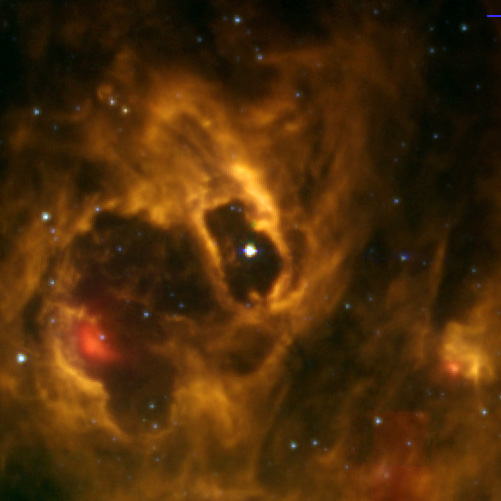
Beyond the immediate binary pair, V1429 Aquilae is wrapped in layers of ejected material that tell a story of past violence. A shell roughly 0.8 parsecs in diameter surrounds the entire system, visible in infrared imagery as a circular ring spanning 25 arc-seconds from the central star. Far more dramatically, a bipolar nebula detected through its H-alpha radiation stretches 13 parsecs from end to end. These structures are interpreted as evidence of episodes of heavy mass loss in the star's past, even though no defining LBV outburst has been directly observed. A third star appears in infrared images just over one arc-second from the pair, statistically likely to orbit the spectroscopic binary at a separation of approximately 5,700 AU. The distance to the system is estimated between 2.4 and 4.3 kiloparsecs, with 3 kpc commonly adopted, though the Gaia EDR3 parallax of 0.2224 ± 0.0203 mas hints at a somewhat greater distance.
Variability, Pulsation & the Luminosity Puzzle
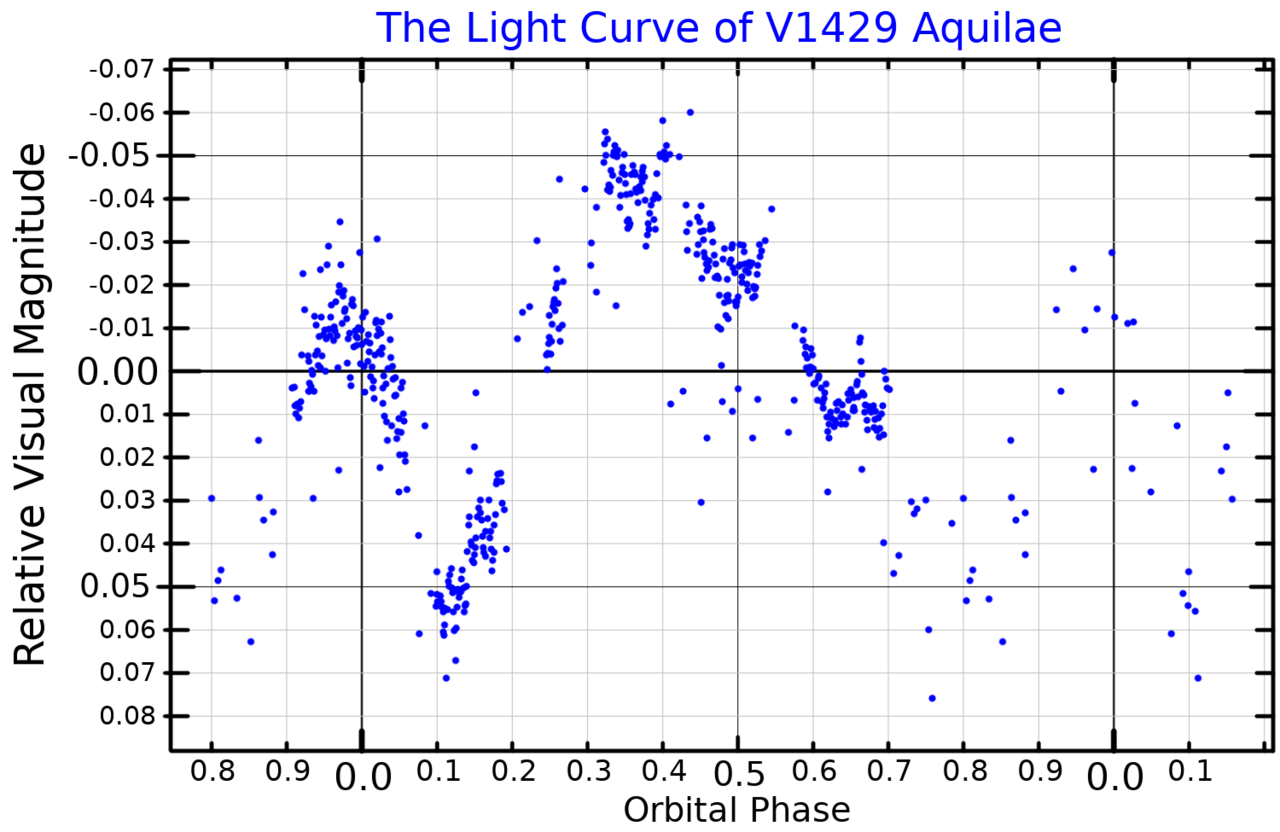
Anatoly S. Miroshnichenko first reported the star's brightness variability in 1996, drawing on photometric data collected between 1990 and 1995; the variable star designation followed in 1997. The system exhibits roughly 0.3-magnitude fluctuations with a detectable period of 4.16 days, driven largely by the orbital motion of the two stars, gas transfer, partial eclipses of circumstellar material, and the ellipsoidal distortion of both stars under mutual gravity. Superimposed on this orbital rhythm are two pulsation modes with amplitudes of only a few thousandths of a magnitude and periods of 0.77 and 1.42 days. No long-term brightness drift has been detected over several decades of monitoring. The luminosity estimates remain contested: early work suggested up to 1.2 million solar luminosities, more recent calculations give 710,000 L☉, alternative orbital assumptions drop it to 500,000 L☉, and a later LBV survey placed it as high as 3.8 million L☉. The radius ranges from 60 to 87 solar radii depending on the model adopted.
Gallery
Frequently Asked Questions
What is V1429 Aquilae?
V1429 Aquilae (also catalogued as MWC 314) is a multiple-star system located in the constellation Aquila that astronomers classify as a candidate luminous blue variable. It is a hot, extremely luminous object whose spectrum is dominated by powerful emission features rather than the absorption lines typical of most stars.
What spectral type does V1429 Aquilae have?
In optical wavelengths it is classified as B3 Ibe, while infrared observations give a B2:e designation. Both labels reflect its very hot, supergiant-like nature combined with prominent emission-line activity.
What makes V1429 Aquilae's spectrum unusual?
Its spectrum is packed with strong hydrogen emission and an unusually rich set of ionized-metal lines, with iron features standing out as especially numerous and intense. Weaker forbidden lines of ionized iron and nitrogen are also detectable, while true absorption lines are either very faint or buried beneath the emission.
What are V1429 Aquilae's orbital parameters?
The system completes one orbit every 60.7 days on a slightly elliptical path with an eccentricity of 0.244. Over the course of that orbit, many spectral lines—particularly hydrogen and helium—shift in shape, revealing the changing geometry of the two stars relative to the observer.
Why is V1429 Aquilae important to variable-star enthusiasts?
As a candidate LBV, it belongs to one of the most extreme and poorly understood classes of massive stars, making it a key target for studying episodic mass loss and circumstellar dynamics. Its multiple-star configuration and variable emission features give observers a rare window into how such luminous objects interact with their companions.
More in Variable Stars, Part 4 1-24
Spotted an error? Know more?
Reader corrections go straight into our review queue. Suggest an edit · How this site is sourced