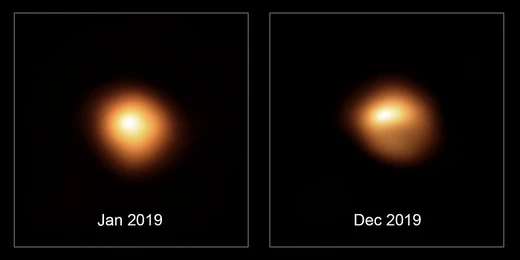
SS 433
First discovered microquasar with relativistic jets and precessing accretion disk.

(Credit: X-ray: NASA/CXC/U.Amsterdam/S.Migliari et al., Radio: G.M. Dubner, et a · Public domain
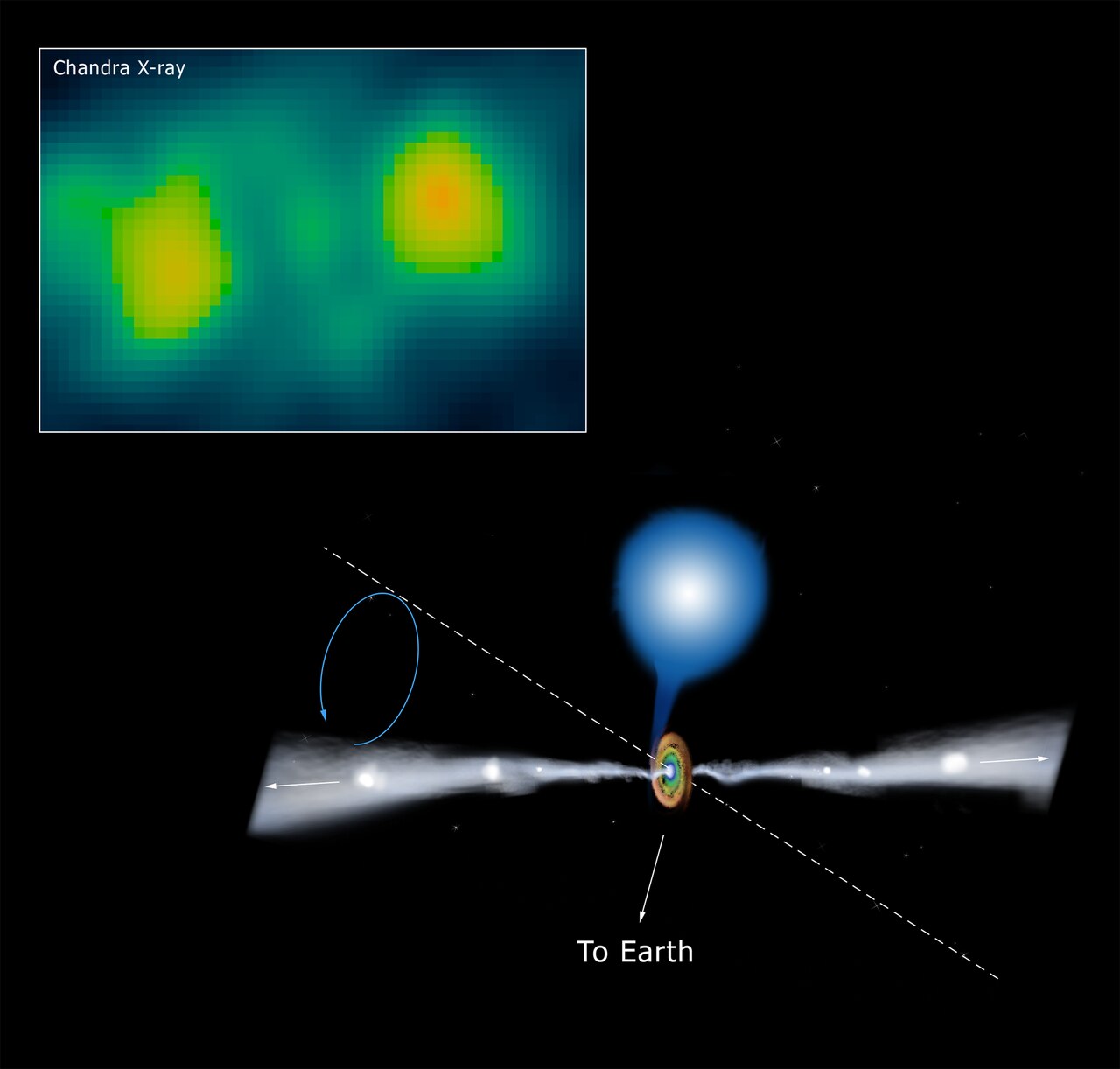
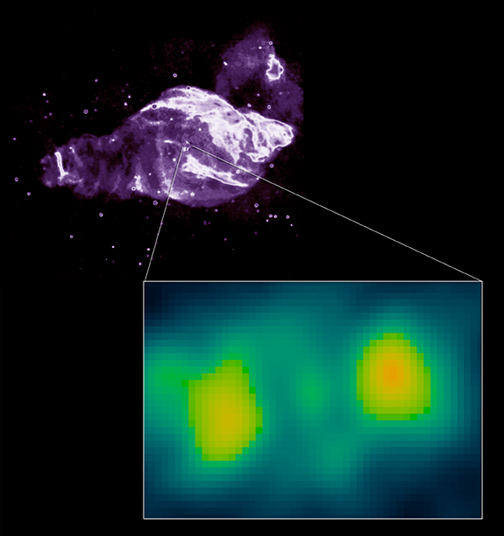
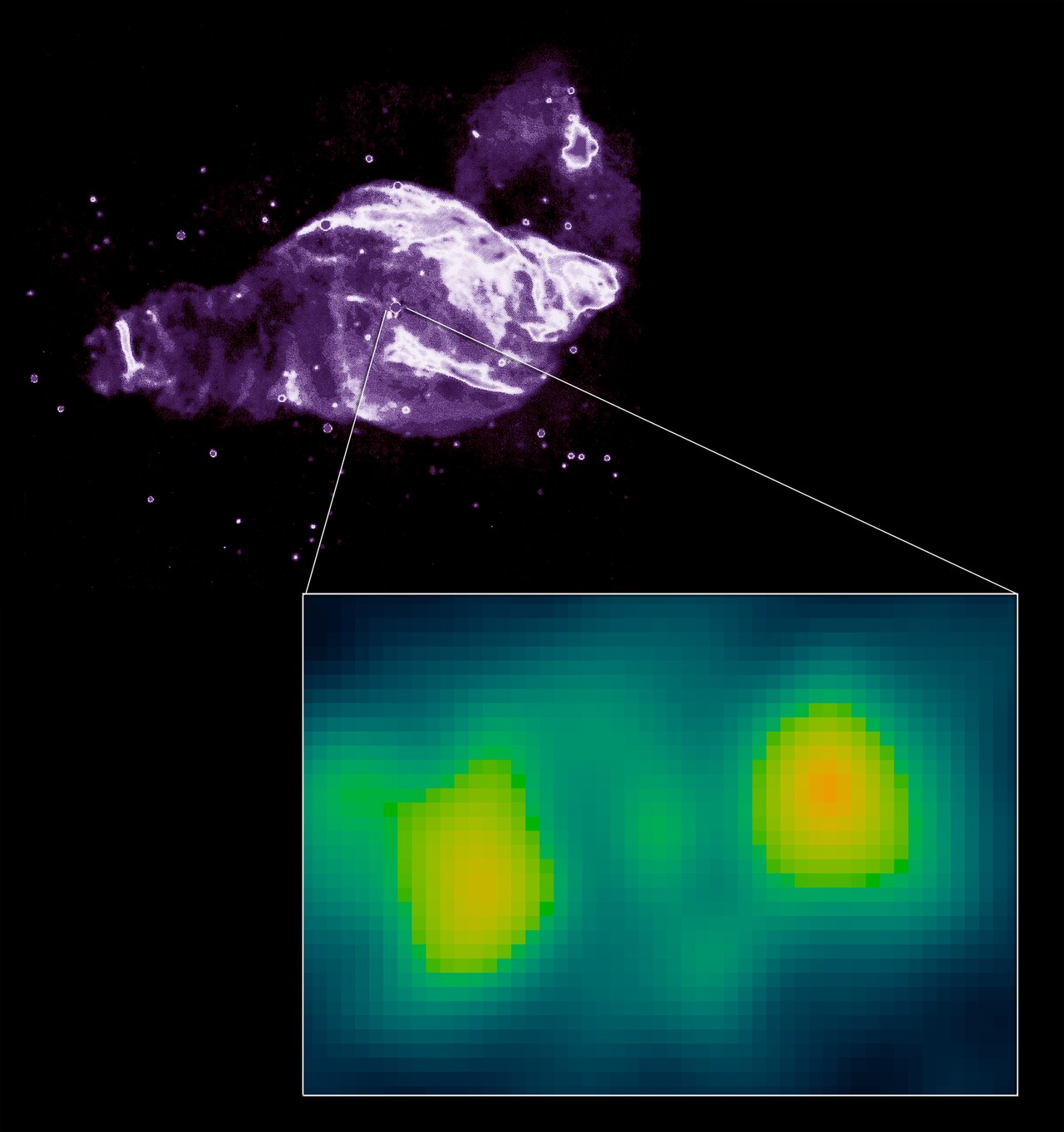
SS 433 is a microquasar and eclipsing X-ray binary system, the first discovered microquasar. It consists of a stellar-mass black hole accreting matter from an A-type companion star and lies at the center of the supernova remnant W50.
- Designation
- V1343 Aquilae
- Discoverers
- Nicholas Sanduleak and Charles Bruce Stephenson
- Catalog entry
- 433rd in their 1977 catalog of stars with strong emission lines
- Distance
- 5.5 kpc
- Orbital period
- 13.082 days
- Jet speed
- 26% of the speed of light
- Precessional period
- 162.5 days
Lore & Background
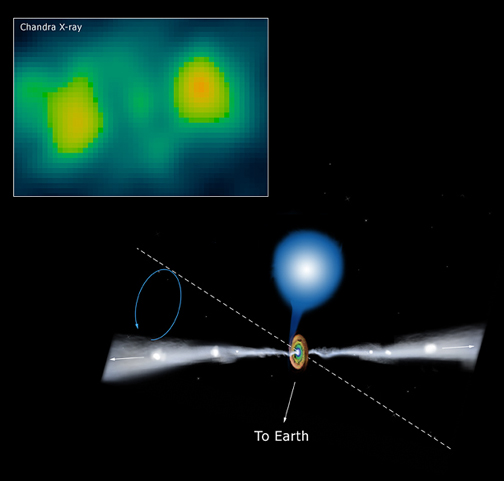
SS 433 was cataloged in 1977 by Nicholas Sanduleak and Charles Bruce Stephenson as the 433rd entry in their catalog of stars with strong emission lines. Its emission lines were studied by Mordehai Milgrom in 1979. The system is located in the galactic plane at galactic coordinates l=39.7° and b=-2.2°, at a distance of 5.5 kpc. The compact central object consumes its companion star, which rapidly loses mass into an accretion disk. Extreme heating of the disk produces intense X-rays and opposing jets of hot hydrogen along the rotation axis, above and below the disk plane. The jets travel at 26% of the speed of light. The companion star's mass is estimated between 3 and 30 solar masses. The primary and secondary orbit each other with a period of 13.082 days; the orbit is slightly eccentric, and its period slowly increases by about 3 seconds per year.
Reader's Guide
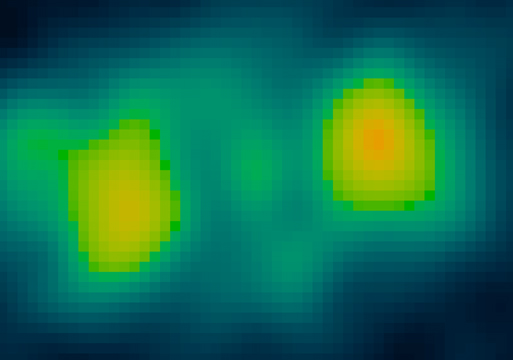
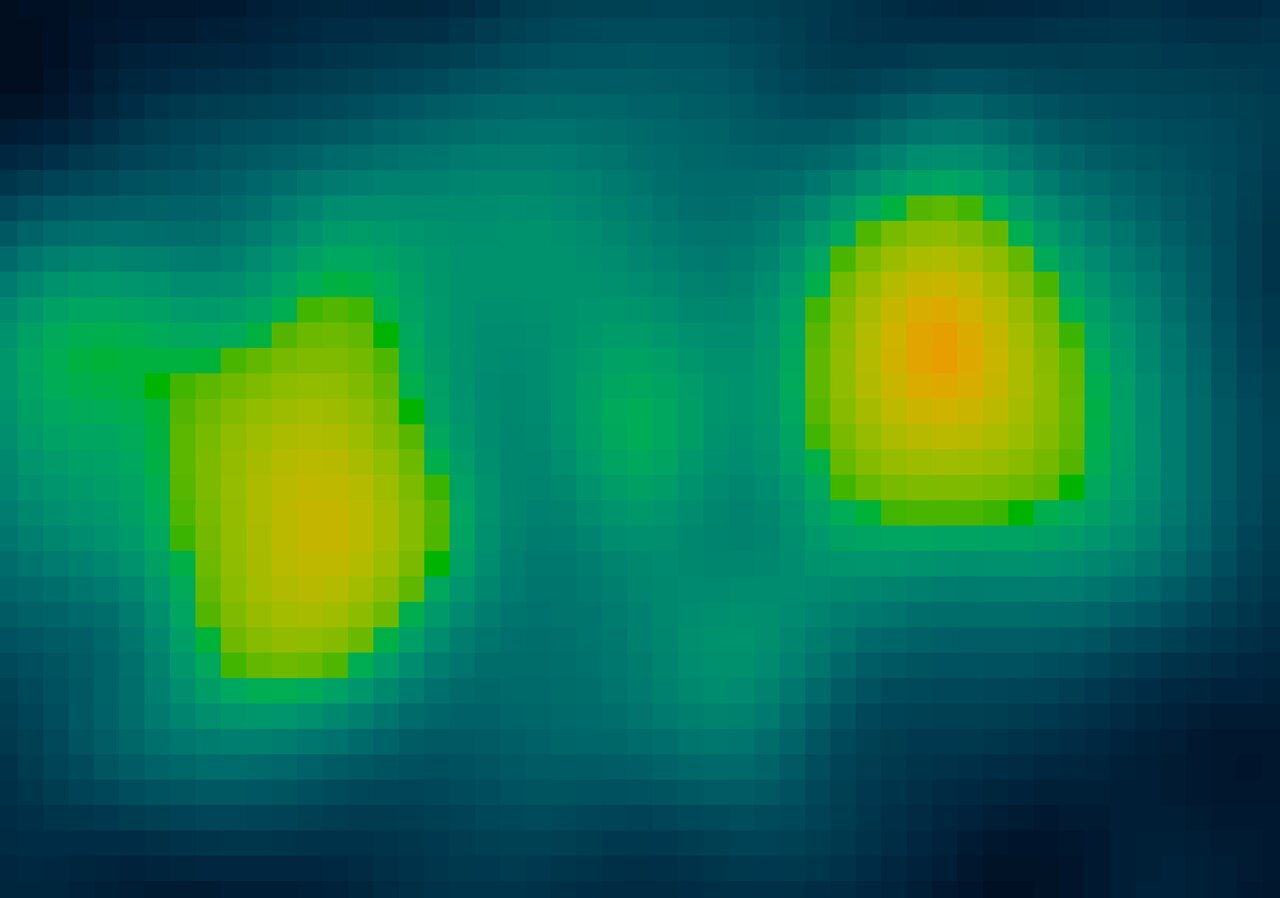
SS 433 is significant as the first discovered microquasar, providing a nearby laboratory for studying relativistic jet phenomena and accretion processes around a stellar-mass black hole. Its precessing jets, inclined about 79° to the line of sight, produce dramatic Doppler shifts and a corkscrew pattern as they impact the surrounding W50 supernova remnant, distorting it into an elongated shape. Observations in 2004 with the Very Long Baseline Array over 42 consecutive days revealed that the jets sometimes brighten upon impacting material shortly after creation, with variations in the replacement of that material. Relativistic effects are also observed: after subtracting Doppler shifts, a residual redshift corresponding to about 12,000 km/s arises from time dilation of moving atoms in the jets. In September 2018, teraelectronvolt gamma-ray observations exceeding 25 TeV from the HAWC Observatory spatially resolved the lobes of the SS 433/W50 system, consistent with a single population of electrons in a magnetic field of about 16 microgauss. These findings underscore the system's role in understanding high-energy astrophysical processes.
Did You Know?
- SS 433 was the first microquasar ever discovered.
- The system's accretion disk and jets precess with a period of about 162.5 days.
- The orbital period of the binary is slowly increasing by about 3 seconds per year.
Two Kinds of Flickering
A variable star is any star whose apparent brightness, as seen from Earth, shifts in a systematic way over time. Astronomers split these into two broad families. Intrinsic variables genuinely alter their emitted light; a star might swell and contract, changing its output from within. Extrinsic variables keep the same energy output, but something in their environment intercepts a portion of that light before it reaches us; an orbiting companion that periodically eclipses the star is the classic case. The pattern of change can be cyclical, irregular, fluctuating, or a one-off transient event. Timescales range from under an hour to multiple years. Luminosity oscillation is so common that many, perhaps most, stars show at least a small wobble: the Sun, for example, varies by roughly 0.1 percent over its eleven-year cycle. At the opposite extreme, a single supernova can briefly outshine an entire galaxy. As of 2023, catalogues list about 58,200 known variable stars, with pulsating types accounting for just under 30,000 and eclipsing binaries for more than 10,000.
Shattering the Eternal Sky
Long before telescopes, human civilizations noticed the night sky was not perfectly static. An Egyptian calendar of lucky and unlucky days, composed roughly 3,200 years ago, may preserve the earliest written record of someone tracking Algol's waxing and waning, though scholars debate that claim. Aboriginal Australians wove the brightness changes of Betelgeuse and Antares into oral narratives passed through generations. Babylonian, Chinese, and Arab astronomers independently logged novae and supernovae. The telescope era accelerated discovery. In 1638, Johannes Holwarda realized Omicron Ceti, later named Mira, pulsed on an eleven-month rhythm; David Fabricius had earlier mistaken it for a new star in 1596. Coupled with the supernovae of 1572 and 1604, these observations dismantled the Aristotelian doctrine that the heavens were eternally unchanging. Geminiano Montanari described Algol's eclipsing behavior in 1669, and John Goodricke supplied the correct physical explanation in 1784. By 1786, ten variable stars had been formally documented. The arrival of photographic plates, especially the systematic sky survey launched by Harvard College Observatory in 1885, sent catalogue numbers soaring.
Rungs on the Cosmic Ladder
In 1912, Henrietta Swan Leavitt uncovered a tight mathematical link between the pulsation period of Cepheid variables and their true luminosity. That period-luminosity relationship turned a single class of variable star into a cosmic measuring stick. Edwin Hubble put it to work in 1924, identifying a Cepheid within what was then called the Andromeda Nebula. The distance he derived proved the nebula lay far beyond the Milky Way, settling the Great Debate and revealing that spiral nebulae were separate galaxies. Variable stars now occupy several critical rungs on the cosmic distance ladder, the step-by-step framework astronomers use to gauge the scale of the observable universe. Beyond distance work, eclipsing binaries offer a uniquely precise laboratory: by measuring the timing of their mutual eclipses, researchers can pin down the masses and radii of the component stars with an accuracy indispensable for modelling stellar evolution. In 1930, Cecilia Payne published The Stars of High Luminosity, a monograph rich with observations of variable stars, especially Cepheids. Her analyses, carried out alongside her husband Sergei Gaposchkin, became the foundation for all subsequent research in the field.
From Glass Plates to Backyard Telescopes
Astronomers probe variable stars using photometry, spectrophotometry, spectroscopy, and polarimetry. Brightness measurements plotted against time yield a light curve, where peaks are called maxima and troughs are minima. For regular variables the period and amplitude can be established with high precision, though many stars drift slowly or even shift from one cycle to the next. Spectral and polarization changes, combined with the light curve, often reveal the physical mechanism driving the variability. The 2008 edition of the General Catalogue of Variable Stars tallied more than 46,000 variables in the Milky Way, roughly 10,000 in other galaxies, and over 10,000 additional suspected cases. Amateur observers have been essential partners for well over a century; the Variable Star Section of the British Astronomical Association, founded in 1890, is among the oldest dedicated organizations of its kind. A backyard astronomer can contribute real science by visually comparing a variable star against nearby reference stars of known, steady magnitude within the same telescope field, estimating the variable's brightness, and recording the time. Those individual visual estimates, gathered over months and years, assemble into a visual light curve that professional researchers fold into their analyses.
Gallery
Frequently Asked Questions
What is SS 433?
SS 433 (also designated V1343 Aquilae) is an eclipsing X-ray binary in which a stellar-mass black hole feeds on material stripped from an A-type companion star. It holds the distinction of being the first object ever recognized as a microquasar.
What makes SS 433 unique among variable stars?
It was the first system confirmed to launch relativistic jets and to host a precessing accretion disk—behaviors previously associated only with supermassive black holes at galactic nuclei. That discovery gave astrophysicists a nearby laboratory for testing microquasar theory.
How fast do SS 433's jets travel?
The outflows ejected from the system reach roughly 26 percent of the speed of light. While slightly below light speed, that velocity makes them among the fastest known outflows tied to a stellar-mass black hole.
Where is SS 433 located and how far away is it?
The system sits at the center of the supernova remnant W50 and lies approximately 5.5 kiloparsecs (around 18,000 light-years) from Earth. Its companion star completes one orbit every 13.082 days.
Who originally cataloged SS 433?
Nicholas Sanduleak and Charles Bruce Stephenson identified the star and listed it as the 433rd entry in their 1977 catalog of stars exhibiting strong emission lines, which is how the number 433 entered its name.
More in Variable Stars, Part 4 1-24
Spotted an error? Know more?
Reader corrections go straight into our review queue. Suggest an edit · How this site is sourced