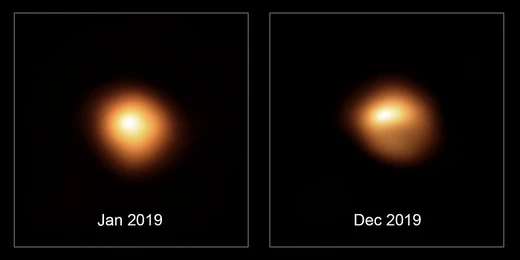
Gliese 752
A nearby binary system with a planet and flaring red dwarfs.

Hubble Space Telescope · Public domain
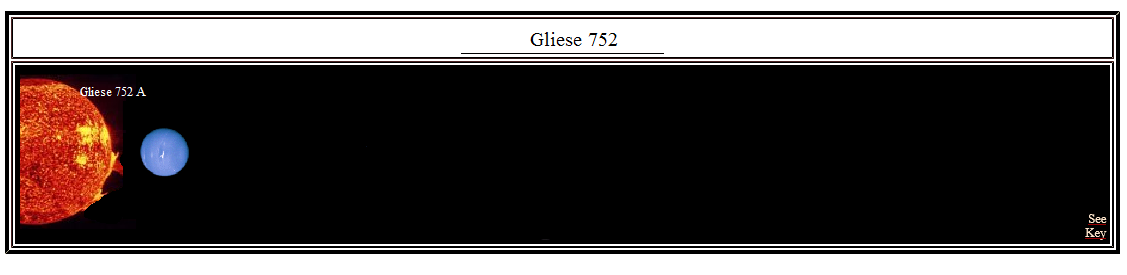
Gliese 752 is a binary star system in the constellation Aquila, consisting of two M-type red dwarfs. It is notable for its high proper motion, its proximity to the bright star Altair, and for hosting a confirmed exoplanet around its primary component.
- Distance
- 19.3 ly
- Constellation
- Aquila
- Primary star type
- M2.5 red dwarf
- Secondary star type
- M8V red dwarf
- Separation
- 74 arc seconds (~434 AU)
- Proper motion
- ~1 arc second per year
- Confirmed exoplanet
- Gliese 752 A (HD 180617) b
Lore & Background
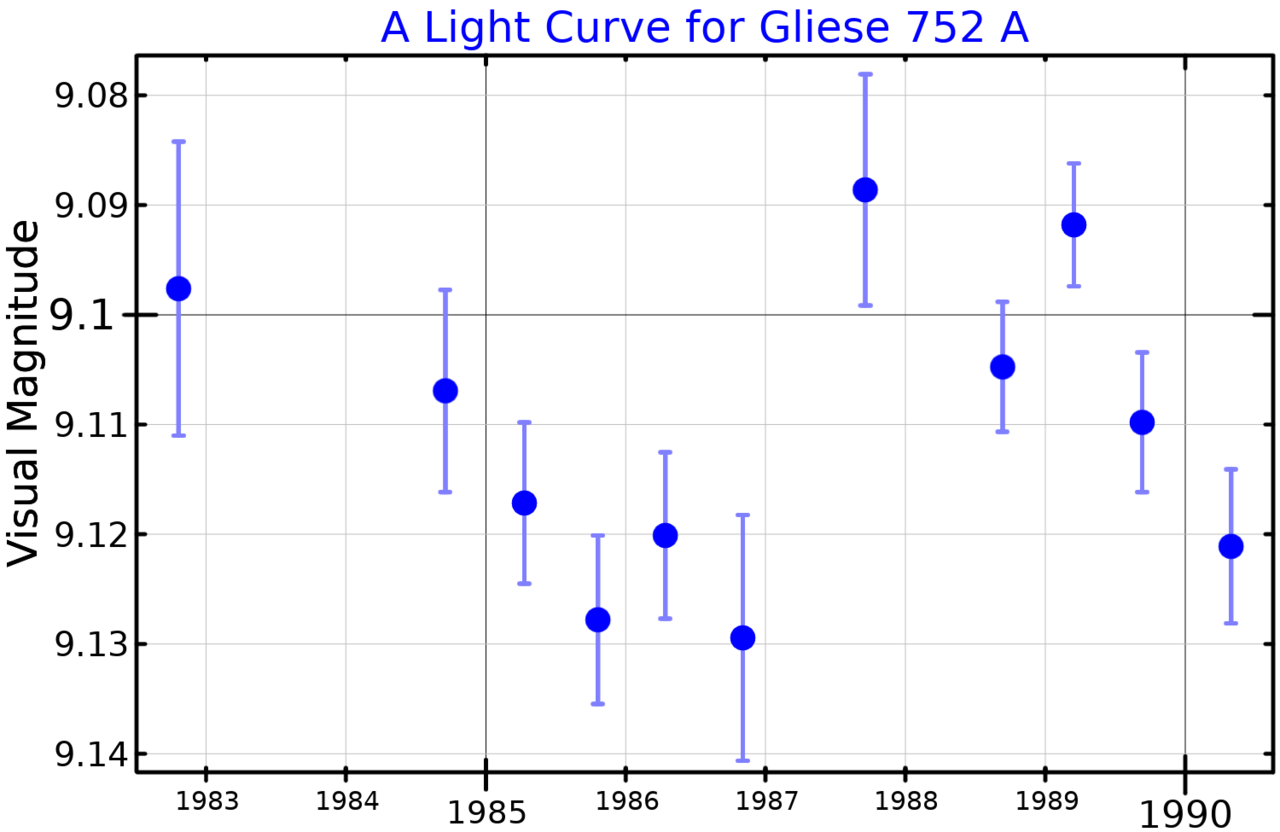
The Gliese 752 system was cataloged in the Catalogue of Nearby Stars published by German astronomer Wilhelm Gliese in 1969. The primary star, Wolf 1055, was first noted for its high proper motion by Max Wolf in 1919 using astrophotography. It is a BY Draconis variable star (V1428 Aquilae) subject to flare events. The secondary star, VB 10, was discovered by George Van Biesbroeck in 1944 and is a UV Ceti variable (V1298 Aquilae) also prone to flares. The system lies only 3.85 light years from Altair, which would appear as bright as Jupiter from that vantage point.
Reader's Guide
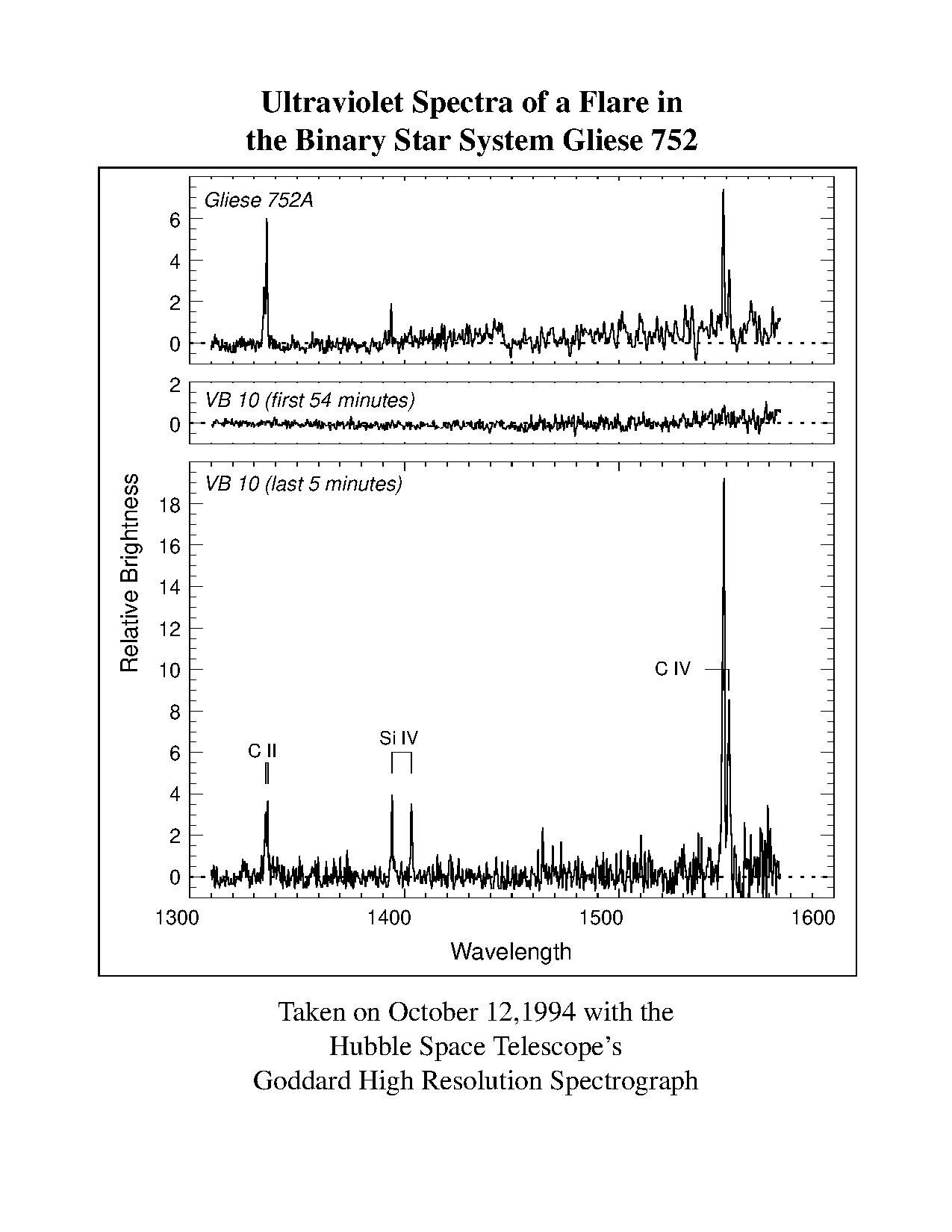
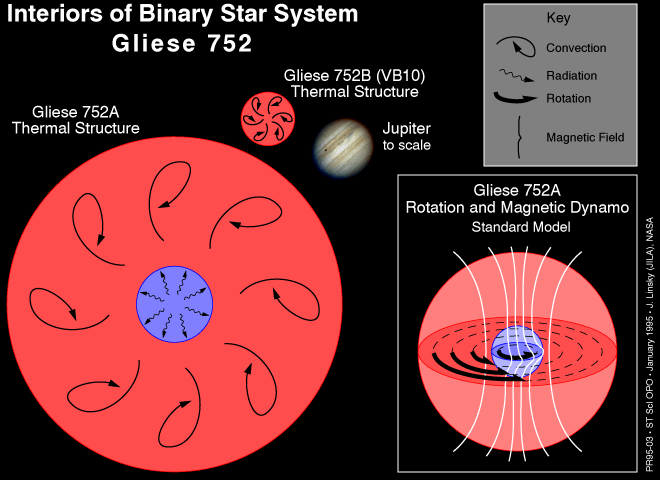
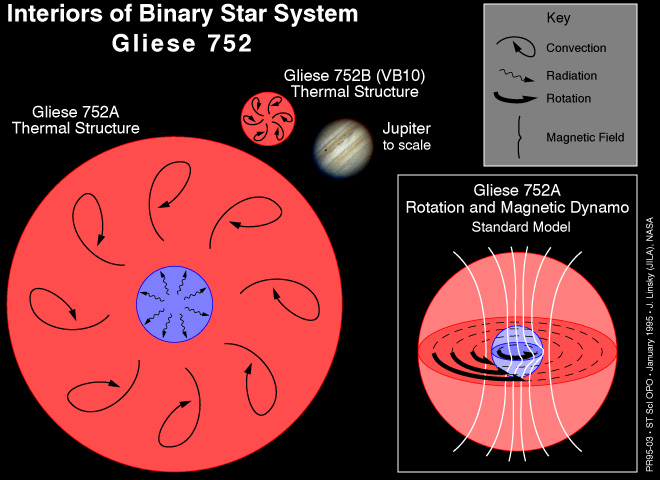
Gliese 752 holds significance as a nearby laboratory for studying low-mass stars and their planetary systems. The primary star hosts a confirmed exoplanet with a minimum mass comparable to Neptune, discovered in 2018 using the CARMENES spectrograph at Calar Alto Observatory. The secondary star, VB 10, is one of the least luminous stars known, with an absolute magnitude near 19 and a surface temperature of only 2600 K. Its mass of 0.08 solar masses places it near the lower limit for stellar fusion. In 1994, the Hubble Space Telescope observed a solar flare on VB 10, surprising astronomers who had assumed such low-mass stars lacked the radiative zone needed for magnetic dynamos. This detection suggests that convection alone can generate sufficient magnetic fields to power flares. The system's high proper motion and binary nature make it a valuable target for astrometric and spectroscopic studies.
Did You Know?
- Gliese 752 is only 3.85 light years from Altair, which would shine at magnitude −2.43 from the system.
- The secondary star VB 10 has a mass of 0.08 solar masses, near the lower limit for a star.
- A 2009 claim of a planet around VB 10 was not confirmed by later spectrographic surveys.
- The Hubble Space Telescope detected a solar flare on Gliese 752 B in 1994, indicating a strong magnetic field.
The Architecture of a Four-Body System
The Gliese 570 system, also catalogued as 33 G. Librae, is a remarkable quaternary arrangement of stellar and substellar objects. At its heart sits an orange dwarf of spectral type K4V, possessing roughly three-quarters of the Sun's mass and radius while producing only about fifteen percent of its visual brightness. This primary star is accompanied by a wide binary pair of red dwarfs—component B (M1V) and component C (M3V)—each dimmer and smaller than our Sun yet both capable of emitting X-rays. The binary pair traces an eccentric orbit around the primary at a mean separation of roughly 190 astronomical units, completing a full revolution in at least 2,130 years. Radial velocity measurements taken during an extrasolar planet survey at Lick Observatory revealed a steady linear trend in the primary's motion, consistent with the gravitational pull of the distant binary companion. Beyond this triple configuration, a confirmed brown dwarf orbits at a separation exceeding 1,500 astronomical units, rounding out the four-body architecture of the system.
A Record-Breaking Brown Dwarf
On January 15, 2000, a team led by Adam Burgasser announced the identification of what was then one of the coolest brown dwarfs ever catalogued. Designated Gliese 570 D, this substellar object was detected at a wide separation of more than 1,500 astronomical units from the triple star core, with an estimated mass around fifty times that of Jupiter. Its status as a genuine brown dwarf was later verified through infrared spectroscopic observations carried out at the Cerro Tololo Inter-American Observatory in Chile. The measurements revealed a surface temperature of approximately 500 degrees Celsius—cool enough to make it both dimmer and less luminous than every previously known brown dwarf, including the prototype object that had given the "T" spectral class its name. On that basis, Gliese 570 D was assigned the classification T7-8V, placing it at the extreme cool end of the brown dwarf sequence at the time. Notably, no X-ray emission has ever been reported from this object, distinguishing it from the three stellar components of the system, all of which are known to produce X-rays.
Locating the System in the Sky and in Space
In the night sky, the Gliese 570 system occupies the southwestern region of the constellation Libra, positioned southwest of the bright star Alpha Librae and northwest of Sigma Librae. Determining its precise distance from Earth proved more challenging than one might expect. During the early 1990s, the European Hipparcos satellite measured the parallax of the two red dwarf components, B and C, and derived a distance of approximately 24.4 light-years. However, this figure carried a relatively large margin of error. Subsequent Earth-based parallax measurements and careful orbital tracking indicated that components B and C are gravitationally bound to the primary orange dwarf, meaning all three stars must share the same distance from the Sun. The currently accepted figure places the system at roughly 19 light-years, making it one of the nearer multiple-star neighborhoods in our galactic vicinity. The discrepancy between the Hipparcos estimate and the revised value underscores how even space-based instruments can struggle when dealing with widely separated, faint stellar companions in a complex multiple system.
The Phantom Planet of Gliese 570
In 1998, astronomers announced the detection of an extrasolar planet orbiting the primary orange dwarf in the Gliese 570 system. The object, designated Gliese 570 Ab, generated considerable interest given the proximity of the system and the growing excitement around the first discoveries of worlds beyond our own. However, the claim was quickly regarded as doubtful, and by 2000 the announcement had been formally retracted. The evidence that had supported the original detection could not be substantiated, and the planet was removed from the catalog of known extrasolar worlds. As of the most recent assessments, no confirmed extrasolar planet has been identified in any of the Gliese 570 system's components. The episode serves as a reminder of how difficult it is to distinguish genuine planetary signals from the complex gravitational perturbations inherent in a quaternary star system, where the wide binary companions and the distant brown dwarf all contribute their own subtle tugs on the primary star's motion.
Gallery
Frequently Asked Questions
What is Gliese 752?
Gliese 752 is a binary pair of red dwarf stars situated in the constellation Aquila, roughly 19.3 light-years from the Sun. The brighter member is an M2.5 dwarf and the dimmer companion is an M8V dwarf, separated by about 434 AU.
What makes Gliese 752 a variable star?
Both components are cool, magnetically active red dwarfs that undergo chromospheric flares, producing irregular brightness spikes rather than the smooth periodic cycles of classical pulsators. This eruptive, flare-driven variability is what places the system in the variable-star catalogues.
Does Gliese 752 have a planet?
Yes, a confirmed exoplanet orbits the primary M2.5 dwarf in the pair. Its detection via radial-velocity measurements made Gliese 752 one of the earlier known planetary systems around a red-dwarf binary.
Where can I find Gliese 752 in the night sky?
Look in the region of Aquila, not far from the brilliant star Altair, which gives the system a handy celestial landmark. Its proper motion of about one arcsecond per year means its coordinates shift measurably over a human lifetime.
Why is Gliese 752 a favorite among variable-star fans?
It packs several appealing traits into a single nearby target: a wide binary of flaring red dwarfs, a confirmed orbiting planet, and a fast proper motion that flags it as kinematically interesting. Its close apparent proximity to Altair also makes it an easy and memorable pick for backyard observers.
More in Variable Stars, Part 4 1-24
Spotted an error? Know more?
Reader corrections go straight into our review queue. Suggest an edit · How this site is sourced