Bryce Canyon
A collection of giant natural amphitheaters and colorful hoodoos in southwestern Utah.
Last updated

via Wikipedia: Bryce Canyon National Park · see source
Where it is
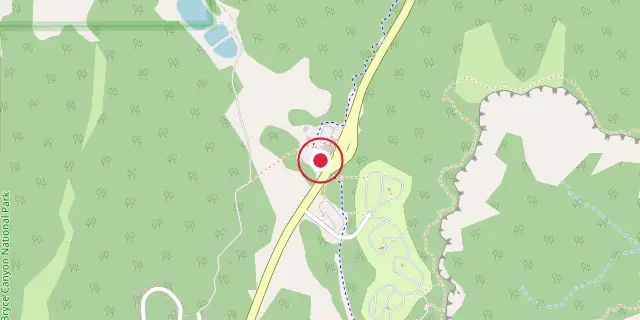
Coordinates: 37°38′24″N 112°10′12″W (37.6400, -112.1700) · Open in OpenStreetMap
Coordinates and connected clubs: the infobox of Wikipedia: Bryce Canyon National Park (CC BY-SA 4.0). Map: drawn by Codexery from OpenStreetMap tiles.
Southwestern Utah's Bryce Canyon National Park, with an area of 35,835 acres, sits at elevations ranging from 8,000 to 9,000 feet.[1] Headward erosion of the Paunsaugunt Plateau created the park's colorful, up-to-200-foot-tall hoodoos.[2]
Geography and history
The park lies within the Colorado Plateau province and straddles the southeastern edge of the Paunsaugunt Plateau.[2] Yellow Creek, where it exits the park in the northeast section, is the lowest part at 6,620 ft.[3] President Warren G. Harding established Bryce Canyon National Monument in 1923, and Congress redesignated it as a national park in 1928.[4] The park has a continental climate with warm, dry summers (Dsb) according to the Köppen classification system.[5]
Yearly temperatures vary from an average minimum of 9 °F in January to an average maximum of 83 °F in July.[6] The record high temperature was 98 °F in July 2002, and the record low was -28 °F in December 1972.[6] Within the park, a chain of amphitheaters stretches over 20 miles from north to south; the largest, Bryce Amphitheater, measures 12 miles in length, 3 miles in width, and 800 feet in depth.[7]
What the cited sources add
The Ecology of Bryce Canyon National Park account notes that the plateau is cooler and wetter than the surrounding arid area, appearing as a green island in a red desert.[8] The same source states that the pink cliffs in the park are mostly bare of vegetation.[8] The Paiute oral tradition, as recorded on a park wayside, holds that the hoodoos are ancient legend people turned to stone by coyote as punishment for bad deeds.[9] The Geology of Bryce Canyon National Park account explains that the park is almost entirely composed of sedimentary rocks.[10]
The same geology source describes that the rocks of the Claron Formation comprise the spectacular structures Bryce Canyon is known for.[10] The park history from Bryce Canyon Lodge states that the lodge was built in 1925 by the Utah Parks Company as part of a Union Pacific railroad project.[11] According to the park's Reptiles and Amphibians account, Bryce Canyon is home to 11 reptile species and 4 amphibian species.[12]
References
- Wikipedia, "Bryce Canyon National Park" (CC BY-SA 4.0), which cites: ; "Hiking at High Altitudes", US National Park Service; "When to go", Bryce Canyon National Park; (original not read by us) en.wikipedia.org
- Wikipedia, "Bryce Canyon National Park" (CC BY-SA 4.0) en.wikipedia.org
- Wikipedia, "Bryce Canyon National Park" (CC BY-SA 4.0), which cites: National Park Service, "Park Planner, Hiking and Shuttle Guide", The Hoodoo, Summer 2005 (original not read by us) en.wikipedia.org
- Wikipedia, "Bryce Canyon National Park" (CC BY-SA 4.0), which cites: "2020 CENSUS - CENSUS BLOCK MAP: Garfield County, UT", U.S. Census Bureau, p. 35 (PDF p. 34/47); "2020 CENSUS - CENSUS BLOCK MAP: Kane County, UT", U.S. Census Bureau, p. 4 (PDF pp. 5/54); (original not read by us) en.wikipedia.org
- Wikipedia, "Bryce Canyon National Park" (CC BY-SA 4.0), which cites: "USDA Interactive Plant Hardiness Map", United States Department of Agriculture (we also read that source) en.wikipedia.org
- Wikipedia, "Bryce Canyon National Park" (CC BY-SA 4.0), which cites: ; National Park Service, "Park Planner, Hiking and Shuttle Guide", The Hoodoo, Summer 2005; National Park Service, "Park Planner, Hiking and Shuttle Guide", The Hoodoo, Summer 2005; Darack, "Weatherscapes: Bryce Canyon: Amphitheater of the Sky", Weatherwise, 2020, p. 10–11 (we also read that source) en.wikipedia.org
- Wikipedia, "Bryce Canyon National Park" (CC BY-SA 4.0), which cites: ; ; (original not read by us) en.wikipedia.org
- "Ecology of Bryce Canyon National Park", Geology and Ecology of National Parks. facts only, no text reused. usgs.gov
- "The Legend People wayside", Bryce Canyon National Park, 2025-10-25. facts only, no text reused. nps.gov
- "Geology of Bryce Canyon National Park", Geology and Ecology of National Parks. facts only, no text reused. usgs.gov
- "Park History", Bryce Canyon Lodge, 2023. facts only, no text reused. visitbrycecanyon.com
- "Reptiles and Amphibians", Bryce Canyon National Park. facts only, no text reused. nps.gov
Each numbered sentence above was checked against the source it cites before publication. Sentences citing Wikipedia adapt text from the English Wikipedia article Bryce Canyon National Park (contributors), used under CC BY-SA 4.0; this entry is available under the same licence. Other sources were used for facts only; no text or images are copied from them.
More in US National Parks
Sources
Compiled from Wikipedia and the sources listed below. Text from Wikipedia is available under CC BY-SA 4.0; this entry is adapted from it.
- Wikipedia: Bryce Canyon National Park (CC BY-SA 4.0).
Spotted an error? Know more?
Reader corrections go straight into our review queue. Suggest an edit · How this site is sourced