Sequoia
Park protecting giant sequoias and the highest point in the contiguous US.
Last updated
Where it is
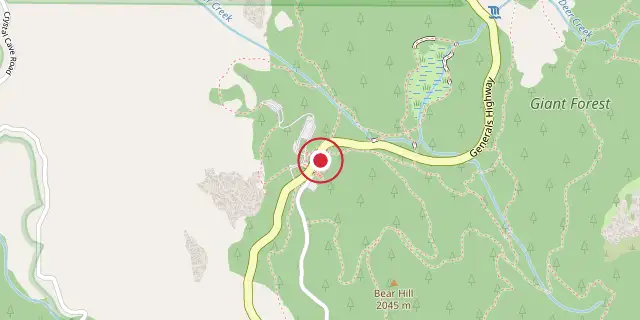
Coordinates: 36°33′54″N 118°46′23″W (36.5650, -118.7730) · Open in OpenStreetMap
Coordinates and connected clubs: the infobox of Wikipedia: Sequoia National Park (CC BY-SA 4.0). Map: drawn by Codexery from OpenStreetMap tiles.
It contains the highest point in the contiguous United States, Mount Whitney, and is notable for giant sequoia trees including the General Sherman Tree.[1][2] Located east of Visalia, California, in the southern Sierra Nevada, Sequoia National Park is a U.S. national park that was created on September 25, 1890, and now covers 404,064 acres of forested mountain land.[3] In 1976, the Sequoia-Kings Canyon area received Biosphere Reserve designation from UNESCO.[4]
Geography and history
The park encompasses 404,064 acres of forested mountainous terrain with a vertical relief of nearly 13,000 ft.[3][1] The Giant Forest contains five of the ten largest trees in the world and is connected by the Generals Highway to General Grant Grove.[2] President Benjamin Harrison signed legislation establishing Sequoia National Park on September 25, 1890, ending logging in the area.[5] Kings Canyon National Park lies to the north of Sequoia National Park, the two parks share a border, and the National Park Service handles the administration of both jointly.[1]
Within Sequoia and Kings Canyon National Parks, the old-growth forests that contain giant sequoias total 202,430 acres.[2] Hale Tharp, the first European to homestead in the region, constructed his dwelling from a hollowed fallen giant sequoia log in the Giant Forest next to Log Meadow.[6][7] The SQF Complex Fire caused a partial closure of the park in September 2020, and the KNP Complex Fire led to a full closure from mid-September through mid-December 2021.[8] Sequoia National Park provided the name for Apple's macOS Sequoia.[9]
What the cited sources add
The NPS geology overview states that the park contains a significant portion of the Sierra Nevada and that the Great Western Divide parallels the Sierran crest.[10] The NPS mammals page notes that the California grizzly once occurred in these parks and was exterminated in California by the 1920s.[11] Seventeen species of bats use these parks, including several species of concern such as the Townsend's big-eared bat.[11] The Great Western Divide's peaks exceed 12,000 ft in elevation, and Kern Canyon, located in the remote backcountry, maintains a depth greater than 5,000 ft for 30 miles.[10]
Subduction during the Cretaceous Period, 100 million years ago, produced molten rock that cooled underground to form granitic rocks.[10] Over 270 marble caves exist within the parks; Lilburn Cave, with nearly 17 miles of surveyed passage, is the longest in California.[10] The USDA reports that the Giant Forest Visitor Center, at 6,444 ft elevation, falls within Plant Hardiness zone 8a, where the average annual extreme minimum temperature is 12.0 °F.[12][13]
References
- Wikipedia, "Sequoia National Park" (CC BY-SA 4.0), which cites: "DATASHEETS", www.ngs.noaa.gov (original not read by us) en.wikipedia.org
- Wikipedia, "Sequoia National Park" (CC BY-SA 4.0), which cites: Bolsinger, "Area of old-growth forests in California, Oregon, and Washington", United States Forest Service, Pacific Northwest Research Station, 1993; Franklin, "Status of the Sierra Nevada", Sierra Nevada Ecosystem Project. Final Report to Congress, 1996, p. 627–671; Steward, "Indian Tribes of Sequoia National Park Region", U.S. Department of the Interior, National Park Service, Field Division of Education, 1935 (original not read by us) en.wikipedia.org
- Wikipedia, "Sequoia National Park" (CC BY-SA 4.0) en.wikipedia.org
- Wikipedia, "Sequoia National Park" (CC BY-SA 4.0), which cites: "UNESCO – MAB Biosphere Reserves Directory" (original not read by us) en.wikipedia.org
- Wikipedia, "Sequoia National Park" (CC BY-SA 4.0), which cites: "History & Culture - Sequoia & Kings Canyon National Parks", U.S. National Park Service (original not read by us) en.wikipedia.org
- Wikipedia, "Sequoia National Park" (CC BY-SA 4.0), which cites: Vankat, "Fire and Man in Sequoia National Park", Annals of the Association of American Geographers, March 1977, p. 17–27 (we also read that source) en.wikipedia.org
- John L. Vankat, "FIRE AND MAN IN SEQUOIA NATIONAL PARK∗", Annals of the Association of American Geographers (1977), doi:10.1111/j.1467-8306.1977.tb01117.x. OpenAlex metadata CC0; paper not read. doi.org
- Wikipedia, "Sequoia National Park" (CC BY-SA 4.0), which cites: "SQF Complex Fire: 122,835 acres burned, 12% contained; latest evacuation orders", ABC30 Fresno, September 17, 2020; "SQF Complex Fire grows, portions of Three Rivers under mandatory evacuations. What we know.", Visalia Times Delta, September 13, 2020; Paterson, "Giant Forest in Sequoia National Park to Reopen on Select Days Beginning December 11, 2021", NPS.gov, December 8, 2021; Yeager, "After four months and thousands of slain sequoia, KNP Complex Fire reaches full containment", Visalia Times-Delta, December 19, 2021 (original en.wikipedia.org
- Wikipedia, "Sequoia National Park" (CC BY-SA 4.0), which cites: "macOS 15 Sequoia: launch date, latest news and everything we know", TechRadar, June 7, 2024 (original not read by us) en.wikipedia.org
- http://www.nps.gov/seki/naturescience/geology_overview.htm. facts only, no text reused. nps.gov
- US NPS, "Mammals". facts only, no text reused. nps.gov
- "USDA Interactive Plant Hardiness Map", United States Department of Agriculture. facts only, no text reused. planthardiness.ars.usda.gov
- Wikipedia, "Sequoia National Park" (CC BY-SA 4.0), which cites: "USDA Interactive Plant Hardiness Map", United States Department of Agriculture (we also read that source) en.wikipedia.org
Each numbered sentence above was checked against the source it cites before publication. Sentences citing Wikipedia adapt text from the English Wikipedia article Sequoia National Park (contributors), used under CC BY-SA 4.0; this entry is available under the same licence. Other sources were used for facts only; no text or images are copied from them.
More in US National Parks
Sources
Compiled from Wikipedia and the sources listed below. Text from Wikipedia is available under CC BY-SA 4.0; this entry is adapted from it.
- Wikipedia: Sequoia National Park (CC BY-SA 4.0).
Spotted an error? Know more?
Reader corrections go straight into our review queue. Suggest an edit · How this site is sourced