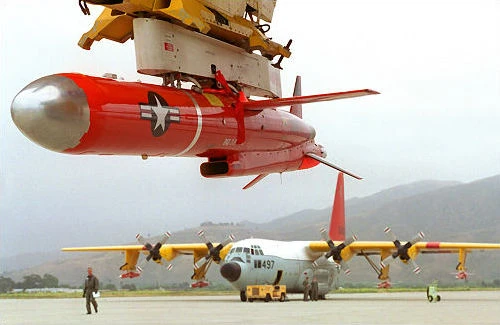
USAF Hunter-Killer
A U.S. Air Force tactical UCAV procurement program for endurance and strike.

The USAF Hunter-Killer was a tactical unmanned combat air vehicle (UCAV) procurement program initiated by the U.S. Air Force. It sought a less expensive, endurance-focused UCAV solution and attracted proposals from multiple aerospace companies. The program's name derived from an unofficial project designation based on an Aviation Week & Space Technology article, and the term 'Hunter-Killer' had earlier appeared in the 1984 film The Terminator to describe autonomous, twin-ducted fan UAS.
- Operating altitude
- 10.7 to 15.25 km
- Endurance
- 16 to 30 hours or more
- Warload
- 1,360 kg (six 225 kg guided bombs)
- Sensors
- SAR/MTI or EO/IR sensors and laser target designator
- Cost per aircraft
- US$10 million
- Cost per system
- US$30 million (two aircraft and support gear)
- Fielding target
- 2007
Lore & Background
The Hunter-Killer program was opened in the summer of 2004 as a short-term UCAV solution emphasizing endurance over stealth. Specifications required an operating altitude of 10.7 to 15.25 km, endurance of 16 to 30 hours or more carrying a warload of 1,360 kg (specifically six 225 kg guided bombs), and fitment of SAR/MTI or EO/IR sensors with a laser target designator. The aircraft would be capable of surveillance or reconnaissance missions alongside its combat role. Cost targets were set at US$10 million per aircraft and US$30 million per system, each system including two aircraft and support gear.
Several companies submitted proposals. Northrop Grumman offered two concepts: the Model 395, a militarized version of the Scaled Composites Proteus in pure UAV configuration with a sensor turret and SAR-MTI pod, capable of carrying six 225 kg munitions or a single 2,270 kg bunker buster; and the Model 396, effectively a half-weight Global Hawk with a 10.7 m wingspan, 7 m length, and 6,800 kg gross weight, powered by a single Pratt & Whitney 545 bizjet turbofan. General Atomics offered the turboprop-powered Predator B. Aurora Flight Sciences and Israel Aircraft Industries jointly offered an armed Heron II. Lockheed Martin responded but kept details quiet. Boeing did not submit a proposal, citing other UCAW work. Raytheon proposed a sixth option: a package of sensors, communications, and mission systems, with the airframe to be chosen later.
The Air Force intended to field the Hunter-Killer by 2007 and might order up to 60 machines. The program aimed to avoid 'gold plate', with most avionics likely off-the-shelf. Ultimately, the General Atomics MQ-9 Reaper, a variant of the MQ-1 Predator, won the project and was deployed in Afghanistan.
Reader's Guide
The Hunter-Killer program represented a pragmatic shift in U.S. Air Force UCAV procurement, prioritizing endurance, cost control, and rapid fielding over the high-stealth, high-cost approaches of concurrent projects like the J-UCAS. By setting firm cost caps of US$10 million per aircraft and US$30 million per system, the Air Force signaled a desire to avoid the 'gold plating' that had plagued other programs. The competition attracted a diverse range of proposals, from militarized business jets (Northrop Grumman Model 395) to scaled-down high-altitude platforms (Model 396) and turboprop designs (Predator B, Heron II). The eventual selection of the MQ-9 Reaper, a Predator variant, confirmed the service's preference for a proven, turboprop-powered platform with long endurance. The program's legacy is the operational deployment of the Reaper in Afghanistan, which established the Hunter-Killer concept as a mainstay of U.S. counterinsurgency and strike operations. The program also highlighted the tension between stealth and endurance, with the Hunter-Killer's focus on the latter influencing subsequent UCAV development.
Did You Know?
- The program's cost target was US$10 million per aircraft and US$30 million per system (two aircraft plus support gear).
- Northrop Grumman proposed a half-weight Global Hawk variant, the Model 396, with a wingspan of 10.7 m.
- The General Atomics MQ-9 Reaper, a Predator variant, won the Hunter-Killer project and was deployed in Afghanistan.
Frequently Asked Questions
What exactly was the USAF Hunter-Killer?
The Hunter-Killer was not a single delivered airframe but a U.S. Air Force procurement initiative seeking a cost-effective, long-endurance unmanned combat air vehicle for tactical strike and surveillance. Multiple aerospace firms submitted proposals, and the program was framed as a far cheaper alternative to manned fighters for persistent combat missions.
What were the Hunter-Killer's key operating specifications?
The program called for an aircraft flying between roughly 10.7 and 15.25 km, sustaining 16 to 30-plus hours aloft, and carrying up to six 225 kg guided munitions for a total warload of about 1,360 kg. Sensor fit included SAR/MTI or EO/IR packages paired with a laser target designator.
Where did the name 'Hunter-Killer' originally come from?
The label was an unofficial project designation that stuck after an Aviation Week & Space Technology article used the phrase to describe the program. The term had earlier entered pop-culture awareness when it described autonomous, twin-ducted-fan unmanned aircraft in the 1984 film The Terminator.
How much did the Hunter-Killer program cost?
The target price was roughly US$10 million per airframe and about US$30 million for a complete two-ship system including ground support equipment. That pricing was a central selling point, positioning the UCAV as a dramatically cheaper option than manned tactical aircraft for the same mission set.
Why does the Hunter-Killer matter in UAV history?
It was one of the earlier serious U.S. efforts to define a dedicated, affordable, long-endurance combat drone rather than simply retrofitting an existing airframe. Its emphasis on 16-plus-hour persistence and multi-target guided munitions helped shape the requirements that later UCAV and loyal-wingman concepts would inherit.
More in Unmanned Aerial Vehicles by Country, Part 5 1-24
Spotted an error? Know more?
Reader corrections go straight into our review queue. Suggest an edit · How this site is sourced