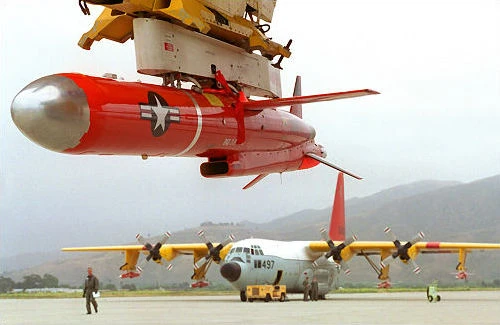
Unmanned Aerial Vehicle Battlelab
U.S. Air Force battlelab dedicated to UAV development and problem-solving.

The Unmanned Aerial Vehicle Battlelab is a U.S. Air Force flight test and development facility dedicated to unmanned aerial vehicles. It is one of six original Air Force battlelabs established in 1997 and falls directly under the Air Warfare Center.
- Established
- 1997
- Parent organization
- Air Warfare Center
- Location
- Creech Air Force Base, near Indian Springs, Nevada (recently moved from Eglin Air Force Base, Florida)
- Commanding officer
- Col. Larry Felder
- Number of liaisons
- 6
- Liaison organizations
- Air Force Research Laboratory, Electronic Systems Center, reserve components
Lore & Background
The battlelab's mission is to work UAV problems and then seek solutions from industry, academia, and service and national labs. According to Col. Larry Felder, who commands the unit and helped develop the original battlelab concept, the lab finds problems, identifies solutions, and transitions them to the warfighter through objective demonstrations. Although the core is on the West Coast, small UAV activities remain at Eglin Air Force Base, which serves as a seed corn of knowledge for training new personnel.
Initially aligned under the Air Warfare Center's 53rd Wing, control of the battlelab transferred to the Aerospace Command and Control and Intelligence, Surveillance and Reconnaissance Center at Langley Air Force Base, Virginia, on 1 March 1999. Control returned to the Air Warfare Center in April 2002 as the UAV mission evolved to include weapons delivery, forward-air control, and surface attack. The battlelab relies on six liaisons from the Air Force Research Laboratory, Electronic Systems Center, and reserve components to reach back into the lab system and forward into the acquisition system.
Reader's Guide
Since its inception, the battlelab has decreased the time it takes for UAV products to reach decision makers. Officials have improved UAV target precision coordinates from sensors and enhanced integration with other airborne intelligence, surveillance, and reconnaissance assets. The battlelab has also enhanced the UAV's ability to operate in civil airspace, improved friendly force combat identification, and illuminated enemy ground targets for attack. Colonel Felder noted that UAVs originally provided intelligence, surveillance, and reconnaissance, but have taken on additional roles including the shooter role. Unmanned combat aerial vehicles are expected to carry multiple payloads, pull high G-forces, penetrate previously inaccessible airspace, and hit high-risk targets without risking pilots' lives. The battlelab continues to support joint warfighting initiatives and is undergoing a buildup process, with the Eglin operating location managing the small UAV program and integral to training new personnel.
A World of Wings Without Pilots
The catalog of unmanned aerial vehicles stretches across every inhabited continent, from Algeria's AL fajer L-10 and Amel to France's Dassault nEUROn combat prototype. What unites these machines is the absence of an onboard pilot, yet their missions diverge enormously. In Australia, AAI Corporation's Aerosonde series has been dedicated to weather data collection, while in Argentina, AeroVision's Arcangel handles agricultural and civilian surveillance. Canada's PrecisionHawk Lancaster serves agriculture, and Denmark's Sky-Watch RQ-35 Heidrun focuses on electro-optical/infrared imaging and mapping. At the military end, Chile's Sirol and Sirol 221 pursue reconnaissance and meteorology research, and Croatia fields the BL M-99 Bojnik. Target drone roles appear in Brazil with the Aeromot K1AM and in France with the Aérospatiale C.22. The timeline spans decades: Belgium's MBLE Épervier dates to 1969, Canada's Canadair CL-89 to 1964, while Australia's Boeing MQ-28 Ghost Bat represents the cutting edge of air power teaming. Some entries like Argentina's Lipán XM4 remain in development, and Brazil's 14-X scramjet targets a staggering Mach 10, illustrating that the field still has dramatic frontiers to explore.
Australia's Drone Playground
Australia's section is the most densely populated in the entire catalog, reflecting a remarkably layered UAV ecosystem. At the research and weather end, AAI Corporation's Aerosonde line runs through four marks (Mk.1 through Mk.4) plus the Aeroguard variant, all oriented toward atmospheric data. The military and defense tier includes BAE Systems' Brumby, Kingfisher, and STRIX, alongside Boeing's MQ-28 Ghost Bat air power teaming system. A whole family of Cyber Technology products—CyberQuad, CyberEye, CyBird, and CyberWraith—suggests a dedicated niche in small tactical platforms. The V-TOL category alone lists nine distinct models: i-copter Phantom, Seeker, Mini Warrigal, Warrigal Explorer, Explore, Arrow, Quadrotor, and Octocopter, indicating a strong vertical-takeoff-and-landing tradition. Other notable names include CSIRO's Mantis, GAF's Jindivik and Turana, Entecho's Demipod and Mupod, ADI's Jandu, Skyborne Technologies' Cerberus GLH and Gannet Glide Drone, and UAV Vision's G18 Aeolus, T21, and T26. The sheer variety of manufacturers and mission profiles makes Australia's entry read less like a simple list and more like a snapshot of an entire national drone industry in miniature.
Brazil's Ambitious Sky
Brazil's UAV portfolio is one of the most ambitious and varied in the catalog, spanning experimental hypersonics to farmer-friendly quadcopters. At the bleeding edge sits the 14-X, a Mach 10 scramjet under development by the Brazilian Air Force. The military reconnaissance and target-drone segment is equally deep: the Aeromot K1AM serves as a Navy target drone derived from the Northrop KD2R-5, the Caçador is developed from the Israeli IAI Heron, and the Harpia medium tactical UAV—born from a joint venture of Embraer Defense and Security, AEL Systems, and Avibras—was halted in January 2016. The Flight Technologies family, including the FS-01 Watchdog, FS-02 AvantVision, FT-100 Horus, FT-200 Watchdog, and VT-15, shows a clear progression of soldier-portable and tactical reconnaissance platforms, some already in small service with the Brazilian Army. Santos Lab contributes the Carcara and Carcara II infantry-portable UAVs for the Marine Corps and Navy, as well as the Jabirú. Agricultural and civilian roles are covered by AGPlane, the 4 kg Tiriba, and Gyrofly Innovations' Gyro 200 ED and Gyro 500 quadcopters. The XMobots Nauru 500C has seen operational use by both the Air Force and Navy, including CENSIPAM's Operation Catramani II.
France's Research-to-Combat Pipeline
France's entries trace a clear arc from simple target drones to sophisticated combat and research platforms. The Aérospatiale C.22 and CAC K100 represent the older generation of target and training drones, while the CAC Fox and Dassault LOGIDUC occupy intermediate roles. The Dassault AVE-D Petit Duc (2000) and AVE-C Moyen Duc (2001) were explicitly research aircraft, part of a broader effort to validate autonomous flight concepts. That research lineage culminated in the Dassault nEUROn, a combat UAV that was expected to enter service around 2011, representing France's most advanced entry in the list. The Dassault-Sagem SlowFast (2004) and EADS Harfang (2006) push into long-range reconnaissance, while the EADS Talarion occupies a higher-altitude, longer-endurance niche. On the lighter side, Flying-Robots' FR102 (2008) uses soft-wing technology, and the Donecle drone performs autonomous aircraft inspection—a civilian application that underscores how French UAV development is not exclusively military. The presence of ARSAERO CT 10, Altec MART, Delair, and Lehmann Aviation's L-A series further illustrates a broad industrial base supporting the sector.
Frequently Asked Questions
What is the Unmanned Aerial Vehicle Battlelab?
It is a U.S. Air Force facility dedicated to flight testing and developing unmanned aerial vehicles. It was one of six original Air Force battlelabs stood up in 1997 and reports directly to the Air Warfare Center.
Where is the UAV Battlelab based?
The facility currently operates out of Creech Air Force Base near Indian Springs, Nevada. It previously ran out of Eglin Air Force Base in Florida before relocating to its present site.
What does the UAV Battlelab actually do day to day?
It acts as the Air Force's dedicated hub for UAV development and solving technical problems in the unmanned domain. The lab maintains six liaison ties to partner organizations, including the Air Force Research Laboratory, the Electronic Systems Center, and reserve components.
Who commands the UAV Battlelab?
Colonel Larry Felder serves as the commanding officer of the facility. The unit sits under the Air Warfare Center, which is its parent organization within the Air Force structure.
Why is the UAV Battlelab significant in Air Force history?
It was part of the original six battlelabs the Air Force created in 1997 to centralize and streamline development work. Its exclusive focus on unmanned aerial vehicles makes it a key node in the service's UAV research and test pipeline.
More in Unmanned Aerial Vehicles by Country, Part 5 1-24
Spotted an error? Know more?
Reader corrections go straight into our review queue. Suggest an edit · How this site is sourced