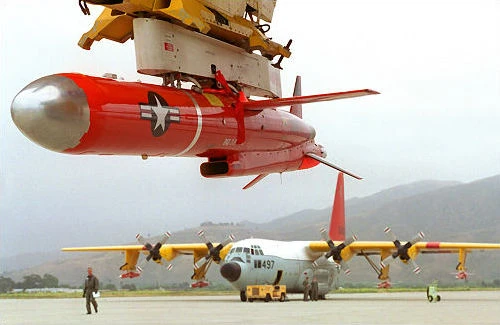
Project Gorgon
Experimental U.S. Navy missile family advancing guidance and control technologies.

Project Gorgon encompassed a family of experimental missiles—air-to-air, air-to-surface, and surface-to-surface—built by the U.S. Navy’s Naval Aircraft Modification Unit from 1943 to 1953. Because the underlying technology was not yet mature, none of the Gorgon missiles ever entered active service; instead, they served as testbeds for advancing guided-missile control and guidance systems.
The program originated in the late 1930s, when Commander Delmer S. Fahrney proposed an “aerial torpedo” to intercept bombers. The Navy’s Bureau of Aeronautics studied the idea in 1940, but it was not until May 1943—when practical jet and rocket engines became available—that the Gorgon project formally began, based at the Naval Aircraft Modification Unit (later the Naval Air Development Station) in Pennsylvania.
The initial Gorgon design called for a turbojet-powered missile weighing about 660 pounds, capable of 510 mph, intended to destroy bombers or transport aircraft. Guidance options considered included television (with a camera in the nose and radio commands), active radar homing, and infrared homing. By October 1943, delays in developing suitable small turbojets and aerodynamic studies led to two parallel designs: the canard-configured Gorgon II and the conventional-aircraft-style Gorgon III. Each was to have three engine variants: ‘A’ (rocket), ‘B’ (turbojet), and ‘C’ (pulsejet). The turbojet-powered IIB and IIIB were never built due to engine limitations, though a small number of target drones derived from the Gorgon III were produced. The Gorgon IIIC was later changed to a twin-rocket configuration. In May 1945, the ramjet-powered Gorgon IV, an air-to-surface missile, was added.
The Gorgon IIA first flew successfully in March 1945 and was noted as the first jet- or rocket-powered radio-controlled aircraft to fly in the United States. However, guidance-system limitations—project officer Molt Taylor worried that human operators could not process information fast enough at the missiles’ speeds—and other technical problems meant that by late 1945, after World War II ended, production contracts for air-launched Gorgon variants were shifted to pure technology demonstration and development, which was generally considered successful.
Quick Facts
- Origin
- United States
- Is Missile
- y
- Design Date
- 1943
- Production Date
- from 1943 to 1953
Facts from the source article.
Lore & Background
The Gorgon program originated in May 1943 when the United States Navy initiated development of a turbojet-powered missile of approximately 660 lb, capable of 510 mph, intended to destroy bombers or transport aircraft. Guidance options considered included television guidance with a camera in the missile's nose and radio steering commands, active radar homing, or infrared homing. By October 1943, delays in small turbojet engines led to two designs: the canard-configured Gorgon II and the conventional-aircraft-shaped Gorgon III, each with rocket (A), turbojet (B), or pulsejet (C) variants. Neither Gorgon IIB nor IIIB were built due to turbojet limitations, and Gorgon IIIC was changed to a twin-rocket configuration. In May 1945, the ramjet-powered Gorgon IV air-to-surface missile was added.
Gorgon IIA successfully flew in March 1945, becoming the first jet- or rocket-powered radio-controlled aircraft to fly in the United States. However, project officer Molt Taylor expressed concerns about the human mind's ability to process information quickly enough at missile speeds. By late 1945, with World War II ending, production contracts for air-launched variants shifted to a technology-demonstration program. The surface-launched Gorgon IIC had been planned for Operation Downfall, the invasion of Japan, with a hundred missiles ordered from the Singer Manufacturing Company, but the atomic bombings of Hiroshima and Nagasaki ended the war and cancelled production, making Gorgon IIC a research-only project.
The final variant was the Pollux, a pulsejet test vehicle based on the Gorgon IIC, flown between 1949 and 1951. In 1950, the Cold War and the Korean War prompted a proposal to develop the Gorgon IV airframe into a chemical-weapons dispenser, designated Gorgon V. Work on Gorgon V continued until late 1953, when the program was cancelled.
Reader's Guide
Project Gorgon's significance lies in its role as a testbed for guided missile technologies during a period when such systems were in their infancy. Although none of its variants reached operational service, the program provided extensive practical experience with radio control, jet and rocket propulsion, and guidance methods including television, radar, and infrared homing. The Gorgon IIA's first flight in March 1945 marked a milestone as the first successful radio-controlled jet- or rocket-powered aircraft in the United States. The program's diversification into multiple airframes and powerplants—turbojet, rocket, pulsejet, and ramjet—allowed systematic exploration of aerodynamic and propulsion challenges. The shift from production to pure research after World War II reflected the technological limitations of the era, particularly in guidance systems, as noted by project officer Molt Taylor. The later Pollux test vehicle and the proposed Gorgon V chemical dispenser show the program's continued relevance into the early Cold War. Ultimately, the Gorgon family contributed foundational knowledge that informed subsequent U.S. missile development, even as the project itself was cancelled in 1953.
Did You Know?
- The Gorgon IIA was the first jet- or rocket-powered radio-controlled aircraft to successfully fly in the United States.
- The Gorgon IIC was planned for use in Operation Downfall, the invasion of Japan, with 100 missiles ordered from the Singer Manufacturing Company.
- The final Gorgon variant was the Pollux, a pulsejet test vehicle flown between 1949 and 1951.
- The Gorgon V was proposed as a chemical-weapons dispenser based on the Gorgon IV airframe.
Frequently Asked Questions
What is Project Gorgon?
Project Gorgon was a U.S. Navy experimental missile family developed by the Naval Aircraft Modification Unit between 1943 and 1953. It spanned air-to-air, air-to-surface, and surface-to-surface configurations, though none of the variants ever reached operational status.
What role did the Gorgon missiles actually play?
Rather than serving as combat weapons, the Gorgon missiles functioned as flying testbeds for maturing guided-missile guidance and control technologies. Their experimental flights provided the data needed to push radio-control and autopilot systems toward practical military use.
What was the Gorgon IIA's landmark achievement?
In March 1945, the Gorgon IIA completed the first successful flight of a jet- or rocket-powered radio-controlled aircraft in the United States. That milestone demonstrated that a fully autonomous, powered aerial vehicle could be steered by radio command, a critical step for the guided-weapon era.
How did the Project Gorgon program end?
The final variant, a pulsejet-powered test vehicle called Pollux, flew between 1949 and 1951, after which the program wound down and officially closed in 1953. Because the underlying guidance technology was still immature throughout, no Gorgon missile was ever accepted into active Navy service.
Who originally conceived the idea behind Project Gorgon?
The concept traces back to the late 1930s, when Commander Delmer S. Fahrney proposed an 'aerial torpedo' designed to intercept enemy bombers. The Navy's Bureau of Aeronautics reviewed the proposal in 1940, laying the groundwork for the formal Gorgon program that would begin in 1943.
More in Unmanned Aerial Vehicles by Country, Part 5 1-24
Spotted an error? Know more?
Reader corrections go straight into our review queue. Suggest an edit · How this site is sourced