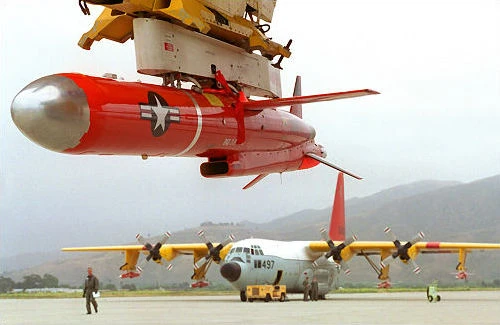
Unmanned aerial vehicles in the United States military
The U.S. military operates a vast and growing fleet of unmanned aerial systems.

The United States military operates a large number of unmanned aerial vehicles (UAVs), also known as Unmanned Aircraft Systems (UAS). The military role of these systems has grown at unprecedented rates, with tactical- and theater-level unmanned aircraft alone having flown over 100,000 flight hours in 2005 in support of Operation Enduring Freedom and Operation Iraqi Freedom.
- Total uavs as of 2014
- 7,362 RQ-11 Ravens; 990 AeroVironment Wasp IIIs; 1,137 AeroVironment RQ-20 Pumas; 306 RQ-16 T-Hawk; 246 MQ-1 Predators; MQ-1C Gray Eagles; 126 MQ-9 Reapers; 491 RQ-7 Shadows; 33 RQ-4 Global Hawk
- First armed uav use
- 2001, MQ-1 Predator carrying anti-tank missiles into Afghanistan, controlled by the Central Intelligence Agency
- Flight hours logging
- Until 2006, flight hours by UAVs were not logged; the DoD now states that millions of UAV flight hours have been logged
- Cost range
- From a few thousand dollars to tens of millions of dollars
- Weight range
- From less than 1 lb to over 40,000 lb
- Armed strikes in 2009
- 43 between January and October 2009
- Armed strikes in 2008
- 34 in all of 2008
Lore & Background
The modern concept of U.S. military UAVs is to have the various aircraft systems work together in support of personnel on the ground, described in terms of a 'Tier' system used by military planners. The U.S. Air Force and the U.S. Marine Corps each have their own tier systems, which are not integrated. UAVs no longer perform solely intelligence, surveillance, and reconnaissance missions, though these remain predominant; roles have expanded to include electronic attack, drone strikes, suppression or destruction of enemy air defense, network node or communications relay, combat search and rescue, and derivations of these themes.
The first use of armed UAVs was in 2001, when an MQ-1 Predator carried anti-tank missiles into Afghanistan, controlled by the Central Intelligence Agency. Throughout U.S. missions in Iraq, Afghanistan, and Iran, rapid improvements in technology enabled steadily increasing capabilities on smaller airframes, contributing to a large increase in the number of unmanned systems deployed on the battlefield. This trend continued following American withdrawals from the Middle East and Central Asia.
The Obama administration announced the deployment of 30,000 new troops in Afghanistan in December 2009, but there was already an increase of attacks by unmanned Predator UAVs against Taliban and al-Qaeda militants in Afghanistan and Pakistan's tribal areas. Between 2006 and 2009, UAV-launched missiles allegedly killed between 750 and 1,000 people in Pakistan, of which about 20 were said to be leaders of al-Qaeda, Taliban, and associated groups; 66 to 68 percent of those killed were militants, and 31 to 33 percent were civilians, though U.S. officials disputed the percentage for civilians.
Reader's Guide
The significance of U.S. military unmanned aerial vehicles lies in their transformation from intelligence-gathering platforms to armed systems capable of targeted strikes, a shift that began in 2001. The rapid increase in deployment and flight hours—over 100,000 in 2005 alone—reflects their growing centrality to U.S. operations in Afghanistan and Iraq. The use of armed Predators for targeted killings, including the first such attack outside a theater of war in Yemen in 2002, established a precedent that expanded under subsequent administrations.
The legacy of these systems includes ongoing debate over legality and morality. Dr. Peter Lee noted that no weapon system since nuclear controversies of the 1980s has prompted more debate. Amitai Etzioni stated that while drones have been successful against Al-Qaida and Taliban members, 24% of kills have been civilian casualties, which she considered to have given rise to increased violence. The first UN General Assembly side event on UAVs in 2015 concluded that clarity surrounding drone strikes is required for legal interpretation of international humanitarian laws. CIA-ordered drone strikes were ended by President Obama, transferring control to the military; President Trump reversed this decision in 2017.
Did You Know?
- As of 2014, the U.S. military operated 7,362 RQ-11 Ravens, 246 MQ-1 Predators, and 126 MQ-9 Reapers among other systems.
- The first UN General Assembly side event on Unmanned Aerial Vehicles was held on 23 October 2015.
Origins: From Hobbyist to DARPA Prototype
The story of the combat drone stretches back further than most people realize. In 1940, inventor Lee de Forest and electrical engineer U.A. Sanabria proposed a radio-command vehicle in a Popular Mechanics article, laying early conceptual groundwork. Yet the figure most credited with birthing the modern military drone was John Stuart Foster Jr., a nuclear physicist at Lawrence Livermore Laboratory who was also a model airplane hobbyist. In 1971, Foster envisioned applying his hobby to weapons development, and by 1973 DARPA had built two prototypes named Prairie and Calera. These small craft, powered by a modified lawn-mower engine, could remain airborne for two hours while carrying a 28-pound payload. What made the early timeline particularly interesting was the strategic context: the United States, Israel, and Iran were all allied powers before 1979, and their simultaneous pursuit of combat UAV technology in the 1970s and 1980s reflected that shared strategic environment rather than independent invention.
Proving Grounds: Decoys, Desert Storm, and the First Kill
The combat drone first proved its worth not by killing, but by dying in place of pilots. During the 1973 Yom Kippur War, Israel flew unarmed American-made Ryan Firebee target drones to bait Egypt into expending its entire anti-aircraft missile stockpile. With Egyptian defenses drained, Israeli pilots struck with impunity. A decade later, in Operation Mole Cricket 19 at the opening of the 1982 Lebanon War, Israeli UAVs provided real-time surveillance and radar decoying that helped neutralize Syrian air defenses entirely, again with no pilots lost. Iran, meanwhile, fielded a drone carrying six RPG-7 rounds during the Iran-Iraq War in the late 1980s. The United States, impressed by these results, acquired Hunter and Pioneer systems directly derived from Israeli designs. The first true UAV war came during Desert Storm in 1991, when a Navy report confirmed that at least one unmanned aircraft was airborne at all times throughout the campaign. That demonstration of sustained, reliable utility triggered a global wave of domestic combat drone investment.
The Human Toll of the Drone Strike Era
The transition from reconnaissance tool to precision killer brought a deeply controversial chapter. On October 7, 2001, an American UAV carried out what is recorded as the first confirmed kill by an unmanned aircraft, striking a target in Kandahar. From 2004 through late 2012, the United States dramatically expanded its drone strike campaign against targets in Pakistan and other regions as part of the broader war on terror. The human cost mounted steadily: by January 2014, estimates placed the number of people killed by U.S. drone strikes over the preceding five years at approximately 2,400. By June 2015, that figure had climbed past 6,000. These strikes represented a fundamentally different operational tempo from traditional air campaigns—prolonged loitering over target areas, real-time remote control from operators far from the battlefield, and the ability to strike high-value targets with minimal risk to the operator. The absence of an onboard pilot eliminated the need for life-support and ejection systems, allowing smaller, lighter airframes for the same payload, but it also removed the immediate human cost that had historically constrained the use of aerial force.
Autonomy, Loyal Wingmen, and the Counter-Drone Arms Race
The next frontier for UCAVs is not simply more firepower but deeper autonomy. Modern platforms are being equipped with artificial intelligence capable of autonomous sensor fusion, real-time target identification, and dynamic mission re-planning—functions that dramatically reduce the cognitive burden on human operators. This integration is central to network-centric warfare, where data flows seamlessly from satellites to ground units, creating a fused battlespace picture that accelerates decision cycles. A particularly ambitious doctrinal concept is the loyal wingman UCAV, designed to fly in collaborative teams alongside manned fighter jets. These drones would absorb high-risk tasks such as electronic attack, forward reconnaissance, and weapons delivery, effectively shielding human pilots and multiplying force. Yet this rapid capability growth has triggered a parallel arms race in countermeasures. Militaries are developing advanced electronic warfare suites, directed-energy weapons, and dedicated anti-drone systems designed to disrupt, deceive, or destroy incoming UCAVs. By March 2026, the British government had indicated it possessed aerial minesweeping drones and was weighing deployment in the Strait of Hormuz, signaling that unmanned aerial systems are now embedded across the full spectrum of strategic operations.
Frequently Asked Questions
What is the scope of the U.S. military's UAV fleet as of 2014?
The inventory included over 7,300 RQ-11 Ravens alongside thousands of other airframes such as MQ-9 Reapers, RQ-7 Shadows, and 33 RQ-4 Global Hawks. The fleet spans an extraordinary size range, from sub-1-pound micro-drones to platforms exceeding 40,000 pounds.
When did the U.S. military first employ an armed UAV in a combat mission?
That milestone came in 2001, when an MQ-1 Predator carrying anti-tank missiles was flown over Afghanistan. Notably, the aircraft was directed by the Central Intelligence Agency rather than a traditional military service.
How many flight hours did U.S. military UAVs log during the early post-9/11 war years?
In 2005, tactical- and theater-level unmanned aircraft alone accumulated more than 100,000 flight hours in support of operations in Afghanistan and Iraq. Prior to 2006 the Department of Defense did not systematically record these hours, but it now reports that millions of UAV flight hours have been logged since tracking began.
What is the cost range across the U.S. military's UAV systems?
Individual platforms vary from a few thousand dollars for small tactical drones to tens of millions of dollars for large strategic aircraft like the Global Hawk. This spread reflects the wide diversity of missions, from short-range battlefield reconnaissance to long-endurance, high-altitude surveillance.
How many armed strikes did U.S. military UAVs carry out in 2009?
Between January and October 2009, U.S. military unmanned aircraft executed 43 armed strikes. That figure underscores how rapidly UAVs shifted from a purely reconnaissance role to a primary precision-strike asset within just a few years of their introduction.
More in Unmanned Aerial Vehicles by Country, Part 5 1-24
Spotted an error? Know more?
Reader corrections go straight into our review queue. Suggest an edit · How this site is sourced