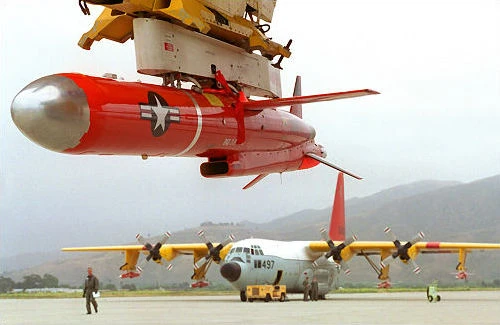
Ryan AQM-91 Firefly
A stealthy reconnaissance drone developed for deep penetration of China.

The Ryan AQM-91 Firefly was a prototype reconnaissance drone developed during the Vietnam War, intended to conduct long-range surveillance missions, particularly over China.
The earlier Ryan Model 147 Lightning Bug drones had proven effective in Southeast Asia during the 1960s, but they could not reach deep into China. The Chinese nuclear facility at Lop Nor was beyond the Lightning Bug’s range and barely within reach of the Lockheed U-2, which had become highly vulnerable to surface-to-air missiles. U.S. intelligence needed a new, survivable long-range drone, requiring a clean-sheet design rather than a modified target drone.
Ryan had been working on advanced drone concepts intermittently. After unsuccessful talks with the CIA, the company pitched its ideas to the Air Force in early 1966. The Air Force opened a design competition between Ryan and North American Aviation. Before a contract was awarded, National Reconnaissance Office director Alexander H. Flax clashed with the Air Force Systems Command over control of the project, but the Air Force prevailed. In June 1966, Ryan received a contract for 100 production models, designated the Model 154 / AQM-91A Firefly. The design resembled Ryan’s earlier Model 136 Red Wagon drone, which had been rejected in favor of modified Firebees. The name “Firefly” was reused from an early Model 147 program, and the project was also called “Compass Arrow.”
A year after the contract was awarded, the NRO reduced the order from 100 to 20 drones.
Test flights took place over the U.S. Southwest. The project was highly classified, but on August 4, 1969, a prototype malfunctioned and parachuted into the Los Alamos nuclear research complex during lunch hour. It landed outside a restricted area, and local journalists photographed the aircraft. The Air Force claimed it was a “high altitude target.”
Flights were paused for a few weeks while procedures were reviewed, then resumed. Long-range evaluations concluded in late 1971. The Model 154 exceeded its altitude requirements and proved nearly invisible to radar. By then, however, its mission had evaporated. In July 1971, President Richard Nixon began diplomatic outreach to China, ending reconnaissance overflights.
Quick Facts
- National Origin
- United States
- Manufacturer
- Ryan Aeronautical
- First Flight
- September 1968
- Number Built
- 28
Facts from the source article.
Lore & Background
The Ryan Model 147 Lightning Bug reconnaissance drone was used successfully in Southeast Asia during the 1960s, but lacked the range to fly deep into China. The Chinese nuclear facility at Lop Nor was out of reach for the Lightning Bugs and barely within reach of the Lockheed U-2, both of which had become vulnerable to surface-to-air missiles. US intelligence required a long-range drone with high survivability, leading to a completely new design rather than a modification of a target drone. Ryan pursued advanced drone concepts on a part-time basis and, after discussions with the CIA that went nowhere, pitched their concepts to the Air Force in early 1966. The USAF opened a design competition between Ryan and North American Aviation. Before the contract was awarded, National Reconnaissance Office director Alexander H. Flax fought with the Air Force Systems Command for control, but the USAF won and awarded Ryan the contract for 100 production models in June 1966. The design resembled the earlier Model 136 Red Wagon drone. The name 'Firefly' was resurrected from the early Model 147 program, though it was also called 'Compass Arrow' after the program name. A year later, the NRO cut production from 100 to 20. Test flights were conducted over the US Southwest. On 4 August 1969, a prototype failed and parachuted into the Los Alamos nuclear research complex during lunch hour, landing in an unsecured area where local newspeople photographed it. The Air Force stated it was a 'high altitude target'. Flights resumed and culminated in long-range evaluations in late 1971. The Model 154 exceeded altitude requirements and proved almost invisible to radar. However, by then the need had vanished: in July 1971, President Richard Nixon began diplomatic efforts with China, ending reconnaissance overflights, and satellite capabilities had improved with the KH-9 Hexagon satellite launched on 15 June 1971. The program lingered until 1973, when all were mothballed and later scrapped. Twenty-eight had been built, including 20 production models, taking five years to build at a cost of $250 million. According to project manager Robert Schwanhausser, Israel sought to acquire these drones before the Yom Kippur War; engineer John Dale added that Richard Nixon personally ordered their destruction to prevent them from reaching Israeli hands.
Reader's Guide
The Ryan AQM-91 Firefly represents a transitional moment in reconnaissance technology, where stealth and long-range drone capabilities were developed but rendered obsolete by diplomatic and satellite advances. Its design incorporated early stealth features: an engine mounted on top of the fuselage to reduce radar and infrared signatures from below, twin inward-canted tailfins to conceal the exhaust, a flat-bottomed fuselage, sloped sides to deflect radar, a high percentage of plastic composite materials, and radar-absorbent material on wing edges. The engine exhaust was mixed with cool air to reduce infrared signature. The drone was launched by a DC-130 Hercules and recovered by helicopter midair. It had a precision-navigation autopilot, a self-destruct system, and could carry electronic countermeasures. The primary payload was an Itek KA-80A Optical Bar Camera, with provisions for thermographic or SIGINT payloads. The guidance system aimed for navigation errors of no more than half a percent but proved tricky; the first powered flight occurred in September 1968. The program's cancellation due to Nixon's China opening and improved satellites highlights how quickly strategic needs can shift, leaving a capable but unused system. The alleged Israeli interest and Nixon's order to destroy the drones add a layer of geopolitical intrigue, though the details remain disputed among those involved.
Did You Know?
- The AQM-91 Firefly was designed to fly deep into China, targeting the Lop Nor nuclear facility.
- On 4 August 1969, a prototype crashed into the Los Alamos nuclear complex during lunch hour and was photographed by local news.
- The drone's engine was mounted on top of the fuselage to reduce radar and infrared detection from below.
- According to project manager Robert Schwanhausser, Israel sought to acquire the shelved drones before the Yom Kippur War.
Frequently Asked Questions
What is the Ryan AQM-91 Firefly?
The AQM-91A Firefly (Ryan Model 154) was a long-range reconnaissance drone conceived during the Vietnam era to fly deep into Chinese airspace and photograph targets that no other U.S. platform could safely reach. It was a ground-up design rather than an evolution of the earlier Lightning Bug series.
Why did the U.S. need the Ryan AQM-91 Firefly?
The existing Ryan Model 147 Lightning Bug simply lacked the range to cover sites like the Lop Nor nuclear complex, while the manned Lockheed U-2 had grown increasingly exposed to Chinese surface-to-air missiles. Intelligence leaders therefore called for a new, survivable, long-endurance unmanned system specifically for deep-penetration surveillance over China.
Who manufactured the Ryan AQM-91 Firefly and what engine did it use?
Ryan Aeronautical built the airframe under the Compass Arrow program, with the contract awarded in June 1966. Propulsion came from a General Electric YJ97-GE-3 turbojet producing roughly 4,000 pounds of thrust.
How many Ryan AQM-91 Firefly drones were actually produced?
A total of 28 airframes were built, of which 20 were designated as production models. The remainder served as development and test vehicles during the Compass Arrow program.
What made the Ryan AQM-91 Firefly different from the earlier Lightning Bug?
Where the Lightning Bug was a small, piston-powered drone with limited endurance, the Firefly was a clean-sheet, jet-powered design meant to cover far greater distances and operate at higher altitudes. Its entire mission profile targeted deep Chinese territory, a reach the Lightning Bug could never achieve.
More in Unmanned Aerial Vehicles by Country, Part 5 1-24
Spotted an error? Know more?
Reader corrections go straight into our review queue. Suggest an edit · How this site is sourced