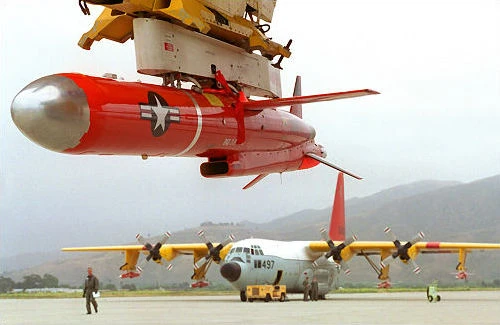
Ryan Model 147
Jet-powered reconnaissance drone developed from the Ryan Firebee target drone.

The Ryan Model 147 Lightning Bug was a jet-powered drone, an unmanned aerial vehicle built by Ryan Aeronautical. It evolved from the company’s earlier Ryan Firebee target drone series. First introduced in 1962, the Model 147 served as a reconnaissance remotely piloted vehicle (RPV) for a U.S. Air Force project called Fire Fly. Over the following decade, with secret funding from the newly formed National Reconnaissance Office, support from the Strategic Air Command, and Ryan’s own resources, the basic design branched into many variants. These were configured for a wide range of missions, including high- and low-altitude photographic and electronic reconnaissance, surveillance, acting as a decoy, electronic warfare, signals intelligence, and psychological warfare. New systems, sensors, and payloads were constantly modified and improved during the drones’ operational deployment in Southeast Asia.
To keep things simple and save weight, the Ryan drones had no landing gear. Like the Firebee before it, the Model 147 could be launched from a larger carrier aircraft in the air or from the ground using a solid rocket booster. When its mission was done, the drone deployed a recovery parachute. A helicopter could snatch this parachute in mid-air—though in a combat zone, recovering the drone over or near enemy territory was naturally undesirable, and a ground or water landing could damage or destroy the drone or its payload.
After the Vietnam War ended in 1975, U.S. military funding and the need for combat drones dropped sharply. Even though Teledyne Ryan kept developing more advanced versions of the Model 147 series—like the BGM-34 strike and defense suppression RPVs—the cost of keeping the Lightning Bugs at full readiness was no longer justifiable. It wasn’t until the 1990s that the U.S. Air Force and intelligence agencies again showed substantial interest, organized efforts, and provided funding to develop, acquire, and widely deploy combat UAVs.
**Development**
**Ryan Model 136 Red Wagon and Lucy Lee** In 1959, Ryan Aeronautical studied how its Firebee target drone could be used for long-range reconnaissance. Engineers figured they could extend the Firebee’s range so it could fly south over the Soviet Union after launch from the Barents Sea, with recovery in Turkey. The Firebee already had a low radar cross-section, making it hard to detect.
Quick Facts
- Manufacturer
- Ryan Aeronautical
- First Flight
- 1962
- Primary User
- United States Air Force
- More Users
- United States Navy
- Developed From
- Ryan Firebee
Facts from the source article.
Lore & Background
Development began in 1959 when Ryan Aeronautical studied using the Firebee target drone for long-range reconnaissance. After the shootdown of a U-2 over the USSR in May 1960 and an RB-47H in July 1960, the Air Force awarded Ryan a contract for further studies. Ryan conducted radar measurements on sub-scale Firebee models, reducing radar signature with a wire screen over the jet intake, non-conductive paint, and radar-absorbent material pads. Test flights in September and October 1961 were given a cover story describing the drones as high-altitude SAM targets. Ryan proposed a new drone, the Model 136 Red Wagon, but it stalled. Another proposal, Lucy Lee, was cancelled in January 1962. The Air Force then selected the cheapest option: a reconnaissance drone based on a Firebee with minimal changes. A $1.1 million contract on 2 February 1962 requested four modified Firebees, funded under the Big Safari program. The first Model 147A was a standard Firebee with a timer-programmer, gyrocompass, and altimeter; it carried no cameras. Three test flights in April 1962 demonstrated the concept. The second Model 147A had a 35-inch fuselage plug for extra fuel and a U-2 camera. After successful tests, the third and fourth Model 147As were deployed at Holloman Air Force Base with a DC-130 launch aircraft. During the Cuban Missile Crisis, Model 147As were authorized for reconnaissance missions after a U-2 was shot down over Cuba, but the mission was scrubbed by Air Force Chief of Staff Curtis LeMay. The Model 147B was designed for high-altitude reconnaissance with a 27-foot wingspan and ceiling of 62,500 feet. The Model 147C was a production version of the 147A.
Reader's Guide
The Ryan Model 147 series represented a significant step in the development of unmanned aerial vehicles for military reconnaissance. Its operational deployment in Southeast Asia demonstrated the viability of remotely piloted vehicles for a wide range of missions, including high and low-altitude photographic and electronic reconnaissance, surveillance, decoy operations, electronic warfare, signals intelligence, and psychological warfare. The drones were designed without landing gear, launched either from a carrier aircraft or by solid rocket booster, and recovered via parachute snatched by a helicopter. At the end of the Vietnam War in 1975, funding and need for combat drones declined sharply, and costs of maintaining the Lightning Bugs at full readiness could no longer be justified, despite further advanced developments such as the BGM-34 strike and defense suppression RPVs. Only by the 1990s did substantial interest, organization, and funding again emerge from the U.S. Air Force and intelligence agencies to develop, acquire, and widely deploy combat UAVs. The Model 147 thus served as a foundational platform that bridged early drone experiments and later operational UAV programs.
Did You Know?
- The Model 147 was developed from the Ryan Firebee target drone series.
- It could be air-launched from a DC-130 Hercules or ground-launched using a solid rocket booster.
- The drone deployed a recovery parachute that could be snatched in mid-air by a helicopter.
Frequently Asked Questions
What is the Ryan Model 147 Lightning Bug?
It was a jet-powered unmanned aerial vehicle manufactured by Ryan Aeronautical, with its first flight in April 1962. The aircraft grew out of Ryan's earlier Firebee target drone line and was configured as a reconnaissance remotely piloted vehicle.
What was the Ryan Model 147's primary mission?
The Lightning Bug served as a reconnaissance drone under the U.S. Air Force's Fire Fly project. Over the following decade it was expanded into numerous variants tailored to a broad range of intelligence-gathering missions, with secret backing from the National Reconnaissance Office.
Who operated the Ryan Model 147?
The principal users were the United States Air Force, the National Reconnaissance Office, and the Strategic Air Command. Ryan Aeronautical also poured its own resources into keeping the program alive and developing new variants.
How did the Ryan Model 147 come to be?
It was developed as a natural evolution of Ryan's Firebee target drone, with the prototype taking to the air in April 1962. From that base design, the aircraft was adapted into many variants over the next ten years, funded through a mix of covert NRO money, SAC support, and Ryan's internal investment.
What are the Ryan Model 147's size and dimensions?
The Model 147A measured 22 feet long (25 feet when fitted with a fuel plug) and had a 13-foot wingspan. The larger Model 147B variant stretched to a 27-foot wingspan.
More in Unmanned Aerial Vehicles by Country, Part 5 1-24
Spotted an error? Know more?
Reader corrections go straight into our review queue. Suggest an edit · How this site is sourced