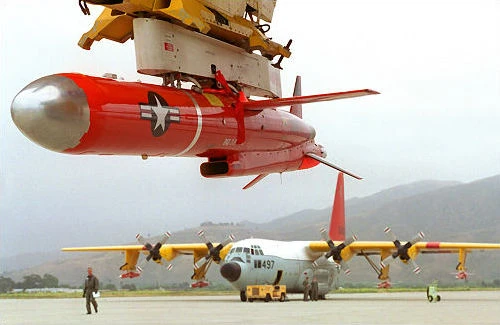
Tadiran Mastiff
Regarded by some as the first modern surveillance UAV.

The Tadiran Mastiff is a battlefield unmanned aerial vehicle produced by Israel’s Tadiran Electronic Industries. Some military historians consider it the first modern surveillance drone used by armed forces.
The Mastiff first flew in 1973. It carried a data-link system and compact electronics that sent live, high-resolution video of the target area back to operators. This combination of real-time video and a flight endurance exceeding seven hours gave Israeli forces deeper coverage, faster intelligence, and longer on-station surveillance than before.
Its engine was a German-made Limbach Flugmotoren two-cylinder, two-stroke motor, driving a two-blade pusher propeller built by Propeller Engineering & Duplicating, Inc. of San Clemente, California.
After the 1973 Yom Kippur War, the Israeli Defence Forces required a way for field commanders to see “over the hill.” The needed vehicle had to carry a 10 kg payload over distances of 30 to 50 km. Tadiran began developing the Mastiff Mini Remote Piloted Vehicle after a group of entrepreneurs approached the company to supply the Mastiff’s radio command system.
The program was also sold to the United States Navy, which deployed the Mastiff aboard aircraft carriers and at Camp Talega in Southern California. The Marine Corps’ VMUT-2 squadron used it from 1984 to 1986.
Three generations of the Mastiff served operationally with the IDF. Among many missions, the most famous occurred during the first Lebanon war, when a Mastiff’s video camera captured Yasser Arafat.
Previous operators include the Israel Army, the Republic of Singapore Air Force, and the United States Navy.
Quick Facts
- National Origin
- Israel
- Manufacturer
- Tadiran Electronic Systems
Facts from the source article.
Lore & Background
The Mastiff first flew in 1973. It featured a data-link system and miniaturized electronics that fed live and high-resolution video coverage of the targeted area to operators. The combination of its long flight endurance of over seven hours and real-time video streaming gave Israeli forces unprecedented depth of coverage, speed of information delivery and on-station surveillance time. Following the 1973 Yom Kippur War, the Israeli Defence Forces introduced an operational requirement to give field commanders the ability to look 'over the hill'. The requirements were for a vehicle that would be able to carry a 10 kg payload to ranges of 30 to 50 km. Tadiran started developing the Mastiff Mini Remote Piloted Vehicle after being approached by a group of entrepreneurs who were looking for Tadiran to provide the Mastiff radio command. Three generations of the Mastiff developed by Tadiran were in operational use by the IDF. They performed numerous operational missions; the most well known of these was flown during the first Lebanon war, when Yasser Arafat was viewed by the Mastiff video camera.
Reader's Guide
The Tadiran Mastiff is significant as a pioneering battlefield UAV that introduced real-time video streaming and a data-link system, capabilities that some military historians consider the hallmarks of the first modern surveillance drone. Its operational use by the Israeli Defence Forces after the 1973 Yom Kippur War addressed the need for field commanders to see beyond immediate terrain, providing over seven hours of endurance and live high-resolution coverage. The Mastiff's deployment extended beyond Israel: the programme was sold to the United States Navy, with deployments aboard aircraft carriers and at Camp Talega in Southern California, and the Marine Corps' VMUT-2 employed it from 1984 to 1986. Its most noted mission occurred during the first Lebanon war, when it captured video of Yasser Arafat. The Mastiff's design, including a German-made Limbach engine and an American-made propeller, reflects international collaboration. Its legacy lies in establishing the template for modern tactical surveillance UAVs, influencing subsequent generations of unmanned systems.
More in Unmanned Aerial Vehicles by Country, Part 5 1-24
Spotted an error? Know more?
Reader corrections go straight into our review queue. Suggest an edit · How this site is sourced