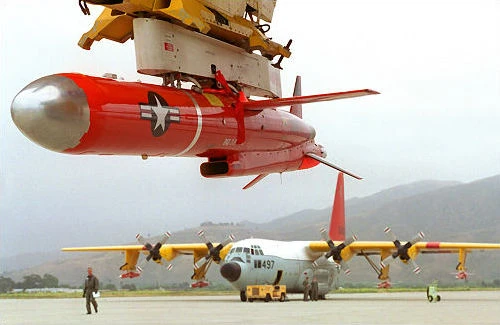
Radioplane XKD4R
American target drone that led to the AQM-38.

The Radioplane XKD4R, designated RP-70 by its manufacturer, was a target drone built by Northrop Corporation's Radioplane Division. Though never mass-produced, it served as the basis for the later AQM-38, which saw successful production.
This air-launched drone was powered by a single Aerojet solid-fuel rocket motor, with exhaust nozzles positioned at the wing's trailing edges. Its airframe was mostly molded plastic, and it used an unusual control setup: three canard fins at the front—one on top and one on each side of the fuselage—along with fixed horizontal fins at the rear. An autopilot guided the drone after launch, and a parachute deployed after roughly nine minutes of flight for recovery.
The XKD4R-1 first flew in January 1958 and underwent extensive testing by the U.S. Navy, typically launched from McDonnell F3H Demon fighters. While the RP-70 performed satisfactorily, it was not put into production. Instead, the improved RP-76 variant first flew in 1959 and was built for both the U.S. Air Force and Navy, eventually becoming the AQM-38 in 1962.
Quick Facts
- Aircraft Type
- Target drone
- National Origin
- United States
- Manufacturer
- Radioplane
- Primary User
- United States Navy
- First Flight
- January 1958
- Developed Into
- AQM-38
Facts from the source article.
Lore & Background
The XKD4R was an air-launched target drone, powered by a single Aerojet solid-fuel rocket engine which exhausted through nozzles located at the trailing edges of the wing. It was constructed largely of molded plastic and utilized an unconventional control configuration, consisting of three canard control fins located forwards, one on top of and one on either side of the fuselage, and fixed horizontal fins at the rear. An autopilot controlled the drone after launch; at the end of an approximately nine-minute flight, a parachute was deployed for recovery.
Conducting its first flight in January 1958, the XKD4R-1 was tested extensively by the United States Navy, launches usually being conducted from McDonnell F3H Demon fighters. Although satisfactory, the RP-70 was not produced; instead, the improved RP-76 was developed, flying in 1959 and being produced for both the U.S. Air Force and Navy, becoming the AQM-38 in 1962.
Reader's Guide
The Radioplane XKD4R holds significance as a developmental stepping stone rather than a production success. Although it was not produced in quantity, its design and testing directly led to the improved RP-76, which entered service with both the U.S. Air Force and Navy as the AQM-38. The XKD4R itself was evaluated extensively by the United States Navy, typically launched from McDonnell F3H Demon fighters, and demonstrated satisfactory performance. Its unconventional control configuration—three canard fins forward and fixed horizontal fins aft—and molded plastic construction were notable features. The drone's solid-fuel rocket engine, with exhaust nozzles at the wing trailing edges, and its parachute recovery system were also characteristic. The XKD4R's legacy is thus primarily as the predecessor to a successful operational target drone, the AQM-38, which saw wider adoption.
Did You Know?
- The XKD4R was also known by the company designation RP-70.
- The drone was typically launched from McDonnell F3H Demon fighters.
More in Unmanned Aerial Vehicles by Country, Part 5 1-24
Spotted an error? Know more?
Reader corrections go straight into our review queue. Suggest an edit · How this site is sourced