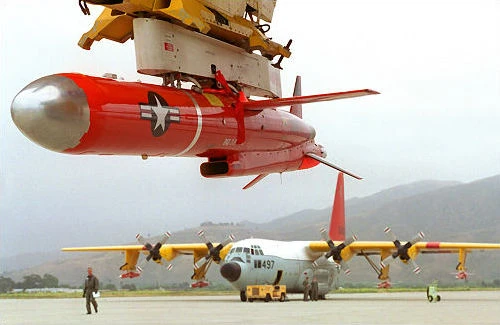
Radioplane RP-77
A plastic target drone evaluated but not procured by the U.S. Army.

The Radioplane RP-77 was a small target drone missile built mostly from plastic materials by Northrop Corporation’s Radioplane division. The U.S. Army tested the RP-77D successfully but chose not to buy it.
Development of the RP-77 started in 1955. Its shape resembled Radioplane’s earlier OQ-19. Four prototypes were built: two RP-77s with a four-cylinder McCulloch piston engine and two RP-77As with a six-cylinder Lycoming engine. Flight tests did not interest the Army enough, but in 1957 a proposal for an improved RP-77D, powered by a Boeing 502 turboprop, led to a contract for 20 aircraft.
The RP-77D used a lot of glass-polyester plastic. It launched with a rocket-assisted take-off system using four Loki rockets. Radio control, aided by radar tracking, let operators fly the drone far from its launch point. Besides standard target drone equipment, it could carry reconnaissance or meteorological sensors, or air sampling gear. The drone used Radioplane’s RPTA tracking system, which controlled it with audio frequency tones. Tip tanks held extra fuel to extend range, and a parachute recovered the drone after flight. A planned improved version would have launched RP-76 target missiles.
The RP-77D first flew in March 1958. The Army evaluated it through the rest of that year, conducting nearly 40 test flights. Results were generally satisfactory, but the Army decided the drone’s performance was not enough of an improvement over existing types to order production. The project was canceled, along with the improved RP-86, a dedicated reconnaissance variant.
After the Army’s evaluation ended, Radioplane privately improved the RP-77D by fitting a larger wing and other modifications that boosted performance. These changes did not rekindle Army interest.
Variants included the RP-77 (two prototypes with McCulloch engine), RP-77A (two prototypes with Lycoming IMO-360 engine), RP-77B (proposed with turbo-supercharged McCulloch, none built), RP-77C (proposed with turbo-supercharged Lycoming SO-360M, none built), RP-77D (20 production prototypes with Boeing 502 turboprop), and RP-86 (proposed reconnaissance version, none built).
Quick Facts
- Origin
- USA
- Is Missile
- yes
- Service
- 1958
- Used By
- United States Army
- Manufacturer
- Radioplane
- Number
- 24
- Weight
- 1050 lb
- Length
- 4.53 m
- Engine
- Boeing 502 turboprop
- Engine Power
- 285 shp
- Speed
- 425 mph
- Guidance
- Radio
Facts from the source article.
Lore & Background
Development of the RP-77 began in 1955. Four prototypes were constructed: two RP-77s powered by a four-cylinder McCulloch piston engine, and two RP-77As powered by a six-cylinder Lycoming engine. Flight-testing results were insufficient to interest the U.S. Army, but in 1957 a proposal for an improved RP-77D, powered by a Boeing 502 turboprop, led to a contract for 20 aircraft. The RP-77D made extensive use of glass-polyester plastic materials. It was launched using a rocket-assisted take-off system with four Loki rockets and fitted with radio control apparatus that, with radar tracking, allowed operation at considerable distance. In addition to target drone equipment, it could carry reconnaissance, meteorological, or air sampling sensors. The RP-77D used the RPTA tracking system, which employed audio frequency tones for control. Tip tanks allowed extra fuel for extended range, and recovery was by parachute. An improved version was projected with provision for launching RP-76 target missiles. Following its maiden flight in March 1958, evaluation by the U.S. Army took place throughout the remainder of that year, with nearly 40 test flights conducted. Although test results were generally satisfactory, the aircraft's performance was deemed an insufficient improvement over existing types, and the project was cancelled, along with the improved RP-86 reconnaissance variant. Radioplane later conducted a private venture improvement program, fitting a larger wing and other modifications, but these did not renew Army interest.
Reader's Guide
The Radioplane RP-77 represents a transitional phase in target drone development, notable for its extensive use of glass-polyester plastic materials and its turboprop powerplant. Despite successful testing and nearly 40 evaluation flights by the U.S. Army in 1958, the aircraft was not ordered into production because its performance was not a sufficient improvement over existing types. The cancellation also ended the RP-86, a dedicated reconnaissance variant. Radioplane's subsequent private venture to improve the RP-77D with a larger wing failed to generate renewed Army interest. The RP-77D's design incorporated advanced features for its time, including rocket-assisted take-off, radar-tracked radio control, and the ability to carry reconnaissance or meteorological sensors, but these were not enough to secure a production contract. The project's termination underscores the challenge of displacing established drone systems even with incremental technological advances.
Did You Know?
- The RP-77D was constructed largely of glass-polyester plastic materials.
- It used a rocket-assisted take-off system consisting of four Loki rockets.
- The RP-77D could be equipped with reconnaissance, meteorological, or air sampling equipment.
- An improved version of the RP-77D was projected with provision for launching RP-76 target missiles.
More in Unmanned Aerial Vehicles by Country, Part 5 1-24
Spotted an error? Know more?
Reader corrections go straight into our review queue. Suggest an edit · How this site is sourced