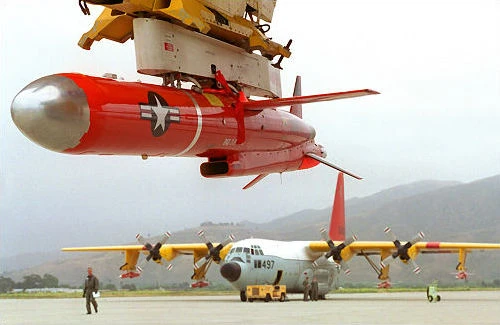
Radioplane Q-1
A pulsejet and turbojet target drone that led to an anti-radar missile.

The Radioplane Q-1 was a target drone built for the U.S. Air Force starting in the early 1950s. It began as a pulsejet-powered design and later received a turbojet engine, but the Air Force never ordered it into full production. Its airframe did, however, serve as the foundation for the GAM-67 Crossbow anti-radar missile.
After the Air Force was established in 1948, it asked for a new high-speed target drone that used jet power for realistic training. The Radioplane Company, later part of Northrop, got the contract. The first version, called the RP-26 by the company and XQ-1 by the Air Force, used a single Giannini PJ39 pulsejet. It was a high-wing aircraft launched from a rocket sled. It originally had one large vertical stabilizer, but this was changed to a twin-tail setup to give more clearance for its carrier aircraft. Recovery was by parachute.
The XQ-1 first flew in 1950, and 28 were built. It worked well enough, but the pulsejet burned fuel quickly, giving it only 60 minutes of flight time. To improve endurance, one XQ-1 was fitted with a Continental YJ69 turbojet, becoming the XQ-1A. Still, more changes were needed, so a major redesign followed.
The redesigned version, called the RP-50 by the company and YQ-1B by the Air Force, first flew in 1953 and was tested later that year. It used the YJ69 engine with an intake moved to the nose, and the airframe was made more streamlined. Instead of a rocket sled, it was launched from an aircraft, usually a Douglas DB-26. Six YQ-1Bs were built for evaluation. They performed without problems, but the Air Force chose the competing Ryan Q-2 drone instead, ending the Q-1 program. The YQ-1B airframe then became the starting point for the GAM-67 Crossbow anti-radar missile.
Variants included the XQ-1 (pulsejet, 28 built), the XQ-1A (one turbojet conversion), the YQ-1B (six turbojet examples), and the XQ-3 (a planned fiberglass version that was never built).
Quick Facts
- Aircraft Type
- High-speed target drone
- Manufacturer
- Radioplane Company
- Primary User
- U.S. Air Force
- Number Built
- 34
- First Flight
- 1950
- Developed Into
- GAM-67 Crossbow
Facts from the source article.
Lore & Background
Shortly after its formation in 1948, the United States Air Force issued a specification calling for a new type of high-speed target drone. Required to be jet-powered to provide the most realistic training, the contract for the development of the drone was given to the Radioplane Company. Powered by a single Giannini PJ39 pulsejet engine, the drone, given the designation RP-26 by the company and XQ-1 by the USAF, was a high-wing, rocket sled launched aircraft. Originally fitted with a large single vertical stabiliser, the design was modified to a twin tail configuration to provide additional clearance of its carrier aircraft. Recovery, following the conclusion of the drone's flight, was by parachute.
The first flight of the XQ-1 prototype took place in 1950; 28 aircraft of the type were built. Although the aircraft proved to be mostly satisfactory, the thirsty nature of the pulsejet engine limited the drone's endurance to a mere 60 minutes. In an attempt to increase the potential flight time of the aircraft, one XQ-1 was re-engined with a Continental YJ69 turbojet replacing the pulsejet, becoming the XQ-1A; however it was determined that further improvements were needed, and so a major redesign of the type was undertaken. Known by the company as RP-50 and designated by the USAF as YQ-1B, the revised drone flew for the first time during 1953, being evaluated by the Air Force later that year. Using the YJ69 engine, the air intake for the jet was relocated to the nose of the aircraft, while the airframe overall was modified to increase the streamlining of the craft. The rocket-sled launch was abandoned in favor of air launching, with the Douglas DB-26 being the most common carrier aircraft.
Reader's Guide
The Q-1 program's significance lies in its role as a stepping stone rather than a production success. Six YQ-1Bs were built for evaluation; they proved trouble-free, but no production order for the type was undertaken, the competing Ryan Q-2 drone having been selected for operational service instead. As a result, the Q-1 program was terminated. However, the YQ-1B airframe was used by Radioplane as the start of development of a new anti-radar missile, which would be tested by the U.S. Air Force as the GAM-67 Crossbow. This legacy—a target drone evolving into an anti-radiation weapon—marks the Q-1's indirect but lasting contribution to U.S. military aviation. The program also demonstrated the shift from pulsejet to turbojet power for drones and the move from rocket-sled to air launching, reflecting broader trends in unmanned aircraft design during the early Cold War.
Did You Know?
- The Q-1 was originally powered by a Giannini PJ39 pulsejet engine.
- The XQ-1 prototype first flew in 1950.
- The YQ-1B was air-launched from a Douglas DB-26 carrier aircraft.
- The Q-1 airframe served as the basis for the GAM-67 Crossbow anti-radar missile.
More in Unmanned Aerial Vehicles by Country, Part 5 1-24
Spotted an error? Know more?
Reader corrections go straight into our review queue. Suggest an edit · How this site is sourced