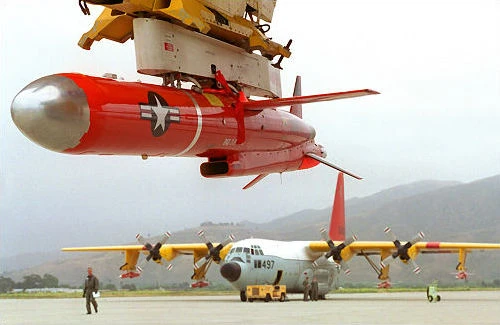
Radioplane OQ-17
Target drone with all-metal construction and unreliable engine.

The Radioplane OQ-17 was a target drone built by the Radioplane Company for the U.S. Army Air Forces and, under the names TD4D and KDR Quail, for the U.S. Navy. Its production was halted early in favor of the OQ-19 because its engine proved unreliable.
As World War II wound down, the Army Air Forces wanted a new target drone that could outperform the earlier OQ-2 series and better mimic the capabilities of modern fighters. Reginald Denny designed the RP-18 in response, an all-metal aircraft with a high-mounted wing and a conventional tail. It was powered by a Righter O-45 four-cylinder horizontally opposed engine, launched from a catapult, and controlled by standard radio. If it survived a training engagement, it could be recovered using an onboard parachute. The manufacturer claimed the OQ-17 could match any maneuver a typical fighter could perform.
The RP-18 was first evaluated in March 1945. After trials, the Army Air Forces ordered it into production in February 1946 as the OQ-17. The Navy also ordered it, having tested it as the XTD4D-1; the production version was initially designated TD4D-1, then redesignated KDR-1 Quail. Only 430 OQ-17 and KDR drones were built, as persistent problems with the O-45 engine could not be solved. The Radioplane OQ-19 was ordered as its replacement.
Variants included the RP-18 prototype; the XOQ-17 test version for the Army; the production OQ-17; the Navy’s XTD4D-1 test version; the TD4D-1 production version; the KDR-1 (the definitive Navy production version); and the KDR-2, which had structural improvements.
Quick Facts
- Aircraft Type
- Target drone
- National Origin
- United States
- Manufacturer
- Radioplane Company
- Designer
- Reginald Denny
- Primary User
- United States Army Air Forces
- More Users
- United States Navy
- Number Built
- 430
- Developed Into
- Radioplane OQ-19
Facts from the source article.
Lore & Background
The Radioplane OQ-17 originated from a U.S. Army Air Forces requirement for a new target drone with higher performance to better simulate improved combat aircraft. Designed by Reginald Denny as the RP-18, it featured all-metal construction, a high-mounted wing, and conventional empennage. Power came from a Righter O-45 four-cylinder horizontally-opposed engine, and the drone was launched via catapult. Control was maintained through conventional radio control, and if not shot down during training, it could be recovered using an onboard parachute. It was claimed that the OQ-17 could perform any maneuver that an ordinary fighter aircraft could.
Evaluation of the RP-18 began in March 1945, and following trials the U.S. Army Air Forces ordered production in February 1946, designating it OQ-17. The U.S. Navy also ordered the drone, evaluating it as the XTD4D-1 before designating the production version as the TD4D-1, later renamed KDR-1 Quail. Production of both the OQ-17 and KDR was terminated after 430 aircraft had been completed because persistent reliability issues with the O-45 engine could not be overcome. The Radioplane OQ-19 was ordered as a replacement.
Reader's Guide
The Radioplane OQ-17 represents a transitional target drone design that attempted to meet the higher performance demands of post-World War II training requirements. Its all-metal construction and claimed ability to mimic fighter maneuvers marked an advance over earlier drones, but the project was ultimately undermined by the unreliable Righter O-45 engine. The production run of 430 aircraft was cut short, and the OQ-19 was chosen as its successor. The OQ-17 also saw service with the U.S. Navy under the designations TD4D-1 and KDR-1 Quail, with a structurally improved variant, the KDR-2, also produced. The drone's legacy is primarily as a stepping stone to the more successful OQ-19, and its failure due to engine problems highlights the critical role of powerplant reliability in unmanned aircraft development.
Did You Know?
- The OQ-17 was also designated TD4D-1 and KDR-1 Quail by the U.S. Navy.
- Production was terminated after 430 aircraft due to engine reliability issues.
- The OQ-17 could be recovered via an onboard parachute if not shot down.
More in Unmanned Aerial Vehicles by Country, Part 5 1-24
Spotted an error? Know more?
Reader corrections go straight into our review queue. Suggest an edit · How this site is sourced