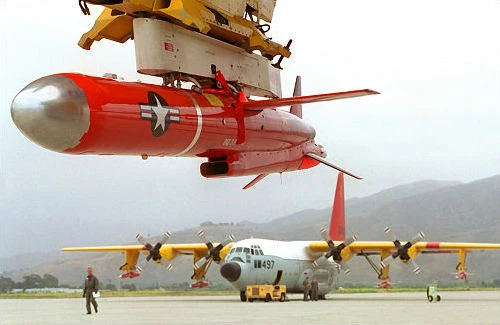
Northrop Grumman X-47B
Tailless jet-powered UCAV demonstrator for carrier operations.

The Northrop Grumman X-47B is a demonstration unmanned combat aerial vehicle (UCAV) designed for aircraft carrier-based operations. Developed by the American defense technology company Northrop Grumman, the X-47B is a tailless jet-powered blended-wing-body aircraft capable of semi-autonomous operation and aerial refueling. It is notable for being the first unmanned aircraft to be catapulted from an aircraft carrier and to perform an arrested landing on a carrier at sea.
Quick Facts
- National Origin
- United States
- Manufacturer
- Northrop Grumman
- First Flight
- 4 February 2011
- Primary User
- United States Navy
- Number Built
- 2
- Developed From
- Northrop Grumman X-47A Pegasus
Facts from the source article.
Lore & Background
The X-47B project began under the Defense Advanced Research Project Agency (DARPA) as part of the Joint Unmanned Combat Air Systems (J-UCAS) program, and subsequently became part of the United States Navy's Unmanned Combat Air System Demonstration (UCAS-D) program. The Navy selected Northrop Grumman's X-47B as its UCAS-D demonstrator after the J-UCAS program was terminated in February 2006. The demonstrator was built to be the same size and weight as the projected operational craft, with a full-sized weapons bay capable of carrying existing missiles. The X-47B prototype rolled out from United States Air Force Plant 42 in Palmdale, California, on 16 December 2008.
Flight testing began with the first flight of Air Vehicle 1 (AV-1) at Edwards Air Force Base, California, on 4 February 2011. A second demonstrator, AV-2, conducted its maiden flight on 22 November 2011. The two X-47Bs performed so consistently that preliminary tests ended after 16 flights. In May 2013, an X-47B launched from the USS George H.W. Bush, marking the first time a UAV was catapulted off an aircraft carrier. On 10 July 2013, an X-47B conducted the first ever arrested landing of a UAV on a carrier at sea. The program included demonstrations of autonomous inflight refueling with a probe and drogue, and integration with manned aircraft operations.
Reader's Guide
The X-47B's significance lies in its demonstration that a tailless, jet-powered unmanned aircraft could operate from an aircraft carrier alongside manned aircraft. By August 2014, the U.S. Navy had integrated the X-47B into carrier operations alongside manned aircraft, and by May 2015 the primary test program was declared complete. The demonstrators proved compatible with the flight deck, hangar bays, and communication systems of an aircraft carrier, and successfully performed precision approaches, catapult launches, and arrested landings at sea. The program also validated the X-47B's ability to autonomously detect and abort landings when a navigational sub-system failed, demonstrating reliability. The Navy initially intended for the demonstrators to become museum exhibits after flight testing, but later decided to maintain them in flying condition pending further development. The X-47B's legacy is as a proof-of-concept for carrier-based unmanned combat air systems, having completed multiple test phases that included operations with a 70-plane carrier air wing.
Did You Know?
- The X-47B first flew in 2011 and its two active demonstrators underwent extensive flight and operational integration testing.
- On 14 May 2013, an X-47B became the first UAV to be catapulted off an aircraft carrier.
- The X-47B performed its first night flight on 10 April 2014.
- The U.S. Navy decided to maintain the X-47B demonstrators in flying condition after the test program, rather than retiring them to museums.
More in Unmanned Aerial Vehicles by Country, Part 4 1-24
Spotted an error? Know more?
Reader corrections go straight into our review queue. Suggest an edit · How this site is sourced