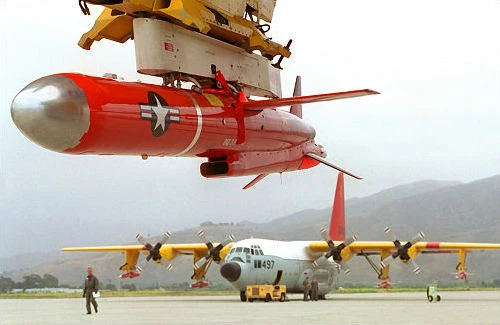
Aerojet SD-2 Overseer
A 1950s Army drone that never entered operational service.

The Aerojet SD-2 Overseer was an unmanned aircraft built by Aerojet General and Rheem Manufacturing Co. for the U.S. Army during the late 1950s. Only a small number were produced, and the type never entered active service.
Development of the SD-2 drone started in 1957 under Rheem Manufacturing, continuing after Aerojet General acquired the company in 1959. It was part of the AN/USD-2 surveillance system. The drone launched from a truck using two solid rocket boosters, then switched to a piston engine for flight. At the end of its mission, it returned by parachute. A translateration navigation system—similar in principle to later differential GPS—allowed the aircraft to follow a pre-programmed route.
The SD-2 carried modular sensors that could be swapped between missions. Payload options included cameras for either recovered or real-time imagery, an AN/AAD-2 infrared sensor, an AN/DPD-2 side-looking airborne radar, or wing-mounted tanks for dispensing biological or chemical agents.
Thirty-five production SD-2s were built. The navigation system performed poorly, leading to the program’s cancellation in 1966, with no Overseers ever used operationally. In 1963, the drone was redesignated MQM-58A under the new naming system.
Quick Facts
- Aircraft Type
- Reconnaissance drone
- National Origin
- United States
- Manufacturer
- Aerojet General
- Primary User
- United States Army
- Number Built
- 35
- Retired
- late 1960s
- First Flight
- c.1959
Facts from the source article.
Lore & Background
Development of the SD-2 drone began in 1957 by the Rheem Manufacturing Company, and the project continued through the company's acquisition by Aerojet General in 1959. It was part of the AN/USD-2 surveillance system and designed for truck launch using two solid rocket boosters; after launch, a piston engine provided propulsion. Recovery was via parachute at the end of its mission. Control used a translateration system for navigation, similar to later differential GPS technology, allowing the aircraft to follow a pre-programmed course.
The SD-2 featured a modular sensor system, enabling equipment to be swapped between missions. Available payloads included cameras for recovered or real-time photography, an AN/AAD-2 infrared sensor, AN/DPD-2 side looking airborne radar, or tanks under the wings for dispensing biological or chemical warfare agents.
Thirty-five production SD-2s were built. Poor results from the navigation system led to cancellation in 1966, and the program ended without any Overseers having seen operational service. In 1963, the SD-2 was redesignated MQM-58A.
Reader's Guide
The Aerojet SD-2 Overseer represents a Cold War-era attempt to field a modular, truck-launched surveillance drone for the U.S. Army. Its development spanned the late 1950s through the mid-1960s, involving two manufacturers and a novel translateration navigation system. Despite a limited production run of 35 units, the aircraft never achieved operational service due to persistent navigation system failures, leading to program cancellation in 1966. The SD-2's modular sensor concept—allowing cameras, infrared, radar, or chemical/biological dispensers—was ahead of its time, but the technology was not mature enough for reliable field use. Its legacy lies in illustrating the challenges of early drone navigation and the Army's experimentation with unmanned systems before more successful platforms emerged. The redesignation to MQM-58A in 1963 reflects the evolving military nomenclature for drones, but did not alter the program's fate.
Did You Know?
- It could be equipped with tanks for dispensing biological or chemical warfare agents.
- The navigation system used a translateration method similar to later differential GPS.
- The program was cancelled in 1966 due to poor navigation system results.
Frequently Asked Questions
Who is Aerojet SD-2 Overseer?
The SD-2 Overseer is a Cold War-era surveillance drone developed in the late 1950s for the U.S. Army by Aerojet General and Rheem Manufacturing Co. It served as part of the AN/USD-2 reconnaissance system and operated as a one-way aerial surveillance platform.
What are Aerojet SD-2 Overseer's powers/role?
The drone was launched from a truck using twin solid-fuel rocket boosters, then sustained flight on a piston engine while performing aerial surveillance. At the end of its mission it descended under a parachute rather than landing conventionally.
Why is Aerojet SD-2 Overseer important?
It represents one of the earlier attempts to field a truck-launched, one-way surveillance drone in the U.S. military. Its development also spans the 1959 acquisition of Rheem Manufacturing by Aerojet General, making it a product of both companies.
What designation did Aerojet SD-2 Overseer receive?
Under the 1962 U.S. military drone naming convention, the SD-2 was redesignated MQM-58A in 1963. This placed it in the standard MQM series of target and surveillance drones.
More in Unmanned Aerial Vehicles by Country, Part 4 1-24
Spotted an error? Know more?
Reader corrections go straight into our review queue. Suggest an edit · How this site is sourced