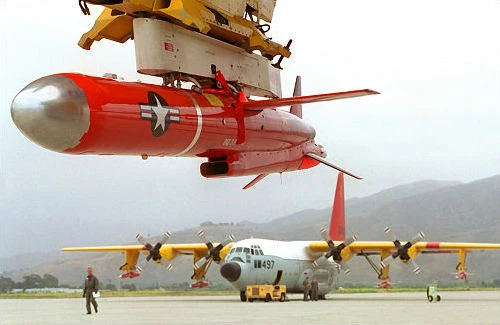
Battlefield UAVs of the United States
Early US battlefield UAVs pioneered tactical drone use with mixed results.

Battlefield UAVs of the United States encompass a range of unmanned aircraft developed for reconnaissance and combat support roles. Their operational history began with the Gyrodyne QH-50 DASH (Drone Anti-Submarine Helicopter) in the early 1960s, a pioneering effort that demonstrated the potential of drones in tactical environments, though the type saw limited success. Later developments included combat surveillance and tactical reconnaissance UAVs, which became more prominent after Israeli successes in the early 1980s spurred international interest.
- First operational uav
- Gyrodyne QH-50 DASH (1961)
- Primary variants
- QH-50A, QH-50B, QH-50C, QH-50D
- Qh-50c empty weight
- 500 kg (1,100 lb)
- Qh-50c rotor diameter
- 6.1 m
- Qh-50c combat radius
- 54 km
- Total qh-50c ordered
- 900 (later cut to ~500)
- Japanese maritime self-defense force pur
- 16 DASHes in 1968
Lore & Background
The first operational battlefield UAV developed by the US military was the Gyrodyne QH-50 DASH, designed for antisubmarine warfare. The US Navy obtained the drone in the early 1960s to fly off frigates or destroyers, carrying homing torpedoes or nuclear depth charges. The initial prototype, the DSN-1, used a Porsche flat-four piston engine, with first flights in summer 1961. Production models included the QH-50C, powered by a Boeing T50-BO-8A turboshaft engine, and the QH-50D with an uprated engine and fiberglass rotors. The DASH was guided solely by radio control, had no sensors or autonomous navigation, and suffered reliability problems—a quarter of the first 100 were lost in crashes. A small number were given reconnaissance gear for naval surveillance over the Gulf of Tonkin in 1966 under project SNOOPY. In the early 1970s, the Air Force evaluated the QH-50D in a program called NITE GAZELLE, experimenting with dropping bomblets and carrying machine guns, though details are unclear. Later, in the 1980s, Aerodyne corporation attempted to sell an updated version, the CH-84 Pegasus, with an Allison 250-C20F turboshaft engine, but it appears not to have been a success.
Reader's Guide
The DASH program, though undistinguished in service, pointed the way to future battlefield UAVs. It was one of the first drones used in a strictly tactical environment, demonstrating the feasibility of unmanned aircraft for naval and potentially land-based missions. The US military's subsequent development of combat surveillance and tactical reconnaissance UAVs built on this early experience, though the DASH itself was limited by reliability issues and a lack of sensors or autonomous navigation. The program's legacy lies in its role as a precursor: it showed that drones could operate from ships, carry weapons, and be adapted for reconnaissance, as seen in the SNOOPY project. The later NITE GAZELLE tests hinted at broader combat roles, but the DASH's mixed record also highlighted the challenges of early drone technology. The attempted Pegasus upgrade in the 1980s reflected continued interest, but the DASH ultimately remained a stepping stone rather than a lasting operational system.
Did You Know?
- The Gyrodyne QH-50 DASH was the first operational battlefield UAV developed by the US military, entering service in the early 1960s.
- A quarter of the first 100 QH-50C DASH drones were lost in crashes due to reliability problems.
- In 1966, a small number of DASHes were fitted with reconnaissance gear for naval surveillance over the Gulf of Tonkin under project SNOOPY.
- The Japanese Maritime Self-Defense Force purchased 16 DASH drones in 1968.
A Worldwide Arms Race in the Sky
The provided facts reveal that unmanned aerial vehicle development is not confined to a handful of military powers but spans an extraordinary range of nations. From Algeria's AL Fajer L-10 to Argentina's Lipán M3 Apache, from Armenia's Krunk to Australia's extensive fleet of V-TOL craft, the list demonstrates that UAV programs have become a near-universal feature of modern defense and civilian infrastructure. Even smaller or less technologically advanced nations like Croatia, with its BL M-99 Bojnik, or Costa Rica, fielding the SA-SkyHunter for aerial mapping, have entered the arena. The sheer number of entries per country—Brazil alone lists dozens of programs from the 14-X Mach 10 scramjet to the 4-kilogram Tiriba mini UAV—underscores how deeply embedded drone technology has become in national planning. This global diffusion suggests that the capability to build and operate unmanned aircraft is no longer the exclusive domain of superpowers but a baseline expectation across the international community.
From Eyes in the Sky to Full-Spectrum Operations
The facts illustrate that UAVs serve a remarkably wide operational palette. Reconnaissance and surveillance dominate the listings—Canada's CL-89 from 1964, Chile's Sirol series, and France's EADS Harfang all fall into this category. Yet the roles extend far beyond observation. Brazil's 14-X is a Mach 10 scramjet, representing a leap toward hypersonic unmanned flight, while its Stella Atobá XR is described as capable of autonomous attack operations. Target drones appear in multiple countries: France's Aérospatiale C.22, Brazil's Aeromot K1AM, and the Czech Republic's HAES 400. Civilian and scientific applications are equally present—Australia's Aerosonde variants collect weather data, Argentina's AeroVision Arcangel handles agricultural surveillance, and Denmark's Sky-Watch RQ-35 Heidrun performs mapping. Combat and research roles appear in France's Dassault nEUROn and its AVE-D and AVE-C research aircraft. This breadth confirms that the unmanned aircraft category encompasses everything from a farmer's field monitor to a hypersonic test vehicle.
Six Decades of Continuous Flight
The entries span a remarkable chronological arc, beginning with Canada's Canadair CL-89 in 1964 and Belgium's MBLE Épervier in the same year, and extending through the 2010s with Canada's Aeryon SkyRaider R80D and Australia's Boeing MQ-28 Ghost Bat. This timeline reveals a steady maturation of the technology. Early entries like Argentina's FMA IA X 59 Dronner (1972) and Canada's CL-227 Sentinel (1977) represent the formative era of fixed-wing reconnaissance drones. The 1990s and 2000s bring a wave of tactical and soldier-portable systems: Brazil's Flight Technologies FT-100 Horus, Canada's Draganflyer X4 and X6, and the Czech Republic's HAES 400. The most recent entries push into new frontiers—Brazil's 14-X scramjet, Australia's Skyborne Technologies Gannet Glide Drone, and the multirotor platforms from Colombia's Advector Unmanned Systems. The progression from simple target drones to autonomous, multi-mission, and hypersonic platforms traces a clear trajectory of increasing complexity, autonomy, and speed over more than five decades of continuous development.
A Patchwork of Builders and Collaborators
The facts reveal that UAV development is driven by an extraordinarily diverse cast of organizations. National air forces and defense ministries anchor many programs—Brazil's FAB developing the 14-X scramjet, the Brazilian Navy operating the Aeromot K1AM, and the Brazilian Marine Corps fielding the Carcara portable UAV. Yet commercial and private firms are equally prominent: Australia's Carbonix (Volanti, Domani), V-TOL (a family of quadrotors and octocopters), and Entecho (Demipod, Mupod) represent a thriving private sector. Joint ventures and consortia appear in Brazil, where Harpia Systems combined Embraer Defense, AEL Systems, and Avibras before the program was halted in January 2016. Research institutions contribute as well—Finland's MASS Mini-UAV, France's Dassault AVE-D and AVE-C research aircraft, and Denmark's Sky-Watch mapping drones. Even agricultural and civilian companies like Argentina's AeroVision and Canada's PrecisionHawk Lancaster blur the line between military and civilian drone ecosystems. This multiplicity of builders ensures that innovation flows from many directions simultaneously.
Frequently Asked Questions
What does "Battlefield UAVs of the United States" refer to?
It is a collective label for the unmanned aircraft the U.S. military built for reconnaissance and combat-support duties. The lineage runs from the early-1960s Gyrodyne QH-50 DASH through later combat-surveillance and tactical-reconnaissance drones that drew wider international attention after Israeli field successes in the early 1980s.
What was the first operational battlefield UAV fielded by the United States?
The Gyrodyne QH-50 DASH (Drone Anti-Submarine Helicopter) entered service in 1961 as the nation's first operational unmanned aircraft. It was tasked with spotting and tracking submarines in tactical settings, though its overall operational record remained limited.
What are the main variants of the QH-50 DASH and what are the QH-50C's key specs?
The program produced four designations—QH-50A, QH-50B, QH-50C, and QH-50D—each refining the original airframe. The QH-50C weighed 500 kg (1,100 lb) empty, featured a 6.1 m rotor diameter, and offered a combat radius of roughly 54 km.
How many QH-50C units were originally ordered and what happened to that number?
The U.S. Navy initially placed an order for 900 QH-50C helicopters, but the procurement was later trimmed to approximately 500 airframes. The reduction reflected the mixed operational results the type achieved during its service life.
Why are early U.S. battlefield UAVs considered a turning point in drone history?
They demonstrated that unmanned aircraft could be pushed into genuine tactical roles—anti-submarine warfare, combat surveillance, and reconnaissance—well before the technology became mainstream. Despite mixed field results, the DASH program and its successors laid the groundwork for the broader international push into battlefield drones that accelerated after the early 1980s.
More in Unmanned Aerial Vehicles by Country, Part 4 1-24
Spotted an error? Know more?
Reader corrections go straight into our review queue. Suggest an edit · How this site is sourced