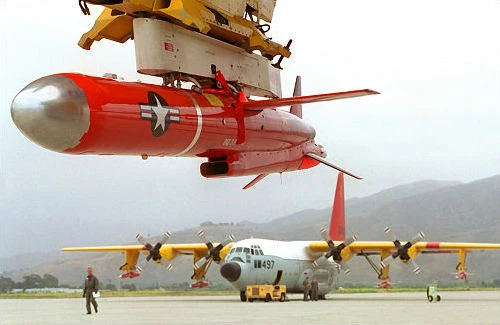
American Dynamics AD-150
High-speed VTOL tilting ducted fan UAV for US Marine Corps programs.

The American Dynamics AD-150 is a high-speed VTOL tilting ducted fan unmanned aerial vehicle developed as a future competitor for the United States Marine Corps' Tier III VUAS program and other current and future United States VTOL UAV programs. It is notable for its use of two wing-tip mounted High Torque Aerial Lift (HTAL) systems driven by a single Pratt & Whitney Canada PW200 turboshaft engine.
Quick Facts
- National Origin
- United States
- Manufacturer
- American Dynamics Flight Systems
Facts from the source article.
Lore & Background
The AD-150 program began in response to continued interest in maritime capable VTOL UAVs by the United States Department of Defense. The vehicle's propulsion configuration is similar to the Doak VZ-4 in that the two propulsion systems can tilt from vertical to horizontal mode to achieve high-speed forward flight. Unlike the Doak VZ-4, however, the AD-150's propulsion systems are also able to pivot longitudinally.
A full-scale model of the AD-150 was displayed for the first time at the Association for Unmanned Vehicle Systems International's (AUVSI) Unmanned Systems North America exhibition in Washington, D.C., on August 7, 2007. In February 2010, the University of Maryland's Industrial Partnerships program approved $135,150 in funding to test a scale model of the company's patented High Torque Aerial Lift (HTAL) system in a tunnel at the university. The testing utilized a 1/3–1/2 scale model tested at different fan and tunnel speeds and duct angles to represent the transition between vertical and horizontal flight.
Reader's Guide
The AD-150 represents a specific approach to VTOL UAV design, combining tilting ducted fans with a single turboshaft engine to achieve both hover and high-speed forward flight. Its development was driven by U.S. Department of Defense interest in maritime-capable VTOL UAVs, positioning it as a competitor for the Marine Corps' Tier III VUAS program. The vehicle's propulsion system, with its ability to pivot longitudinally in addition to tilting, distinguishes it from earlier designs like the Doak VZ-4. The program's progress included a full-scale model display in 2007 and subsequent university-funded wind tunnel testing of a scale model in 2010, indicating ongoing refinement of the HTAL system. While the AD-150 did not enter production, its design illustrates the engineering challenges and solutions explored for high-speed VTOL unmanned aircraft in the late 2000s and early 2010s.
Did You Know?
- Its propulsion systems can tilt from vertical to horizontal mode and also pivot longitudinally, unlike the Doak VZ-4.
- In February 2010, the University of Maryland received $135,150 to test a 1/3–1/2 scale model of the HTAL system in a wind tunnel.
Frequently Asked Questions
What is the American Dynamics AD-150?
It is a high-speed vertical takeoff and landing unmanned aerial vehicle designed by American Dynamics Flight Systems. The airframe uses a tilting ducted fan layout and was pitched as a contender for the US Marine Corps' Tier III VUAS slot as well as other military VTOL UAV programs.
How is the American Dynamics AD-150 powered?
A single Pratt & Whitney Canada PW200 turboshaft engine supplies all thrust. That one engine drives two High Torque Aerial Lift (HTAL) units mounted at the wing tips, which handle both vertical lift and forward-flight propulsion.
When and where was the American Dynamics AD-150 first shown to the public?
A full-scale model was unveiled at the AUVSI Unmanned Systems North America conference in Washington, D.C., on August 7, 2007. In February 2010, the University of Maryland's Industrial Partnerships program approved about $135,000 to fund further scale-model testing.
Why does the American Dynamics AD-150 matter in VTOL UAV history?
It offered a compact, single-engine architectural alternative to the more common tiltrotor or multi-rotor concepts chasing the same Marine Corps Tier III VUAS requirements. Its dual HTAL wing-tip arrangement demonstrated that a leaner propulsion stack could still target high-speed VTOL performance.
What happened to the American Dynamics AD-150 project?
The design never advanced beyond the concept and scale-model testing stage, with its public footprint limited to the 2007 full-scale display and the 2010 university-funded test grant. It remains a notable 'what-if' entry in the VTOL UAV space rather than an operational or flight-proven system.
More in Unmanned Aerial Vehicles by Country, Part 4 1-24
Spotted an error? Know more?
Reader corrections go straight into our review queue. Suggest an edit · How this site is sourced