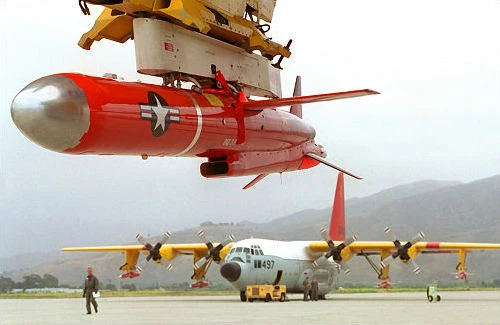
AAI RQ-2 Pioneer
Joint US-Israeli UAV used for reconnaissance from 1986 to 2007.

The AAI RQ-2 Pioneer served the U.S. Navy, Marine Corps, and Army from 1986 to 2007, operating both at sea and on land. It first underwent testing aboard the USS Iowa, where it was used for naval gunfire spotting, before its role shifted to reconnaissance and surveillance, especially in support of amphibious operations. The aircraft was a joint effort between AAI Corporation and Israel Aircraft Industries, building on earlier experience with the Tadiran Mastiff UAV used by American and Israeli forces.
The Pioneer was essentially an upgraded IAI Scout, modified with a more powerful engine to carry a larger payload as requested by the U.S. Navy. The original Limbach two-cylinder two-stroke engine, which turned a 71 cm propeller from Propeller Engineering and Duplicating, Inc., was replaced by a Fichtel & Sachs two-cylinder two-stroke engine. This newer engine used a 74 cm propeller from the Sensenich Propeller Manufacturing Company, which rotated in the opposite direction.
Launched via rocket assist, catapult, or from a runway, the Pioneer could be recovered into a net or with arresting gear. It could fly for up to five hours with a 75-pound payload, operating day or night using a gimbaled electro-optical/infrared sensor. Real-time analog video was transmitted through a C-band line-of-sight data link. Starting in 1991, the Pioneer flew reconnaissance missions in the Persian Gulf, Somalia (UNOSOM II), Bosnia, Kosovo, and Iraq. By 2005, the Navy operated two Pioneer systems (one for training) and the Marines operated two, each with five or more aircraft. Israel and the Republic of Singapore Air Force also used the Pioneer. The U.S. Navy retired the Pioneer in 2007, replacing it with the Shadow UAV.
Internationally, the Pioneer is best known for its role in the 1991 Gulf War. A Pioneer launched from a U.S. Navy ship observed Iraqi troops on Failaka Island surrendering after a battleship attack on their trenches. When the Navy offered to donate a Pioneer to the Smithsonian Institution, curators at the National Air and Space Museum specifically requested the UAV that Iraqi troops had surrendered to. During that same war, the U.S. Army deployed a UAV Platoon from Fort Huachuca, Arizona, which conducted surveillance and target acquisition from KKMC and later moved north under Operation Sand Hawk, where combat engineers built a metal runway for the aircraft.
The "
Quick Facts
- Aircraft Type
- Reconnaissance UAV
- National Origin
- Israel/United States
- Manufacturer
- AAI Corporation, Israel Aircraft Industries
- Introduction
- 1986
- Retired
- 2007
- Number Built
- 175 delivered; 35 in service
- Developed Into
- AAI RQ-7 Shadow
Facts from the source article.
Lore & Background
The RQ-2 Pioneer was developed as an upgraded IAI Scout, re-engined to accommodate a greater payload by request of the US Navy. The original Limbach two-cylinder two-stroke engine was replaced with a Fichtel & Sachs two-cylinder two-stroke. The Limbach motor used a 71 cm propeller from Propeller Engineering and Duplicating, Inc. of San Clemente, California, while the newer Fichtel & Sachs motor was outfitted with a 74 cm propeller (spinning in the opposite direction) from the Sensenich Propeller Manufacturing Company of Lancaster, Pennsylvania.
Launched by rocket assist (shipboard), by catapult, or from a runway, the Pioneer recovered into a net (shipboard) or with arresting gear. It flew day or night missions with a gimbaled EO/IR sensor, relaying analog video in real time via a C-band line-of-sight data link. Since 1991, Pioneer flew reconnaissance missions during the Persian Gulf, Somalia (UNOSOM II), Bosnia, Kosovo and Iraq conflicts. In 2005, the Navy operated two Pioneer systems (one for training) and the Marines operated two, each with five or more aircraft. It was also operated by Israel and the Republic of Singapore Air Force. In 2007 Pioneer was retired by the US Navy and replaced by the Shadow UAV.
Internationally, Pioneer drones are perhaps most remembered for their role in the 1991 Gulf War, when a Pioneer launched by the US Navy observed Iraqi troops on Failaka Island surrendering shortly after a naval attack on their trenchlines. When navy officials offered to transfer a Pioneer to the Smithsonian Institution, curators at the National Air and Space Museum specifically asked for the UAV that Iraqi troops surrendered to during the Gulf War. In the 1991 Gulf War, the US Army operated a UAV Platoon from Fort Huachuca, Arizona, conducting flight surveillance and target acquisition missions from KKMC and later pushing north (Operation Sand Hawk) where US Army combat engineers built a metal runway for the aircraft to launch and recover.
Reader's Guide
The RQ-2 Pioneer's significance lies in its long service as a joint US-Israeli UAV that bridged early experimental drone operations and modern persistent surveillance. It was the first UAV to be deployed operationally from US Navy ships, initially for gunnery spotting and later for reconnaissance and surveillance, primarily supporting amphibious forces. Its most famous moment came during the 1991 Gulf War when a Pioneer observed Iraqi troops on Failaka Island surrendering after a naval attack, an event that led the National Air and Space Museum to specifically request that aircraft for its collection. The Pioneer also saw action in Somalia, Bosnia, Kosovo, and Iraq. Its retirement in 2007 marked the end of a 21-year run, replaced by the Shadow UAV. The Pioneer demonstrated the viability of shipboard UAV operations and set the stage for later systems. Its design, an upgraded IAI Scout with a more powerful engine and larger propeller, reflected the iterative development of UAV technology. The Pioneer's legacy includes its role in psychological operations and battle damage assessment, as well as its use by multiple branches of the US military and international operators such as Israel, Singapore, and Sri Lanka.
Did You Know?
- The RQ-2 Pioneer was initially tested aboard USS Iowa.
- It was developed jointly by AAI Corporation and Israel Aircraft Industries.
- The Pioneer's engine was changed from a Limbach to a Fichtel & Sachs two-cylinder two-stroke to accommodate a greater payload.
Frequently Asked Questions
What is the AAI RQ-2 Pioneer?
The RQ-2 Pioneer is a small tactical unmanned aerial vehicle developed as a joint program between AAI Corporation and Israel Aircraft Industries, entering U.S. military service in 1986. It was essentially an upgraded IAI Scout airframe fitted with a more powerful engine to extend its operational reach.
What missions did the RQ-2 Pioneer actually fly?
Its mission set covered artillery target acquisition, close air support coordination, reconnaissance and surveillance, battle damage assessment, search and rescue, and psychological operations. During early sea trials aboard the USS Iowa it was specifically tasked with naval gunfire spotting before its role broadened to general reconnaissance in support of amphibious operations.
Which countries and branches operated the Pioneer?
The U.S. Marine Corps, Navy, and Army all fielded the type, and it was also exported to Sri Lanka (both Air Force and Navy), Israel, and Singapore. The U.S. Army and Navy are now listed as former operators after the aircraft was retired in 2007.
What were the Pioneer's endurance and payload figures?
The aircraft could remain airborne for up to five hours and carried a 75-pound payload. Those specifications made it a compact, single-operator-friendly platform well suited to shipboard and forward-deployed use.
Why does the RQ-2 Pioneer matter in the history of military drones?
It was one of the first U.S. tactical UAVs born from a formal U.S.-Israeli partnership, directly building on lessons learned from the Tadiran Mastiff program. Its two-decade service life (1986–2007) across Navy, Marine, and Army units helped cement the operational doctrine for small, man-portable reconnaissance drones in both maritime and ground combat.
More in Unmanned Aerial Vehicles by Country, Part 4 1-24
Spotted an error? Know more?
Reader corrections go straight into our review queue. Suggest an edit · How this site is sourced