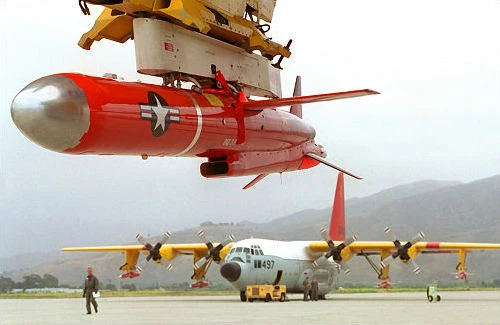
Northrop Grumman RQ-4 Global Hawk
High-altitude, long-endurance remotely-piloted surveillance aircraft operated by the USAF.

The Northrop Grumman RQ-4 Global Hawk is a high-altitude, remotely piloted surveillance aircraft that entered service in 2001. It was originally developed by Ryan Aeronautical, now part of Northrop Grumman, and was referred to as Tier II+ during its design phase. The aircraft uses high-resolution synthetic aperture radar and electro-optical/infrared sensors to provide broad, systematic surveillance, and can loiter over target areas for extended periods. The United States Air Force operates the Global Hawk as a high-altitude, long-endurance platform for intelligence collection in support of global military operations. According to the USAF, its surveillance capabilities enable more precise weapons targeting and improved protection for friendly forces.
Cost overruns reduced the planned acquisition from 63 aircraft to 45, and in 2013 there was a proposal to mothball the 21 Block 30 signals intelligence variants. The flyaway cost for each of the first 10 aircraft was $10 million in 1994, rising to $60.9 million by 2001, and reaching $131.4 million in 2013. The U.S. Navy adapted the Global Hawk into the MQ-4C Triton for maritime surveillance. The Air Force plans to retire its Global Hawks in 2027.
Development began in the 1990s, when the Air Force was pursuing two uncrewed aerial intelligence platforms: the stealthy Lockheed Martin RQ-3 DarkStar and the Global Hawk. Budget cuts forced a choice, and the Global Hawk was selected for its range and payload over the Dark Star’s stealth. The first flight occurred on 28 February 1998 at Edwards Air Force Base. The first seven aircraft were built under DARPA’s Advanced Concept Technology Demonstration program to evaluate the design. Demand in the Middle East was high, so prototypes were actively used by the USAF in the War in Afghanistan. The aircraft entered low-rate initial production while still in engineering and manufacturing development. Nine production Block 10 aircraft (sometimes called RQ-4A) were built; two were sold to the Navy, and two were deployed to Iraq. The final Block 10 was delivered on 26 June 2006.
To increase capabilities, the airframe was redesigned with a stretched nose and wings. This version, designated RQ-4B Block 20, can carry up to 3,000 pounds of internal payload. The first Block 20, the 17th Global Hawk produced, was rolled out on 25 August 2006.
Quick Facts
- Aircraft Type
- Unmanned surveillance and reconnaissance aerial vehicle
- National Origin
- United States
- Manufacturer
- Northrop Grumman
- First Flight
- 28 February 1998
- Introduction
- November 2001
- Primary User
- United States Air Force
- More Users
- NASA / NATO
- Produced
- 1998–present
- Number Built
- 42 RQ-4Bs as of FY2013
- Developed Into
- Northrop Grumman MQ-4C Triton
Facts from the source article.
Lore & Background
In the 1990s, the Air Force was developing uncrewed aerial intelligence platforms, including the stealthy Lockheed Martin RQ-3 DarkStar and the Global Hawk. Due to budget cuts, only one program could survive, and the Global Hawk was chosen for its range and payload. The first flight took place on 28 February 1998 at Edwards Air Force Base, California. The first seven aircraft were built under the Advanced Concept Technology Demonstration (ACTD) program sponsored by DARPA. Demand for the RQ-4's abilities was high in the Middle East, and prototype aircraft were actively operated by the USAF in the War in Afghanistan. The aircraft entered initial low-rate production while still in engineering and manufacturing development. Nine production Block 10 aircraft (RQ-4A) were produced; two were sold to the US Navy and two were deployed to Iraq. The final Block 10 aircraft was delivered on 26 June 2006.
To increase capabilities, the airframe was redesigned with a stretched nose and wings, resulting in the RQ-4B Block 20, which can carry up to 3,000 lb (1,360 kg) of internal payload. The first Block 20 aircraft, the 17th Global Hawk produced, was rolled out on 25 August 2006 and first flew on 1 March 2007. The U.S. Navy developed the Global Hawk into the MQ-4C Triton maritime surveillance platform. The Navy took delivery of two Block 10 aircraft for evaluation under the Global Hawk Maritime Demonstration (GHMD) program. In September 2010, the Navy's variant was officially designated the MQ-4C. The Triton differs mainly in its wing, which is stronger, has anti-icing capabilities, and can handle rapid altitude changes from 50,000 ft to 10,000 ft.
Cost overruns led to the original plan to acquire 63 aircraft being cut to 45, and to a 2013 proposal to mothball the 21 Block 30 signals intelligence variants. In June 2011, the Global Hawk was certified by the Secretary of Defense as critical to national security following a breach of the Nunn-McCurdy Amendment. The Secretary stated that the Global Hawk costs $220M less per year than the Lockheed U-2 to operate on a comparable mission. In January 2012, the Pentagon announced plans to end Block 30 procurement as it was found more expensive to operate and less capable than the U-2. As of 2013, the USAF planned to procure 45 RQ-4B Global Hawks. The U.S. Air Force plans to retire its Global Hawks in 2027.
Reader's Guide
The RQ-4 Global Hawk represents a significant shift in aerial surveillance, providing persistent, high-altitude intelligence collection that supports precise weapons targeting and protection of friendly forces. Its development was marked by competition with the stealthy DarkStar, with the Global Hawk chosen for its superior range and payload. The program faced repeated cost overruns, leading to procurement cuts from 63 to 45 aircraft and a 2013 proposal to mothball the Block 30 signals intelligence variants. Despite these challenges, the Global Hawk was certified as critical to national security, with the Secretary of Defense noting its lower annual operating cost compared to the U-2. The aircraft's operational history includes active deployment in the War in Afghanistan and Iraq, as well as a 13-year Navy deployment in the Middle East that ended in June 2022. The Navy's MQ-4C Triton variant, with its strengthened wings and ability to descend to lower altitudes for target identification, extends the platform's maritime surveillance role. The Global Hawk's legacy is one of a pioneering HALE platform that, despite cost and reliability issues, provided capabilities that the USAF deemed essential, though its retirement is planned for 2027.
Did You Know?
- The Global Hawk took its first flight on 28 February 1998 at Edwards Air Force Base, California.
- The initial flyaway cost of each of the first 10 aircraft was US$10 million in 1994, rising to US$131.4 million by 2013.
More in Unmanned Aerial Vehicles by Country, Part 4 1-24
Spotted an error? Know more?
Reader corrections go straight into our review queue. Suggest an edit · How this site is sourced