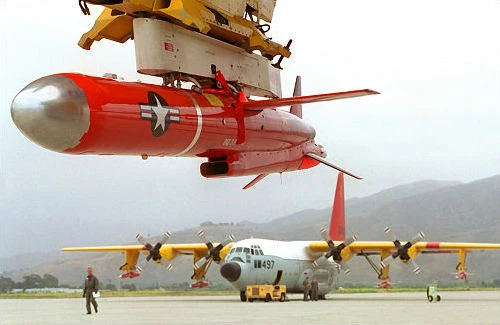
Lockheed X-7
American ramjet test bed of the 1950s.

The Lockheed X-7, known as the "Flying Stove Pipe," was an unmanned American test platform from the 1950s, built to evaluate ramjet engines and missile guidance systems. It later evolved into the Lockheed AQM-60 Kingfisher, which was employed to challenge U.S. air defenses in simulations of a nuclear missile attack.
Development began in December 1946, driven by a U.S. Air Force need for an unmanned ramjet test aircraft capable of at least Mach 3. The project carried the AMC designation MX-883 and Lockheed’s internal code L-171. The Air Force first called it the PTV-A-1, then redesignated it the X-7 in 1951. The initial launch failed, but after reworking the ramjet, subsequent flights succeeded. From April 1951 to July 1960, 130 X-7 flights took place.
The X-7 served as the foundation for the AQM-60 Kingfisher. Over several years of testing, the airframe underwent many modifications to better suit its role. The Kingfisher was pitted against three surface-to-air missiles: the Nike Ajax, Nike Hercules, and Bomarc. In these trials, the X-7 consistently outperformed the interceptors, with only a handful of critical hits scored. Military embarrassment and political pressure led to the project’s cancellation in the mid-1960s.
Beyond SAM tests, the X-7 was used to test communication gear, acceleration, aerodynamics, booster propellants, thermodynamics, and parachutes.
The X-7 was built from steel—unlike later Lockheed aircraft like the A-12 and YF-12, which used titanium. Its wings were stainless steel, and its fuselage was a nickel alloy. Aluminum could not withstand the heat from hypersonic flight, and titanium was not yet widely available. The engines developed for the X-7 and AQM-60 were short-duration designs meant to validate the Bomarc’s propulsion. These engines were later refined with better materials for the hypersonic D-21 drone, which launched from the M-21 or a B-52.
The X-7 was released from under a B-29 or B-50 carrier aircraft at speed. After release, its own ramjet accelerated it to 1,000 mph, and later redesigns pushed it to Mach 4.3. Recovery used a simple multi-stage parachute. After fuel exhaustion, the chute slowed the descent, and a long metal rod on the nose penetrated the ground on impact, keeping the vehicle upright and undamaged.
In 1954, a modified version, the X-7A-3, appeared.
Quick Facts
- Manufacturer
- Lockheed Corporation
- First Flight
- April 26, 1951
- Retired
- 1960
- Primary User
- United States Air Force
- Developed Into
- AQM-60 Kingfisher
Facts from the source article.
Lore & Background
Development of the Kingfisher was first initiated in December 1946. The X-7 was called into production by the United States Air Force requirement for an unmanned ramjet test plane with a top speed of at least 3 Mach. The project was developed under the AMC designator MX-883 and given the Lockheed in-house designation L-171. Initially designated the PTV-A-1 by the USAF, it was later designated the X-7 in 1951. Despite its first launch being a failure, after re-development of the original ramjet, following test flights were successful. A total of 130 X-7 flights were conducted from April 1951 to July 1960.
The X-7 was constructed from steel, with wings built from stainless steel and a fuselage made from a nickel alloy. Steel was used because aluminum could not endure air friction heating at hypersonic speeds, years before the widespread introduction of titanium. The engines developed for the X-7/AQM-60 were designed to operate for a short time to test the design for the CIM-10 Bomarc. They were later redesigned with better materials for use on the hypersonic Lockheed D-21 drone.
The X-7 was launched at speed from the underside of either a B-29 or B-50 carrier plane. Recovery used a multi-stage parachute deployed after the jet exhausted its fuel; a long metal rod on the nose penetrated the ground, keeping the plane upright and preventing damage. In 1954, the modified X-7 was renamed the X-7A-3, with altered wing shape and two small boosters added under each wing, allowing a simpler fuselage-mounted dropping system. This system was used until its final flight in July 1960.
Reader's Guide
The X-7 laid the foundation for the AQM-60 Kingfisher. As a testbed for several yearlong projects, it underwent many structural changes to adapt more closely for its intended purpose. The Kingfisher was tested against three surface-to-air missiles: the SAM-A-7/MIM-3 Nike Ajax, SAM-A-25/MIM-14 Nike Hercules, and IM-99/CIM-10 Bomarc. During these tests, the X-7 outperformed the missiles, and a very small number of critical hits were achieved. Due to pressure and embarrassment of the military, the X-7 project was terminated in the mid-1960s. Besides surface-to-air missile tests, the X-7 project was also used to test communication equipment, acceleration, aerodynamics, booster propellants, thermodynamics, and parachutes. The engines developed for the X-7/AQM-60 were designed to operate for a short time to test the design for the CIM-10 Bomarc, and were later redesigned with better materials for use on the hypersonic Lockheed D-21 drone. The X-7's legacy lies in its role as a pioneering high-speed test platform that directly influenced later unmanned systems and missile technology.
Did You Know?
- The X-7 was nicknamed the 'Flying Stove Pipe'.
- The X-7 was constructed from steel because aluminum could not endure hypersonic heating.
- Recovery involved a multi-stage parachute and a nose rod that penetrated the ground.
More in Unmanned Aerial Vehicles by Country, Part 4 1-24
Spotted an error? Know more?
Reader corrections go straight into our review queue. Suggest an edit · How this site is sourced