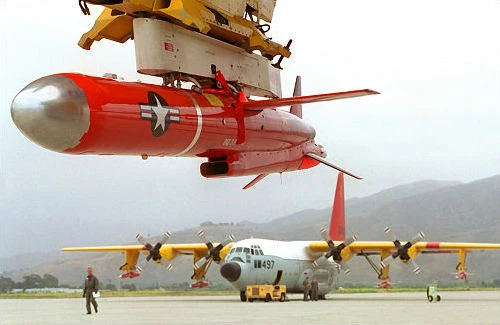
Lockheed D-21
Supersonic reconnaissance drone developed for deep-penetration missions.

The Lockheed D-21 is an American supersonic reconnaissance drone developed by Lockheed's Skunk Works. It was notable for its extreme speed and altitude, designed to conduct deep-penetration reconnaissance missions over hostile territory.
Quick Facts
- National Origin
- United States
- Manufacturer
- Lockheed
- First Flight
- 22 December 1964
- Introduction
- 1969
- Retired
- 1971
- Primary User
- Central Intelligence Agency
- More Users
- United States Air Force
- Number Built
- 38
Facts from the source article.
Lore & Background
Development of the D-21 began in October 1962 under the Lockheed designation Q-12. It was intended to be launched from the back of an M-21 carrier aircraft, a variant of the Lockheed A-12. The drone carried a single high-resolution photographic camera over a preprogrammed path, then released the camera module for retrieval before self-destructing. The design used titanium construction and radar cross-section reduction features derived from the A-12 program. The drone was powered by a modified Marquardt ramjet engine originally built for the Boeing CIM-10 Bomarc missile.
After a fatal accident during a launch from an M-21 on 30 July 1966, the D-21 was modified to be launched from a Boeing B-52 Stratofortress with a solid rocket booster. The modified version was designated D-21B. Several successful test flights were made, followed by at least four unsuccessful operational missions over China to spy on the Lop Nor nuclear test site, before the program was canceled in 1971.
Reader's Guide
The D-21 represented an ambitious attempt to create a high-speed, high-altitude reconnaissance platform that could operate deep within enemy airspace without risking a pilot. Its development reflected the urgency of the Cold War intelligence gap following the 1960 U-2 shootdown. The program's technical achievements included sustained Mach 3.3 flight at 90,000 feet and the use of a recoverable camera hatch snagged mid-air by a JC-130 Hercules. However, the program was plagued by reliability issues: of the four operational missions over China, none were successful. The cancellation in 1971 ended one of the most advanced drone projects of its era, though its technology influenced later unmanned systems. The D-21 remains a landmark in the history of reconnaissance drones for its extreme performance and the innovative but ultimately unsuccessful operational concept.
Did You Know?
- The D-21 was originally designated Q-12 by Lockheed.
- The drone's camera module was ejected mid-flight and snagged by a JC-130 Hercules for recovery.
- The D-21 was modified to be launched from a B-52 after a fatal accident during an M-21 launch.
- At least four operational D-21 missions were flown over China to spy on the Lop Nor nuclear test site.
More in Unmanned Aerial Vehicles by Country, Part 4 1-24
Spotted an error? Know more?
Reader corrections go straight into our review queue. Suggest an edit · How this site is sourced