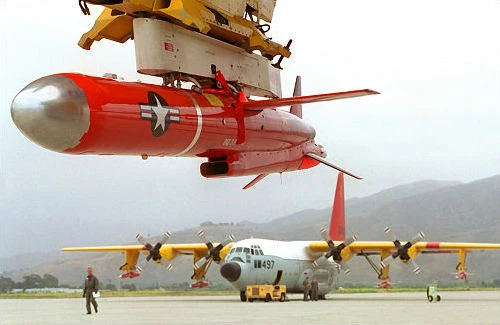
Interstate TDR
Early U.S. Navy assault drone used in the Pacific Theater.

The Interstate TDR was an early unmanned combat aerial vehicle, known at the time as an "assault drone," built by the Interstate Aircraft and Engineering Corporation for the U.S. Navy during World War II. It could carry bombs or torpedoes. Although the Navy ordered 2,000 of these drones, only about 200 were actually built. The TDR saw limited action in the Pacific Theater against Japanese forces, but ongoing technical problems and the effectiveness of conventional weapons led to the program being canceled in October 1944.
The idea for a remotely controlled combat aircraft came from Lieutenant Commander Delmar S. Fahrney in 1936. Early technology limited progress, but advances in radar altimeters and television made the concept more practical by the early 1940s. After tests with converted manned planes, the first operational drone strike against a naval target occurred in April 1942. That same month, following trials of the Naval Aircraft Factory TDN, Interstate received a contract for two prototypes and 100 production aircraft of a simplified, improved design called the TDR-1.
The TDR-1 was controlled from a nearby aircraft, usually a Grumman TBF Avenger, whose operator watched a television screen showing the drone’s camera view and radar altimeter reading. For test flights, a pilot could also fly the drone from an onboard cockpit. The drone was powered by two 220-horsepower Lycoming O-435 engines. Its design was remarkably simple: a steel-tube frame built by the Schwinn bicycle company, covered with molded wood skin, using little strategic material to avoid slowing production of higher-priority aircraft. During operational missions, the cockpit was covered with an aerodynamic fairing. The TDR-1 had fixed tricycle landing gear that was jettisoned after takeoff to improve performance.
In September 1942, the Navy chose DeKalb, Illinois, as the manufacturing site for the TDR-1 and built an airport on the city’s east side, complete with a guarded airfield and large hangar. DeKalb was selected because Wurlitzer, a piano maker skilled in wood products, was located there. Interstate Aircraft and Engineering Corporation, based in El Segundo, California, assembled the planes at the new DeKalb Airport. About 200 drones were built, tested, boxed, and shipped to the South Pacific for use against the enemy.
Quick Facts
- Aircraft Type
- Assault drone
- National Origin
- United States
- Manufacturer
- Interstate Aircraft
- Primary User
- United States Navy
- Number Built
- 195
- Introduction
- September 1944
- Retired
- October 1944
- First Flight
- 1942
Facts from the source article.
Lore & Background
In 1936, Lieutenant Commander Delmar S. Fahrney proposed that unpiloted, remotely controlled aircraft had potential for combat operations. Development was low priority until radar altimeter and television technology made the project more feasible. Following trials using converted manned aircraft, the first operational test of a drone against a naval target was conducted in April 1942. That same month, Interstate Aircraft received a contract for two prototype and 100 production aircraft to a simplified and improved design, designated TDR-1.
The TDR-1 used a steel-tube frame constructed by the Schwinn bicycle company covered with a molded wood skin, making little use of strategic materials. It was powered by two Lycoming O-435 engines and could be optionally piloted for test flights, with an aerodynamic fairing covering the cockpit during operational missions. The fixed tricycle landing gear was jettisoned after takeoff. Control was conducted from a Grumman TBF Avenger, with the operator viewing a television screen showing the drone's camera view and radar altimeter readout.
DeKalb, Illinois was chosen as the manufacturing site because Wurlitzer, known for wood product expertise, was located there. About two hundred drones were built, tested, and boxed at DeKalb Airport, then shipped to the South Pacific. Under Operation Option, the Navy projected up to 18 squadrons, but technical difficulties and low priority reduced the order to around 300 aircraft. A single TDR-1 was tested by the U.S. Army Air Forces as the XBQ-4, but no production contract resulted.
Reader's Guide
The Interstate TDR represents an early attempt at unmanned combat aerial vehicles, predating modern drone warfare by decades. Its development was driven by the vision of Lieutenant Commander Delmar S. Fahrney and enabled by advances in television and radar altimeter technology. The aircraft's simple construction—using a bicycle company's steel-tube frame and wood skin—reflected wartime priorities to conserve strategic materials for higher-priority aircraft.
Operationally, the TDR-1 saw limited combat in the Pacific Theater under the Special Air Task Force, with Special Task Air Group 1 conducting missions from September to October 1944. While 31 of 50 expended drones successfully struck their targets without loss to pilots, the program was canceled due to continued technical problems, failure to meet expectations, and the adequacy of conventional weaponry. The type's legacy is as a pioneering but ultimately unsuccessful step in unmanned combat aviation, with only one surviving example displayed at the National Naval Aviation Museum and parts being collected for potential reconstruction.
Did You Know?
- The TDR-1's steel-tube frame was constructed by the Schwinn bicycle company.
- The aircraft could be optionally piloted for test flights, with a fairing covering the cockpit during missions.
- The TDR-1 was deployed under the code-name Operation Option.
- After the war, some TDR-1s were converted for use as private sportsplanes.
More in Unmanned Aerial Vehicles by Country, Part 4 1-24
Spotted an error? Know more?
Reader corrections go straight into our review queue. Suggest an edit · How this site is sourced