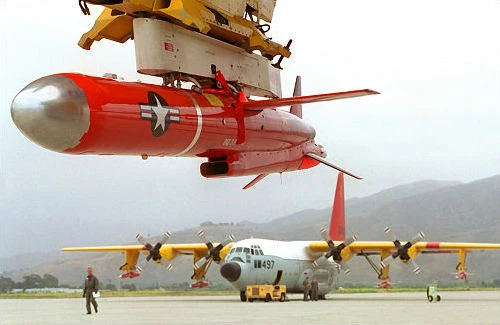
Fairchild SD-5 Osprey
Cancelled high-speed reconnaissance drone for U.S. Army targeting.

The Fairchild SD-5 Osprey was a high-speed reconnaissance drone from the early 1960s, built by Fairchild Aircraft for the U.S. Army. Its purpose was to supply targeting data for tactical ballistic missiles, supporting the Army Signal Corps. However, the project was terminated before the first prototype was finished, and it never entered active service.
The U.S. Army issued a requirement for such a drone in 1960, seeking a fast, long-range unmanned aircraft to feed targeting information to its tactical missile units. Two companies won contracts: Republic Aviation proposed an entirely new design, the SD-4 Swallow, while Fairchild adapted its existing Bull Goose decoy missile into the SD-5 Osprey. The complete system was designated AN/USD-5.
The SD-5 had a tailless delta wing shape. It was powered by a Pratt & Whitney J60 turbojet (the military version of the civilian JT12). For launch, a single JATO rocket booster provided 40,000 pounds of thrust for three seconds, enabling a zero-length launch from a custom trailer. Recovery used a parachute, with airbags to soften the landing. The drone could carry sensors such as infrared scanners, side-looking airborne radar (SLAR), and optical mapping equipment. Data could be retrieved after the mission or transmitted in real time via telemetry. An inertial navigation system and autopilot handled guidance.
The first SD-5 flight occurred in May 1960. Fifteen prototypes were built for testing, and Fairchild estimated production costs at $350,000 to $400,000 per drone. An operational debut was planned for 1964, but due to program costs, the SD-5 was canceled in November 1962 before it could be deployed.
Quick Facts
- Aircraft Type
- Reconnaissance drone
- National Origin
- United States
- Manufacturer
- Fairchild Aircraft
- Primary User
- United States Army
- Number Built
- 15
- Developed From
- Fairchild SM-73 Bull Goose
Facts from the source article.
Lore & Background
In 1960 the U.S. Army issued a requirement for a high-speed, long-range reconnaissance drone to provide targeting information to its tactical ballistic missile force. Fairchild Aircraft developed a variant of the Bull Goose decoy missile as the SD-5 Osprey, while Republic Aviation proposed the all-new SD-4 Swallow. The SD-5 was of tailless delta configuration, powered by a Pratt & Whitney J60 turbojet, and used a single JATO rocket booster for zero-length launch from a specially designed trailer. Recovery was by parachute with airbags cushioning the landing. Sensors included infrared scanners, side-looking airborne radar (SLAR), and optical mapping; data could be recovered after the mission or transmitted via telemetry. Guidance was provided by an inertial navigation system and autopilot.
The first flight of the SD-5 took place in May 1960. Fifteen prototypes were constructed for the test program, with Fairchild quoting a cost per drone of $350,000–$400,000 USD for production aircraft. An operational date of 1964 was anticipated. However, due to the cost of the program, the SD-5 was cancelled in November 1962 before entering service.
Reader's Guide
The Fairchild SD-5 Osprey represents an early attempt by the U.S. Army to field a high-speed, long-range reconnaissance drone for tactical ballistic missile targeting. Its development in 1960 reflected the Army's interest in unmanned systems to gather targeting information, a role that would later be filled by other platforms. The SD-5's tailless delta design, JATO-assisted zero-length launch, and parachute recovery with airbags were innovative for their time. The availability of infrared scanners, SLAR, and optical mapping, with options for data recovery or telemetry transmission, showed a sophisticated sensor suite. Despite a successful first flight in May 1960 and the construction of fifteen prototypes, the program was cancelled in November 1962 due to cost, before it could enter operational service. The anticipated 1964 operational date was never realized. The SD-5 did not see operational service, and its cancellation ended Fairchild's effort to produce a production run of drones at the quoted unit cost of $350,000–$400,000.
Did You Know?
- The SD-5 Osprey was a variant of the Bull Goose decoy missile.
- It used a JATO rocket booster providing 40,000 lbf thrust for 3 seconds for zero-length launch.
- Fifteen prototypes were built for the test program.
More in Unmanned Aerial Vehicles by Country, Part 4 1-24
Spotted an error? Know more?
Reader corrections go straight into our review queue. Suggest an edit · How this site is sourced