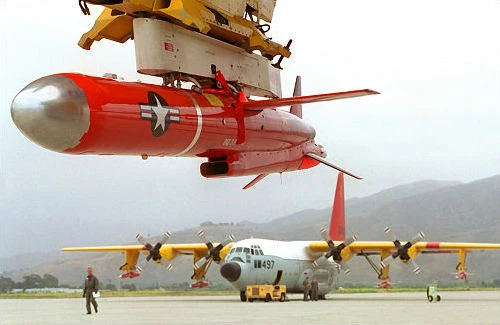
Boeing X-45
Autonomous combat air vehicle demonstrator from Boeing's Phantom Works.

The Boeing X-45 is an unmanned combat air vehicle (UCAV) concept demonstrator developed by Boeing's Phantom Works for a next generation of completely autonomous military aircraft. It was part of DARPA's J-UCAS project and built by Boeing Integrated Defense Systems. The X-45 is notable for being one of the first UCAVs to demonstrate autonomous teaming and coordinated attacks without direct human control of the aircraft's flight.
Quick Facts
- Manufacturer
- Boeing Integrated Defense Systems
- First Flight
- 22 May 2002
- Primary User
- United States Air Force
- Number Built
- 2
- Variants
- Phantom Ray / Boeing X-46
Facts from the source article.
Lore & Background
The X-45 was developed from research gathered during the development of the Bird of Prey, a stealth technology demonstrator. Boeing stated that Bird of Prey 'paved the way' for the X-45 by proving out stealth shaping and construction methods. After McDonnell Douglas merged with Boeing, the stealth knowledge from Bird of Prey was carried into Boeing Phantom Works, which designed the X-45. The aircraft features an extremely low-profile dorsal intake near the leading edge, a blended center fuselage into a swept lambda wing, a small exhaust outlet, and no vertical control surfaces—split ailerons near each wingtip function as asymmetric air brakes for rudder control, similar to Northrop's flying wings.
Two X-45A proof-of-concept aircraft were built, the first completed in September 2000. The X-45A had its first flight on May 22, 2002, and the second vehicle flew in November 2002. On April 18, 2004, the X-45A successfully hit a ground target with a 250 lb inert precision-guided munition at Edwards Air Force Base. On August 1, 2004, two X-45As were controlled in flight simultaneously by one ground-based pilot for the first time. On February 4, 2005, on their 50th flight, the two X-45As autonomously determined which vehicle held the optimum position, weapons, and fuel load to attack a target, then one changed course and the ground pilot authorized the strike. After a successful strike, a second simulated threat was destroyed by the other X-45A, demonstrating autonomous teaming and engagement of previously undetected targets.
The larger X-45B design was modified into the X-45C with more fuel capacity and three times greater combat range. The X-45C included an F404 engine. DARPA awarded $767 million in October 2004 for three X-45C aircraft, and an additional $175 million in July 2005 to continue the program and implement autonomous aerial refueling. On March 2, 2006, the US Air Force decided not to continue with the X-45 project. Boeing then submitted a proposal for a carrier-based demonstrator, the X-45N, to the Navy's Unmanned Combat Air Systems demonstration project. The contract was awarded to Northrop Grumman's X-47, ending the X-45 program. Boeing later used the X-45C prototype for an internally funded program called Phantom Ray.
Reader's Guide
The X-45 program demonstrated key technologies for autonomous unmanned combat air vehicles, including stealth shaping, autonomous teaming, and coordinated attacks without direct human piloting of the aircraft. By removing the pilot and associated facilities, the aircraft's cost was dramatically reduced. Ground-based pilots executed higher-level decisions while the mechanical flying was autonomous. The X-45A's ability to autonomously determine which vehicle should attack a target based on position, weapons, and fuel load, and to engage previously undetected targets, represented a significant step beyond predetermined attack paths. The program also advanced autonomous aerial refueling technology, with plans for the X-45C to refuel from a KC-135 Stratotanker. Although the US Air Force ended funding in 2006 and the Navy chose the X-47 over the X-45N, the software developed for autonomous carrier landings and takeoffs was installed on an F/A-18F for testing. The X-45's legacy includes its influence on subsequent UCAV development and the transfer of its stealth knowledge from the Bird of Prey program.
Did You Know?
- The X-45A introduced yaw axis thrust vectoring.
- The X-45A's first bombing run test on April 18, 2004, used a 250 lb inert precision-guided munition.
- Boeing's Phantom Ray program used the X-45C prototype vehicle originally developed for the J-UCAS program.
More in Unmanned Aerial Vehicles by Country, Part 4 1-24
Spotted an error? Know more?
Reader corrections go straight into our review queue. Suggest an edit · How this site is sourced