Larch
Deciduous conifers, the most abundant tree genus on Earth.
Larches are conifers that lose their needles each year, belonging to the genus Larix within the pine family. They can reach heights of up to 60 meters (195 feet) and are found naturally in the cooler parts of the Northern Hemisphere, growing in lowland forests at high latitudes and in mountainous areas farther south. These trees dominate the boreal forests of Siberia and Canada, making Larix the most abundant tree genus on Earth. Their wood is tough and fairly durable, commonly used for boatbuilding, cladding, decking, garden furniture, fencing, and construction. Products derived from larch include arabinogalactan (larch gum), rosin, turpentine, and an essential oil.
The English name "larch" first appeared in 1548, recorded by botanist William Turner. It comes from the German Lärche, which traces back to Middle High German larche, likely from an unrecorded Old High German word larihha. That, in turn, derives from the Latin Larix, which was probably borrowed from a Gaulish language spoken in the Alps.
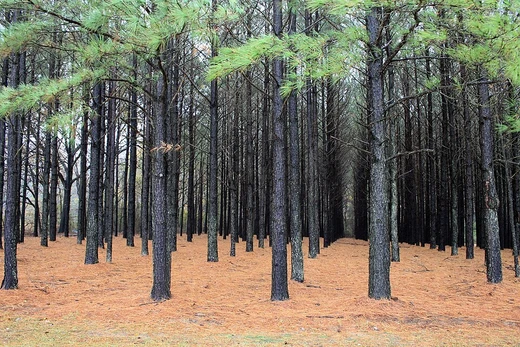
The tallest species, Larix occidentalis, can grow 50 to 60 meters (165 to 195 feet) tall. Larch crowns are open, with main branches arranged in whorls and horizontal; smaller branchlets may be horizontal or drooping, depending on the species. Shoots come in two types: long shoots with needle-like leaves borne singly and several buds, and short shoots with dense clusters of 20 to 50 needles and a single bud. The wood is resinous. Young trees have smooth bark, while older trees develop thick, scaly bark. Larches are among the few conifers that are deciduous, unlike most evergreens.
Male (pollen) cones are small and grow at the tips of shoots that die after pollination. Female (seed) cones are also small, typically upright, and take 4 to 7 months to mature. When ripe, the seed scales spread apart, releasing two winged seeds per scale. The bract scales may be long and visible (exserted) or short and hidden between the seed scales. The chromosome number is 2n = 24, similar to most other pine family species.
The genus Larix occurs across all temperate-cold zones of the Northern Hemisphere, from North America through Europe to northern Siberia, as well as mountainous China and Japan. Larches are important forest trees in Russia, Central Europe, the United States, and Canada.
Quick Facts
- Type species
- Larix decidua
Facts from the source article.
Lore & Background
The English name larch was recorded in 1548 by the botanist William Turner. It derives from the German Lärche, in turn from the Middle High German larche, which is conjectured to derive from an unrecorded Old High German name for the tree, larihha. That derives from the Latin name of the tree, Larix. The Latin name probably was borrowed from a Gaulish language spoken in the Alps.
The genus Larix was described by the English botanist Philip Miller in 1754. In the 20th century, cone bract length was used to divide the larches into two sections, but genetic evidence does not support this division, indicating instead that the cone and bract size are merely adaptations to climatic conditions. Late 20th century and early 21st century genetic studies proposed three groups within the genus, with a primary division into North American and Eurasian species, and a secondary division of the Eurasian into northern short-bracted species and southern long-bracted species; there was dispute over the position of Larix sibirica. A 2025 study by Qiu and colleagues cast doubt on the species circumscriptions accepted by Farjon and the POWO, showing that the primary divide is between high-latitude circumboreal species and low-latitude Sino-Himalayan species.
Did You Know?
- The larch species Larix gmelinii is the world's most northerly-growing tree, at 75° north in the Taymyr Peninsula.
- The Dunkeld larch, a hybrid of L. decidua × L. kaempferi, arose more or less simultaneously in Switzerland and Scotland in 1901–1904.
More in Trees & Timber
Spotted an error? Know more?
Reader corrections go straight into our review queue. Suggest an edit · How this site is sourced